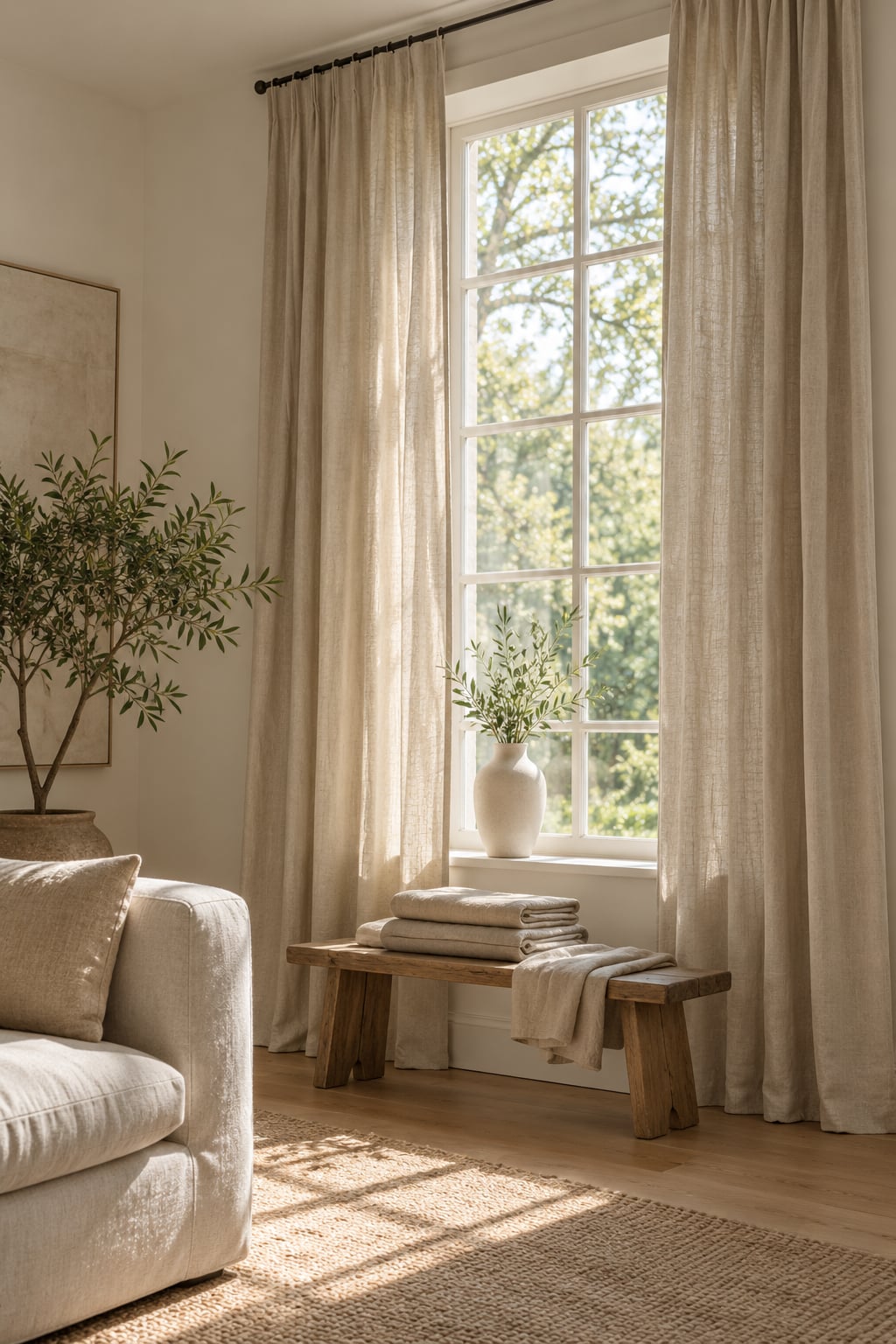
To choose curtains for a room, work through six decisions in this order: the job the curtain has to do, then length, then width and where the rod goes, then fabric and opacity, then heading style, and finally the hardware. Most people start at the wrong end, falling for a fabric first and discovering later that it cannot block light or cover the glass.
The order matters more than the fabric. Naming the job eliminates most of the shelf, length and rod placement tell you exactly how much material to buy, and only then does fabric weight decide which heading and hardware will hold it up. A whole house takes an afternoon to measure and a weekend to hang.
Table of Contents
- 1What You Need
- 2How to Choose Curtains for a Room: Step by Step
- 31. Measure the Window and Decide Where Curtains Will Hang
- 42. Decide How High to Hang the Rod
- 53. Choose the Right Level of Privacy and Light Control
- 64. Select a Fabric That Suits the Room
- 75. Pick a Color and Pattern That Works with the Room
- 86. Choose the Right Curtain Length, Width, and Heading Style
- 97. Plan Hardware, Layers, and Installation
- 108. How to Choose Curtains for a Tall or Small Room
- 119. A Per-Room Cheat Sheet
- 12Common Curtain Mistakes and How to Fix Them
- 13Frequently Asked Questions
- 14How long should curtains be in a bedroom?
- 15What is the difference between blackout and room-darkening curtains?
- 16How do I hang curtains in a rental without drilling?
- 17How do I match curtain colour to an existing sofa and wall?
- 18How do I clean and care for different curtain fabrics?
- 19What is the rule of thumb for how wide curtains should be?
- 20Conclusion
What You Need
Before you open a browser window or a fabric swatch book, gather five things. Without them, you are guessing, and guessing is why curtains get returned.
- A tape measure, plus a notepad or your phone. Measure twice; window frames are rarely square.
- Your ceiling height, floor to ceiling, in the room where the curtain will hang. This decides the drop and where the rod goes.
- The window width and height, frame included, plus the width of any trim, radiator, or furniture directly beneath it.
- The job the curtain must do: darkness, privacy, glare and fading control, warmth, or purely looks.
- Your existing décor: wall colour, sofa colour, floor, rug, and artwork. Bring a photo of the room when you shop.
Also check what is already in place. If a rod is fitted, measure its length and note whether it is a pole or a track, because that limits your heading style. If nothing is fitted, you have freedom on both counts.
One more practical note: know your rental situation before you plan hardware. Tension rods, tension tracks, and no-drill brackets change the whole layout, and they cap how heavy your fabric can be.
How to Choose Curtains for a Room: Step by Step
1. Measure the Window and Decide Where Curtains Will Hang
Measure the window frame from outer edge to outer edge, then add 4 to 8 inches on each side so the panels stack on the wall rather than across the glass. Then multiply that total by 1.5 for fullness, or by 2 for a fuller, tailored drape that suits heavier fabrics. That product is the flat width of fabric you need.
For example, a 48 inch window plus 8 inches each side is 64 inches. At 1.5x fullness that is 96 inches of flat fabric, or two 48 inch panels. At 2x it is 128 inches, or two 64 inch panels. Most decorators land in the same place: mount wide of the frame, high up, and let the panels stack on the wall instead of the glass.
Next, decide the length. Measure from the top of where the curtain will hang to the floor, and subtract about half an inch so the hem clears the ground and can be swept. Working that number back into panel sizes tells you whether you need standard 84 inch, 96 inch, or extra-long drops.
2. Decide How High to Hang the Rod
Hang the rod 4 to 6 inches above the window frame or as close to the ceiling as you can manage without crowding the cornice. In a room with a normal ceiling, most decorators go no higher than that, because a wide gap between rod and frame reads as a mistake rather than a tall window.
There is one exception that most advice gets wrong. If the room has a high ceiling and no architectural feature at the top, mount the rod 6 to 8 inches below the ceiling line. The curtain then reads as a full-height wall treatment, which visually lowers the ceiling and makes the room feel deliberate. On a standard 8 foot ceiling in a low room, mount just above the frame instead, because there is no vertical budget to spend.
Whatever you decide, keep it consistent across every window in the house. Mixed mounting heights are the single most obvious sign that curtains were added rather than designed.
3. Choose the Right Level of Privacy and Light Control
Opacity is not a quality scale, it is a product type, and you should pick the weakest one that still does the job. More opacity than the room needs means heavier fabric, harder cleaning, and a stack that eats wall space when open.
| Opacity tier | What it does | Best for | Watch out for |
|---|---|---|---|
| Sheer or voile | Softens daylight, keeps shapes vague, adds almost no privacy at night | Layering over a shade, bright rooms where furniture matters more than privacy | Not privacy fabric on a ground floor after dark |
| Light-filtering | Diffuses light into the room, no silhouettes, soft shadows only | Living rooms, dining rooms, home offices, kitchens | Still glows around the edges at night |
| Room-darkening | Blocks most direct light while keeping a soft ambient glow | Bedrooms for most sleepers, nurseries during naps, street-facing rooms | Good enough for many, frustrating for shift workers |
| True blackout | Blocks light through the fabric itself, usually via an opaque coating or triple weave | Shift workers, nurseries, media rooms, street-facing bedrooms | Heaviest, stiffest drape and the most expensive to clean |
The most common complaint about blackout curtains is the same in every forum thread and showroom: panels labelled blackout still leak light around the top and sides, because the fabric does the blocking and the gaps do the rest. Fix that at installation, not at purchase. Fit the rod or track so it sits past the frame on every side, add a valance or a pelmet if the gap above is visible, and choose side panels wide enough to overlap by a few inches when closed.
For privacy without darkness, many homeowners hang a sheer or a roller blind behind the curtains. That combination gives you a view-obstructing layer during the day and a decorative one at night.
4. Select a Fabric That Suits the Room
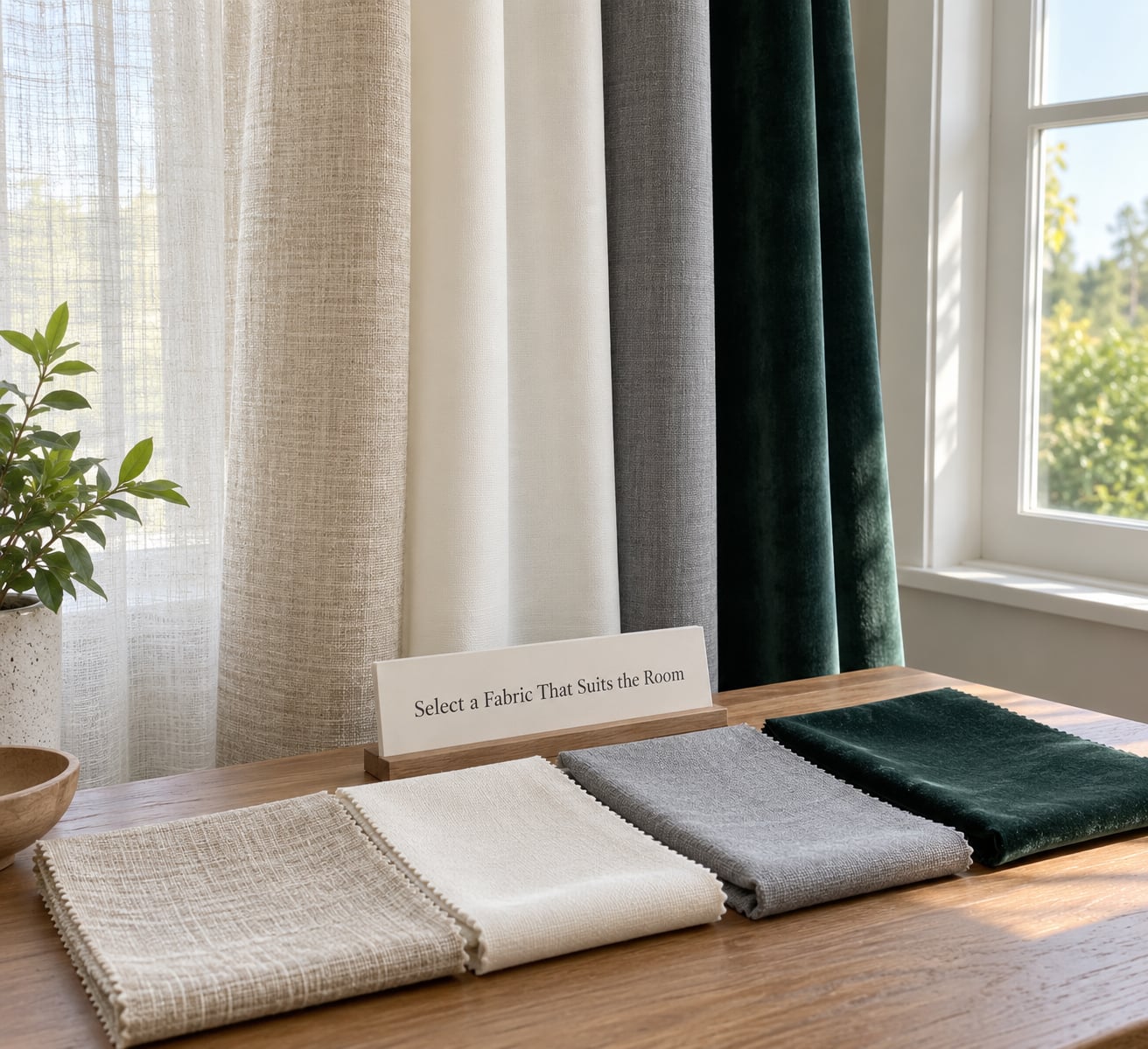
Fabric is the fourth decision, not the first, and it follows from the job. A blackout obligation rules out most lightweight cottons. A west-facing room with a glare problem wants something heavy enough to absorb rather than bounce light.
- Linen breathes well and looks expensive, but it creases hard and relaxes over time. Best in a low-traffic room or a sunny one where you like the relaxed look. The question people ask most about linen is whether it is worth the ironing; the honest answer is that you are paying for drape, and drape is what you are buying.
- Cotton is the middle path: affordable, washable at home, and available in almost every opacity tier. Its weakness is that it holds a crease almost as well as linen when it is not lined.
- Polyester and polyester blends hold a pleat, resist wrinkling, dry fast, and are usually the easiest fabric to live with. A good lined or interlined polyester curtain looks far heavier than its price suggests.
- Velvet absorbs light and sound, and it looks luxurious in low light, which is exactly why designers like it in a living room. It is dense, needs a strong rod, and shows every fingerprint in a hallway.
Two construction terms come up constantly. Lining is a single layer sewn to the back of the face fabric, adding body and opacity. Interlining is a layer between the lining and the face fabric, adding drape, weight, and heat retention. For a bedroom that needs real darkness, an interlined panel is the difference between a tint and a blackout.
For warmth, thicker fabric does help at the window but the gain is modest; an unlined sheer does nothing. In a high-traffic hallway, washable polyester earns its place. In a formal room nobody touches, velvet or heavy linen is fine.
5. Pick a Color and Pattern That Works with the Room
The sofa question comes up so often that it deserves a direct answer. Choose curtains lighter than your sofa when the sofa is a mid to deep tone and you want the window to feel open; choose darker or a matching tone when the sofa is already pale and you want the window to recede. The most reliable rule is to pick a colour within two steps of the sofa on the light-to-dark scale, then decide direction based on how much light the room gets.
Next, look at the walls. Curtains a shade deeper or lighter than the wall read as a soft frame around the window; curtains at exactly the wall colour read as a single continuous surface, which suits small rooms and a quiet, tailored look.
Give the pattern a job. If the rug, the sofa, and the artwork are already patterned, the curtains should be solid, or the room will hum. If everything else is plain, a patterned curtain becomes the focal point and the room can stay simple. Keep the pattern repeat related to something else in the room rather than matching it exactly.
For 2026, the practical direction is unchanged: a room with low ceilings wants a light, single-colour curtain, and a tall room can carry a deeper tone or a vertical stripe. Wide horizontal patterns in a low room visually shorten it. Heavy swags and elaborate pelmets have not returned, but nobody is skipping curtains.
6. Choose the Right Curtain Length, Width, and Heading Style
Length sets the formality. Sill length ends just past the bottom of the glass and is casual. Apron length falls a few inches below and suits kitchens and cottage rooms. Floor length stops a half inch above the floor and looks the most tailored. Puddled fabric pools on the floor and reads romantic, but it collects dust, blocks vacuuming, and is a bad match for a house with pets.
Width sets the drape. Ready-made panels are sold in fixed flat widths, commonly 45, 52, 63, and 84 inches, so you work backwards from your target and see whether the multiples land neatly. If a 63 inch panel gives you exactly the fullness you need, great. If it leaves you one inch short, you are looking at a seam or a made-to-measure job.
| Heading | How it hangs | Looks formal? | Needs |
|---|---|---|---|
| Rod pocket | Panel slides over the rod | Casual | Deep pocket, plain rod, more fabric used in the pocket |
| Tab top | Loops over the rod | Casual | Light fabric, thin rod |
| Grommet | Metal rings set into the header | Casual to mid | Rings, and it eats roughly 4 inches of drop |
| Eyelet | Small reinforced holes | Casual to mid | Cheapest heading to make, needs a thin rod |
| Pinch pleat | Fabric gathered by hand at set points | Formal | Track or pole, specialist heading tape, higher fabric use |
| Triple pinch pleat | Three pleats per hook for a fuller fold | Most formal | Professional making, generous fabric budget |
| Ripple fold | Flat folds from a wave heading, minimal gather | Formal and modern | Track system, precise fabric width, stacks neatly |
For most homes, grommet or eyelet panels on a simple rod cover the job at a fair price. Ripple fold and pinch pleat look markedly better and need a proper track and enough fabric to work, so budget accordingly.
Panel count follows from width. A single wide window usually needs two panels so they can open fully. A very wide window needs three or four, or two pairs that overlap slightly in the middle when closed, which removes the leak of light at the join.
7. Plan Hardware, Layers, and Installation
A pole suits a room with traditional details, a visible window reveal, or a window that is not perfectly straight. A track suits a modern room, a ceiling-mounted treatment, a bay window, or anywhere you want the curtain to sit flush to the wall. Tracks also stack more compactly, which matters in a small room.
Size the rod or track for the fabric, not the window. A heavy interlined panel adds real weight, and undersized brackets sag visibly over time, which is one of the complaints homeowners run into again and again. Follow the weight rating on the hardware and stay inside it.
Layering is where most people get the biggest visual return. A double track lets a sheer sit behind a blackout or a patterned panel, so you get privacy and softness in the day and real darkness at night from the same window. A blackout blind or roller behind curtains is the cheaper version of the same idea and works well in a rental.
Check ventilation before you commit. A fully closed heavy panel traps radiator heat and can shorten the life of the radiator valve, and it makes condensation on cold glass more likely. If a radiator sits under the window, keep the hem above it and confirm the panel can still be drawn across that gap.
8. How to Choose Curtains for a Tall or Small Room
In a tall room, hang higher and go longer: extra-long drops of 96 inches or 108 inches, and panels wide enough to keep the vertical line unbroken. Keep the colour on the lighter side if you want the ceiling to feel less pressing. A vertical stripe works with the height rather than against it.
In a small or low room, do the opposite. Mount the rod just above the frame, keep the hem clean at the floor with no pooling, choose a light single-colour fabric, and push the panels as far onto the wall as the width allows. A curtain that stacks clear of the glass is the single cheapest way to make a small room read as wider.
9. A Per-Room Cheat Sheet
Here is the short version for the rooms people ask about most, pulled from the steps above.
| Room | Main job | Opacity and fabric | Length and note |
|---|---|---|---|
| Bedroom | Darkness for sleep | Room-darkening or true blackout, interlined polyester | Floor length. Add side overlap and a valance if light leaks at the top. |
| Living room | Glare control, softness, style | Light-filtering linen, cotton, or velvet | Floor length. Heavier fabric softens a hard room. |
| Bathroom | Privacy, steam and splash | Washable polyester or cotton, light-filtering | Often sill or apron length. Short lengths clean far more easily. |
| Nursery | Daytime nap and early darkness | True blackout, machine washable | Floor length. Check every cord, tieback, and loop is out of reach. |
| Home office | Screen glare without losing daylight | Light-filtering with a lined blackout behind, or the reverse | Floor length. Mount high enough that stacks do not block a monitor. |
| Rental | Reversible, no damage | Washable polyester, light to mid weight | Tension rod or track, or no-drill brackets. Avoid anything needing long screws into masonry. |
| West-facing room | Heat and fading control | Heavier fabric, lined, with UV protection | Floor length. Insulating properties help most at night with the panels closed. |
Common Curtain Mistakes and How to Fix Them
Almost every complaint about curtains traces back to one of these, and nearly all of them are fixable without buying new curtains.
| Mistake | Why it looks wrong | How to fix it |
|---|---|---|
| Measuring only the glass | Panels cover the window when open and the room feels smaller | Add 4 to 8 inches each side, then multiply for fullness |
| Panels too narrow | Flat fabric on a rod, visible light gaps, no drape | Target 1.5x to 2x the rod width in flat fabric |
| Hanging the rod too low | Window looks short, ceiling looks lower, style reads dated | Raise the rod 4 to 6 inches above the frame, or nearer the ceiling |
| Hem hovering above the floor | Curtains read as too short and unfinished | Rehem or buy longer; aim to within half an inch of the floor |
| Rod too short for the fabric | Sagging span, brackets straining | Replace with hardware rated above the fabric weight |
| Impossible fabric for the room | Wrinkles, creases, or a fabric that cannot meet the light requirement | Switch to lined polyester or a washable blend for high-traffic rooms |
| Blackout with light leaking at the edges | Halos of light around the frame, worst at night | Widen the panels, add a valance, extend the track past the frame |
| Clashing colour with the sofa | The eye jumps to the window and reads it as an error | Stay within two shades of the sofa, or repeat a colour from the rug |
If the curtains are already hung, the repairs are mostly cheap. Raising the rod means new brackets and a longer pole, which is a short afternoon. Rehemming a panel a few inches shorter than planned is a quick job if you are comfortable with a needle, or a small cost at an alterations shop. Adding a second sheer on a slim tension track can transform a dark bedroom without replacing anything.
Two more tips that cost nothing. Always hang the panels a full width beyond the frame on each side, because the stack has to clear the glass to look deliberate. And open the curtains fully when you judge a room in daylight, not half-open, since that is the state most of your day actually uses.
Frequently Asked Questions
How long should curtains be in a bedroom?
Floor length is the safest choice for most bedrooms, ending about half an inch above the floor so the hem can be swept. If you have pets or hard flooring and want zero dragging, an inch or two above the floor works well. Avoid puddled lengths in a bedroom, since they collect dust around the bed and the sleeping area.
What is the difference between blackout and room-darkening curtains?
Room-darkening curtains block most direct light but still let a soft glow around the edges, which most sleepers never notice. True blackout curtains use an opaque coating or a tight triple weave to block light through the fabric itself. Choose true blackout for shift sleeping, daytime naps, street-facing windows, or a light-sensitive sleeper.
How do I hang curtains in a rental without drilling?
Tension rods and tension tracks press against the wall with a spring or screw mechanism and leave no holes, which makes them ideal for rentals. No-drill brackets with adhesive strips also work on drywall, though check the weight rating against your fabric before you commit. Keep to light and mid-weight washable fabric so the hardware is not carrying more than it should.
How do I match curtain colour to an existing sofa and wall?
Pick a curtain colour within two steps of your sofa on the light-to-dark scale. Go lighter than the sofa when the room needs to feel open, and deeper when the sofa is pale and you want the window to recede. If the wall is a strong colour, choose curtains close to the wall tone for a framed look, or a clear neutral for contrast.
How do I clean and care for different curtain fabrics?
Always check the care label first, because lined and interlined panels usually cannot be washed at home. Cotton and polyester panels are often machine washable on a cool cycle and can be line dried, while lined versions generally need dry cleaning. Vacuum on a low suction regularly, and treat direct sun exposure as a reason to wash or clean panels on a schedule rather than when they look dirty.
What is the rule of thumb for how wide curtains should be?
The flat fabric width should be 1.5 times the rod or track width for a standard gathered look, and about 2 times for a fuller, tailored drape that suits heavier fabrics. Remember to size the rod itself past the window frame by 4 to 8 inches on each side, so the finished fabric covers the window and still stacks back onto the wall.
Conclusion
Start with the tape measure, not the fabric swatches. Note the window width, the ceiling height, and whether a rod already exists, then write down the one job the curtains must do: darkness, privacy, glare, warmth, or simply looks. Everything after that is arithmetic and taste, and the arithmetic is much easier when the job comes first.
Work out the flat fabric width from the rod, choose the opacity that meets the job without going further, and pick a colour that sits near your sofa rather than fighting it. Get those three right and the heading and hardware are simple follow-on decisions.