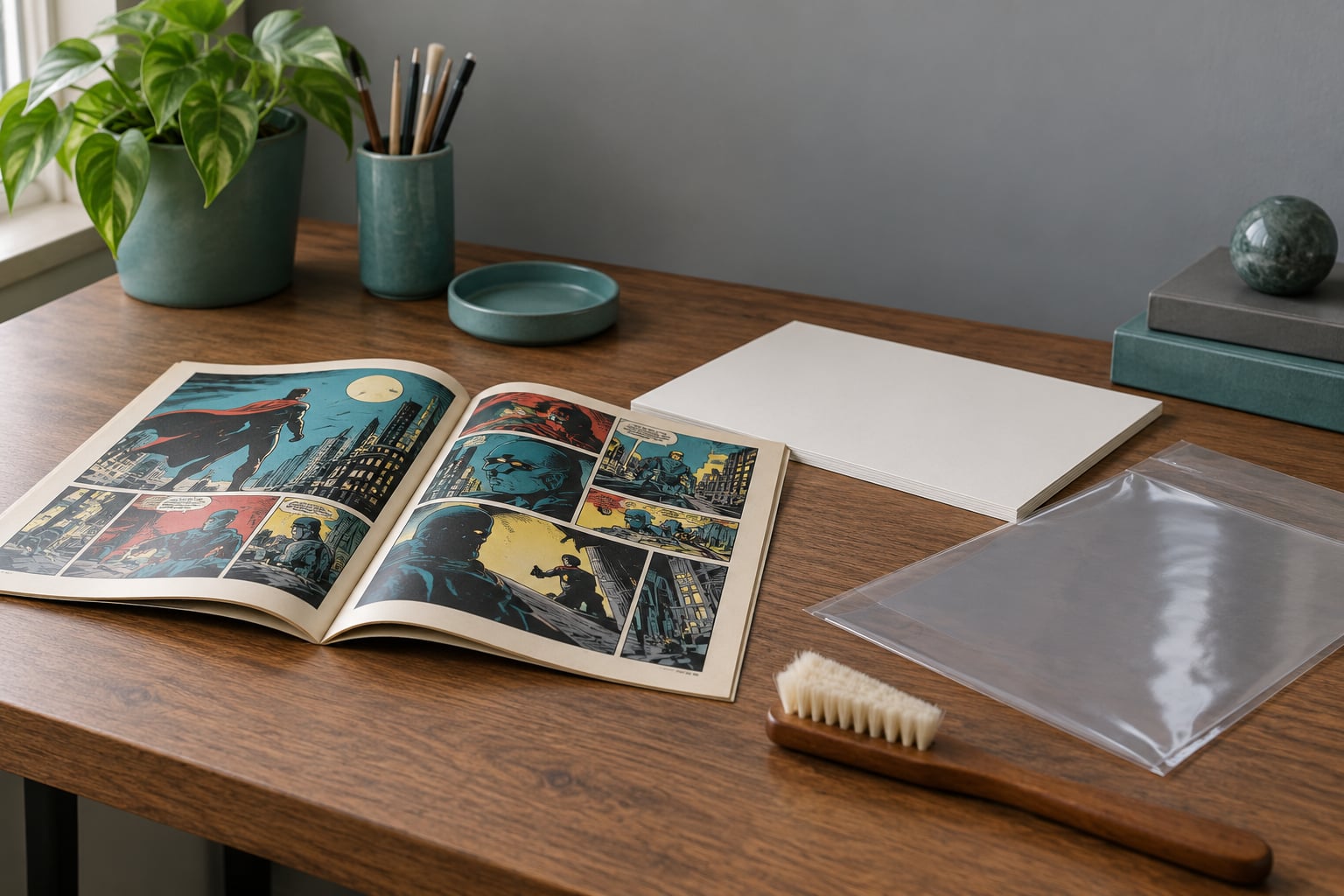
The fastest way to protect comic books from yellowing is to isolate every issue in an acid-free bag with a buffered backing board, then store the box somewhere cool, dark, and dry. Add light-touch handling and a yearly inspection, and paper that started white stays white for decades.
That sounds simple because it is. Most yellowing happens because books sit in a warm, lit room, touch each other directly, or wait years in a bag with nothing behind them. Fix any one of those and the clock slows down a lot.
Yellowing is also the one part of comic condition you cannot undo. Everything below is about stopping what has not started yet, and slowing what has. Updated for 2026 as collector habits and material options keep shifting.
Table of Contents
- 1Why Comic Book Pages Turn Yellow, and Why You Cannot Undo It
- 2What You Need
- 3Step-by-Step
- 4Step 1: Inspect and Identify the Comic’s Condition
- 5Step 2: Clean the Cover and Pages Carefully
- 6Step 3: Reduce Acids and Handle the Comic Safely
- 7Step 4: Bag and Back the Comic Correctly
- 8Step 5: Store Comics in a Stable, Dark Environment
- 9Step 6: Check Stored Comics Periodically
- 10Common Mistakes
- 11Frequently Asked Questions
- 12Can you reverse yellowing on comic book pages?
- 13Do all yellow pages mean there is mold?
- 14How does humidity affect comic books?
- 15How should I store rare comics long term?
- 16When is professional conservation the right call?
- 17Conclusion
Why Comic Book Pages Turn Yellow, and Why You Cannot Undo It
American comics were printed on cheap wood-pulp paper through the 1980s. Pulp paper is made in an acid bath that was never fully neutralized, so the finished pages carry leftover acids inside the fibres. Paper that sits in that state has a pH somewhere around 4.5 to 5.5, which is meaningfully acidic.
Those internal acids do their damage slowly. Given oxygen, moisture, and warmth, they break the cellulose chains that give paper its strength, and the breakdown products are the yellow chromophores you see on the page. The paper also loses flexibility on the way, which is why old comics crack along the spine instead of flexing.
Three outside factors push that reaction along. Ultraviolet light breaks colour molecules out of the ink and photographs on top of the paper damage. Humidity lets acids migrate between pages, so one acidic book in a box slowly affects its neighbours. Airborne pollutants settle on exposed pages and begin their own slow reaction.
The result is a visible sequence most collectors recognise. Uniform cream tone is early-stage aging. A deeper tan with darkening at the edges usually means acid migration from adjacent pages or boards. Brown or brown-spotted areas, sometimes called foxing, point to moisture or fungal activity. Papery, translucent edges and tears that appear out of nowhere signal brittleness, the stage where handling itself causes damage.
Once that sequence is underway, you cannot reverse it. Chemical bleach, hydrogen peroxide, and household sprays will lighten the page temporarily by breaking down cellulose fibres along with the chromophores, and the result is weaker, thinner paper that fails faster than if you had done nothing. Sprays marketed as archival coatings leave a film that triggers aggressive cleaning later and pushes a book out of most graded categories. Neither belongs near a comic you care about.
The one legitimate professional option is deacidification, where a conservator sprays the paper under controlled conditions with a suspended alkaline neutralising compound and presses out the excess. It genuinely helps, it does not whiten a page back to its original tone, and it makes a book ineligible for the highest grading tiers. It is worth it for a scarce book in poor condition, not for routine collection maintenance.
What You Need
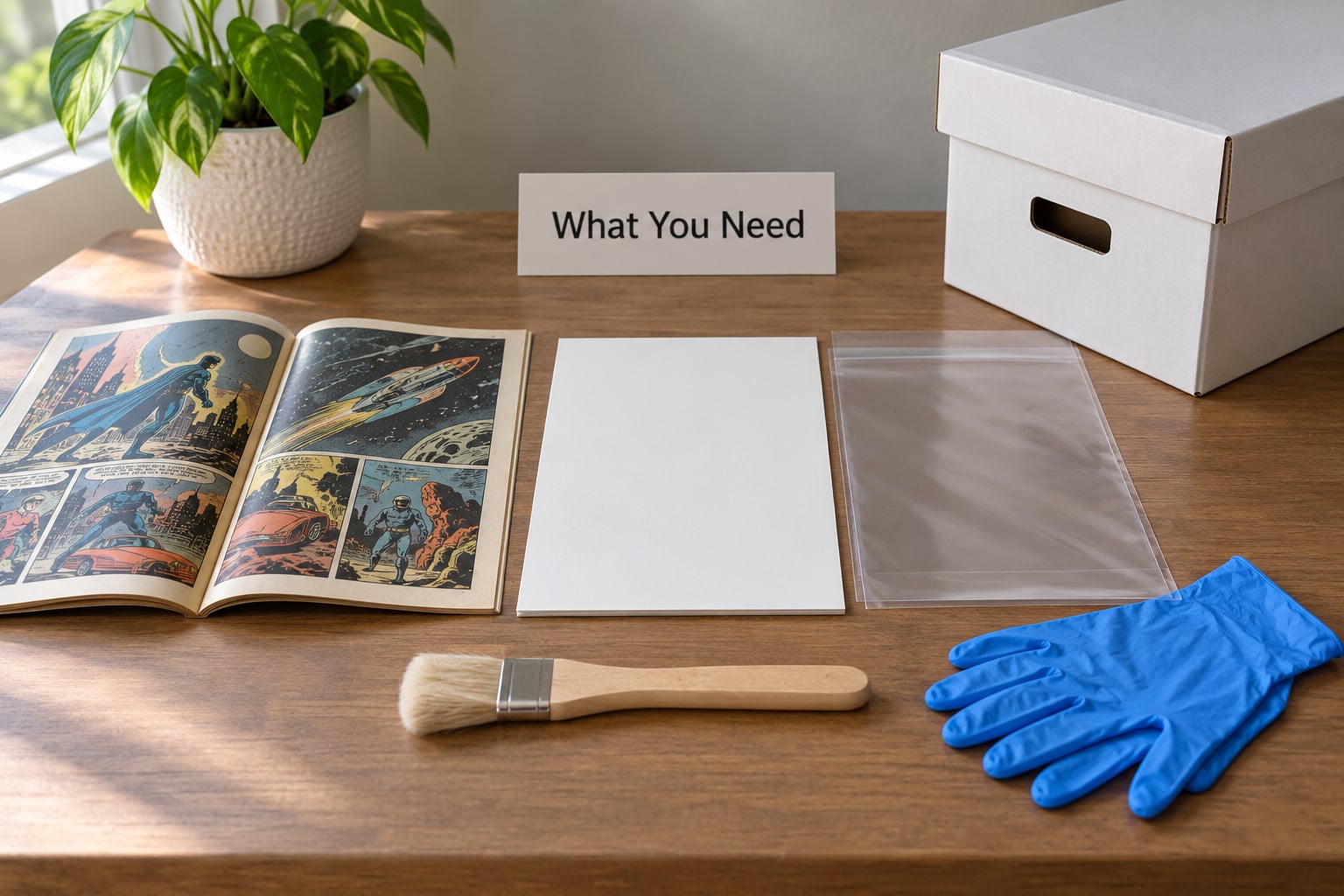
Materials first, then environment. Almost any yellowing project goes wrong at the supplies stage, usually because the bag or board looked archival on the packet but was not.
- Bags: archival polyester Mylar for high-value books and soft polypropylene for the rest. Skip anything with PVC in it, and skip untested plastic that looks clear but clouds yellow after a few years.
- Backing boards: acid-free boards in two flavours. Plain boards are neutral, buffered boards carry a calcium carbonate alkaline reserve that neutralises nearby acid. Buy the buffered version for anything pre-1990.
- Boxes: short comic boxes or longboxes made from acid-free board, with a snug fit so books stand upright rather than slumping.
- Gloves and hands: clean, dry hands for most handling. Nitrile gloves for the handling step, since skin oils transfer and nitrile grips better than cotton.
- Cleaning tools: a soft, clean artist brush for dust, plus an air blower or screened air tool for pages. A soft eraser, used sparingly, works on some modern covers.
- Climate kit: a hygrometer or data-logging thermometer and hygrometer, a silica gel packet for boxes in variable conditions, and a dehumidifier if your space runs damp.
- Storage space: an interior closet or interior cabinet, dark, with stable temperature and airflow. Not an attic, not an unheated garage, and not a basement that smells musty.
One caveat about labels. Collectors on r/comicbookcollecting and r/MangaCollectors repeatedly hit the same wall: a packet says acid-free and gives no pH number, no board thickness, and no mill material. Where a supplier publishes a spec sheet, check it. Where they do not, treat the product as unverified and use it on books you can replace rather than ones you cannot.
Step-by-Step
Step 1: Inspect and Identify the Comic’s Condition
Work out what you are dealing with before you touch anything with a cloth or a spray. Lay the comic on a clean, dry, flat surface and open it once, gently, without forcing the spine.
Check for these six things:
- Mold: fuzzy growth, a musty smell, or scattered dark specks that smear when touched with a damp fingertip. Mold is urgent and always isolated.
- Brittleness: edges that look ragged, translucent, or furry, or pages that crack when the book is opened past halfway.
- Tears and creases: spine stress, corner dog-ears, and creases that have pulled ink off the page.
- Fading versus yellowing: ink that has lost saturation is a light problem, whereas paper that has browned is an acid problem. Only one of them responds to better storage.
- Adhesive failure: a cover detached at the gutter or a backing board glued onto the paper.
- Type of yellowing: even cream across the whole book reads as age; yellow at the spine and edges suggests something the book has been touching is feeding acid into it.
Note what you find. A short written record or a photo per box turns a two-hour job into something you can repeat next year and actually compare.
Brittle books do not get cleaned. They go straight into a bag with a board and minimal handling, because every extra bend is a permanent loss.
Step 2: Clean the Cover and Pages Carefully
Dust is an active accelerant. It holds moisture against the page and brings pollutants into contact with paper, so a light cleaning is worth doing before a comic goes into storage.
Use a clean, soft brush with the comic open on a firm surface, brushing outward from the gutter so you are not driving grit into the crease. For modern glossy covers, an air blower or screened air tool clears loose particles better than contact. Hold the book by the edges, never by the middle of the page.
Know the limits. Household cleaners, glass cleaner, dish soap, alcohol wipes, and damp cloths do real damage to coated covers and newsprint pages, and water on a spine is how a good book becomes a torn one. Skip anything with flaking ink or a brittle surface.
Skip newspaper, printed paper towels, and fabric softener sheets too. Ink transfer and lint are hard to remove, and ink from newsprint carries its own acidic load.
Step 3: Reduce Acids and Handle the Comic Safely
Handling is where most damage happens, and it happens fast. Wash with soap and dry fully before you touch paper, then work with clean, dry hands for most tasks and switch to nitrile gloves when the book is older, flaking, or valuable.
Support the comic at the binding with both hands when you open it, and turn pages from the outer corner rather than pinching near the staple. If a page tears, stop, do not tape it, and bag the comic with the tear facing inward so the fold does not work at it.
The rule that matters most in storage is that every surface touching your comic should be archival. Acid migrates through contact, so a single cheap board sitting against a Silver Age cover will do more harm than a decade in the open. Keep vintage material in its own box, which is the most repeated recommendation across comic collecting forums, and keep the buffers facing the pages.
Separate anything that smells, looks spotted, or has visible foxing. Put it in its own bag and its own box until you decide what to do with it.
Step 4: Bag and Back the Comic Correctly
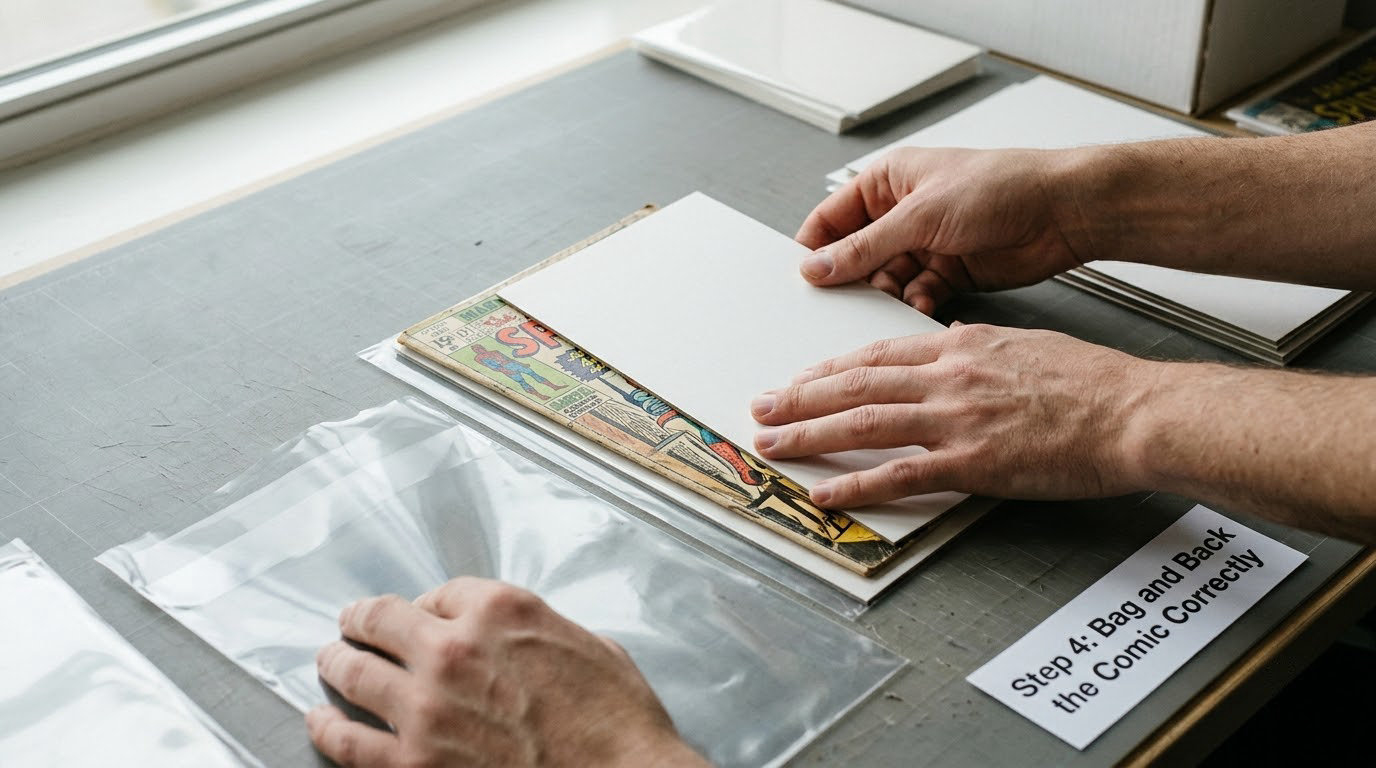
Correct order: bag first, board second, then final seal. Reversing it is the reason so many bagged comics have a bent spine.
Slide the backing board into the bag first with its buffered side facing the comic’s back cover. Hold the comic by its edges, align it with the board at the top edge, and let it drop the rest of the way down. Pushing the board into the book to meet it is what creates a curved spine and a permanent crease.
Choose the bag size for the book, not the other way round. Too small means a pinched spine and rounded corners. Too large means the board wanders inside and the cover takes a diagonal crease when the bag is sealed. Most modern comics sit on a bag sized for the issue count or trim size; oversized Silver Age and Bronze Age books need a bag cut or folded a few millimetres narrower than the book, or a bag made for large format.
Seal with a peel-and-stick strip rather than a heat sealer. Heat is fine in principle but easy to overdo, and a sealed bag cannot be reopened for inspection without damage. Press the strip down along the back, run a bone folder or the edge of a ruler once over the front face so the board lies flat inside, and check the corners.
Finish by squeezing the bag gently at the centre. If you feel a hard rectangular edge pressing on the cover, the board is misaligned and needs to come out and go back in square.
Step 5: Store Comics in a Stable, Dark Environment
Once bagged and boarded, the remaining damage is environmental. Aim for these targets and you have done most of what is available to a collector working at home.
- Temperature: 59 to 68 F. The ceiling matters more than the target, because every warm day accelerates the acid reaction.
- Relative humidity: 45 to 55 percent. Sustained humidity above 60 percent brings mold, warping, and staple corrosion; sustained dryness below 40 percent makes brittle pages snap.
- Light: zero direct sun, and no long-term lit shelf. Even ambient room light fades covers over time.
- Position: upright in a box, not stacked flat under weight. Laying a box of books flat for months bends the pages below the weight.
- Separation: vintage in its own box, modern in its own box, and any suspect book isolated.
Put a hygrometer inside the closet or cabinet where the comics actually are, not in the hallway where it reads nicer. Check it seasonally and after any weather event, and write the number down.
For collectors who want the books visible, the trade-off is real and worth taking deliberately rather than by accident. UV-filtering museum glass or acrylic in a display case handles direct light. LED lighting runs cool and does not emit the ultraviolet output of halogen or incandescent bulbs. Keep display rotations to a few weeks rather than a permanent shelf, and treat the display case as a viewing spot rather than a home.
Basements and storage units get complicated fast. A unit in a dry climate with insulation and no shared exterior wall can be acceptable if you use gasketed plastic bins instead of cardboard boxes and a dehumidifier, plus a hygrometer you check monthly. Basements in humid regions are close to unusable. Attics are never acceptable, in any region, because summer heat cooks the paper.
Step 6: Check Stored Comics Periodically
Set a repeating date and put it in your calendar. Twice a year covers most collections; yearly is the minimum for a small, stable collection.
Each pass, check five things:
- Colour shift, by comparing against your photos from the last check.
- Moisture or mustiness when you open a box, plus any warping or ripple in the block.
- Mold specks, insect frass, or webbing between books.
- Bag and board condition, including clouding, yellowing of the plastic, or a board that has gone wavy.
- Staples, which on old books may be rusting and streaking the cover from inside.
Plastic bags that have clouded or yellowed are the confusing one. Collectors on r/MangaCollectors ask this constantly, and the answer is that it is usually the bag, not the book. Polypropylene degrades over time and turns milky or amber, which reads exactly like paper yellowing. Pull the book, check the paper against a white surface, and replace the bag if the pages are still clean.
If you do find mold, isolate that book in a sealed bag, keep it dry, and get advice before cleaning. Dry brushing removes spores, but moisture spreads them and the staining stays regardless.
Common Mistakes
These come up again and again, and every one of them makes yellowing faster rather than slower.
Using ordinary cardboard or unverified boards. Corrugated board and recycled board carry acids that migrate into the paper. Use spec-verified acid-free boards, buffered for anything vintage.
Trying home bleach or peroxide. It lightens pages and weakens fibres at the same time, permanently. There is no safe version of this.
Spraying varnish or archival coatings on a cover. It traps dirt, darkens with age, and affects grading. Collectors who spray covers usually regret it within a few years.
Buying cheap PVC bags. PVC off-gasses plasticisers that yellow and embrittle the paper inside, and it never fully reverses. Choose labelled archival polyester or polypropylene instead.
Storing in an attic, garage, or damp basement. Heat and damp are the two accelerants that no amount of bagging can outrun.
Stacking books flat under heavy weight. Long-term, this bends pages and crushes staples. Boxes belong on a shelf, upright.
Bagging without boarding. A bag without a board protects against dirt and handling only. Books sitting back to back in a box will still yellow from contact.
Over-handling. Reading copies should stay out of the storage boxes entirely. Have a separate reading copy so the collectibles never leave their bags.
Writing on a backing board with a permanent marker. It bleeds through to the back cover. Use a soft pencil on the board, away from the book’s edges.
Skipping manga because advice was written for comics. Japanese tankobon uses thinner, lighter paper and usually shows yellowing sooner. Manga collectors also know that yellowed pages cut resale value visibly, which is why so many switch to archival supplies quickly.
Frequently Asked Questions
Can you reverse yellowing on comic book pages?
No. Yellowing is chemical change inside the paper fibres, so it cannot be undone. Household bleach and peroxide will lighten a page temporarily while also breaking down the cellulose, leaving weaker, thinner paper that fails faster. Professional deacidification neutralises the acid and slows further damage, but it does not whiten pages and it makes a comic ineligible for the highest grading tiers.
Do all yellow pages mean there is mold?
No. Uniform cream tone across a whole book is ordinary acid aging. Mold shows as fuzzy growth, a musty smell, or dark specks that smear with a damp fingertip. Brown spotting concentrated near the spine usually means acid migration from a neighbouring book or an acidic board. Check for a smell and for specks before treating anything as mold, and isolate any book you are unsure about.
How does humidity affect comic books?
Relative humidity between 45 and 55 percent is the practical target. Above 60 percent, mold, page warping, and staple corrosion become real risks, and moisture lets acids migrate between books in a box. Below 40 percent, brittle pages become fragile and can crack when handled. A hygrometer placed in the actual storage closet, checked seasonally, tells you more than any general advice.
How should I store rare comics long term?
Give each book its own archival polyester bag and buffered acid-free board, keep books upright in an acid-free short box, and separate vintage material from modern. Store the box upright in a dark, stable interior closet around 59 to 68 F and 45 to 55 percent relative humidity, away from exterior walls. Inspect twice a year, photograph the condition, and record any change in a log.
When is professional conservation the right call?
Get a paper conservator involved when a book is scarce, brittle, actively moldy, has detached covers, or needs deacidification. Deacidification sprays a controlled alkaline neutraliser onto the paper and presses out the excess, which slows damage but does not restore whiteness. Book restorers and aggressive pressing will reduce a comic’s grade, so for high-value books the usual advice is to stabilise and store rather than cosmetically restore.
Conclusion
If you do four things this week, do these. Move every bagged book out of direct light and into a closet or cabinet away from an exterior wall. Check the humidity in that space with a hygrometer and aim for 45 to 55 percent. Wash your hands, wear nitrile gloves for anything vintage, and stop touching pages by their faces. Then buy spec-verified acid-free bags and buffered boards, and bag and board everything that is currently loose.
Book a repeating calendar check twice a year, photograph each box as you go, and separate any book that smells musty. Yellowing you cannot reverse, but you can make a clean comic stay clean for the next forty years, and that is a better outcome than most collections in a spare bedroom ever manage.