To book a hotel that is actually quiet, you need to do three things: work out which noise actually ruins your sleep, research where that noise lives inside that specific building, then make one precise request and confirm it before you arrive. The word “quiet” in a hotel description means nothing on its own. Hotel staff allocate rooms, not guests, so a request is a preference the property tries to honour rather than a locked-in guarantee.
Updated October 2026. This guide covers the whole sequence, from picking the property on the map to the phone call two days before check-in.
Most of the advice out there stops at “ask for a high floor away from the elevator”. That is a decent start and it is also vague enough to be ignored. What follows is the fuller version, with the noise sources mapped to the architecture, the review phrases worth searching for, and wording you can paste straight into a booking form.
Table of Contents
- 1What You Need Before You Search
- 2Step-by-Step: How to Book a Hotel That Is Actually Quiet
- 3Step 1: Set Your Quiet-Room Requirements
- 4Step 2: Check the Hotel and Room Location for Noise Sources
- 5Step 3: Read Reviews for Specific Noise Evidence
- 6Step 4: Contact the Hotel Before Booking
- 7Step 5: Book a Flexible or Refundable Rate
- 8Step 6: Confirm the Room After Booking
- 9Step 7: Booking Mistakes to Catch Before You Pay
- 10Common Mistakes
- 11Frequently Asked Questions
- 12Is a quiet hotel room request guaranteed?
- 13What floor is the quietest floor in a hotel?
- 14How do hotels pick which room you get?
- 15Does every floor of a hotel have an ice machine?
- 16What time should you be quiet in a hotel?
- 17Can I move to a quieter room after check-in?
- 18Conclusion
What You Need Before You Search
Gather five things before you open a booking site. Skipping any of them is how people end up in a room they would have rejected from the listing photo.
- Your dates and destination, including the specific street. Airport hotels, downtown high-rises and suburban properties fail in completely different ways, so the address matters more than the star rating.
- Your room category ceiling. You need to know whether you are booking a standard king or paying up for a corner suite, because that decides what you are allowed to ask for.
- A written list of what would actually wake you. Voices through a wall, an elevator ding, a street, a barking dog, an air conditioning unit.
- Candidate properties plus their floor plans or site maps. Most hotel sites publish a map or floor plan somewhere in the booking flow or on the property page.
- A backup sleep kit. Earplugs, a white noise app or device, a sleep mask. This is not a substitute for research, but it is what saves a bad night once you are already in the room.
Also worth having open: recent reviews from at least two platforms, and the front desk phone number. You will need it in step four.
Step-by-Step: How to Book a Hotel That Is Actually Quiet
Step 1: Set Your Quiet-Room Requirements
Write down one primary requirement and one secondary, then stop. A short list gets acted on; a twelve-item wish list gets ignored, because the front desk is juggling arrivals and the guest next to you in the queue has asked for a crib, a late checkout and a specific bed type.
Decide which of your conditions are requirements and which are nice-to-haves. “No room beside an elevator” is a requirement for most light sleepers. “A high floor” is a preference, because it can make things worse.
Keep the two-list rule: requirements go in the booking notes, preferences go in your head. Anything you would happily survive without does not belong in the request.
Step 2: Check the Hotel and Room Location for Noise Sources
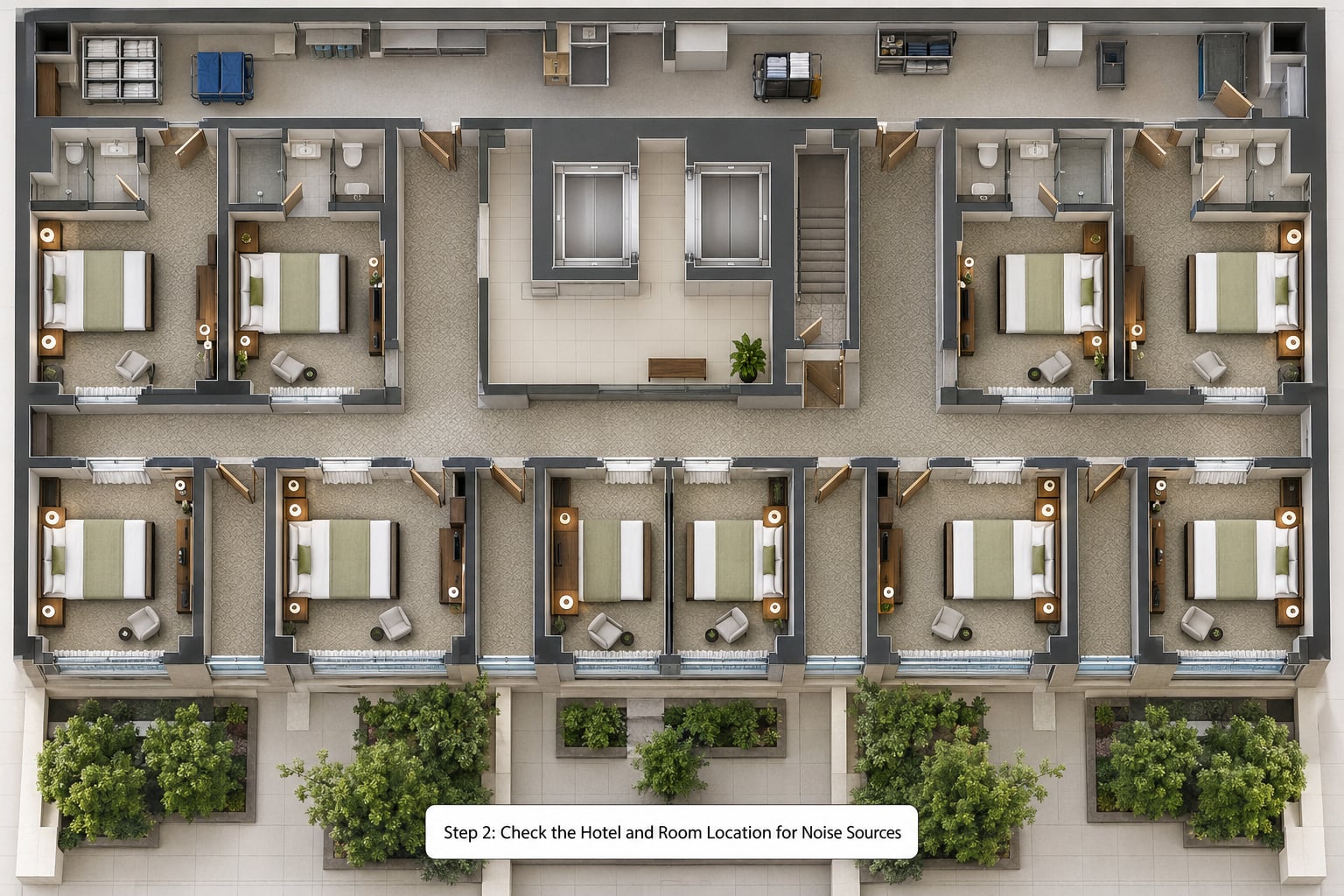
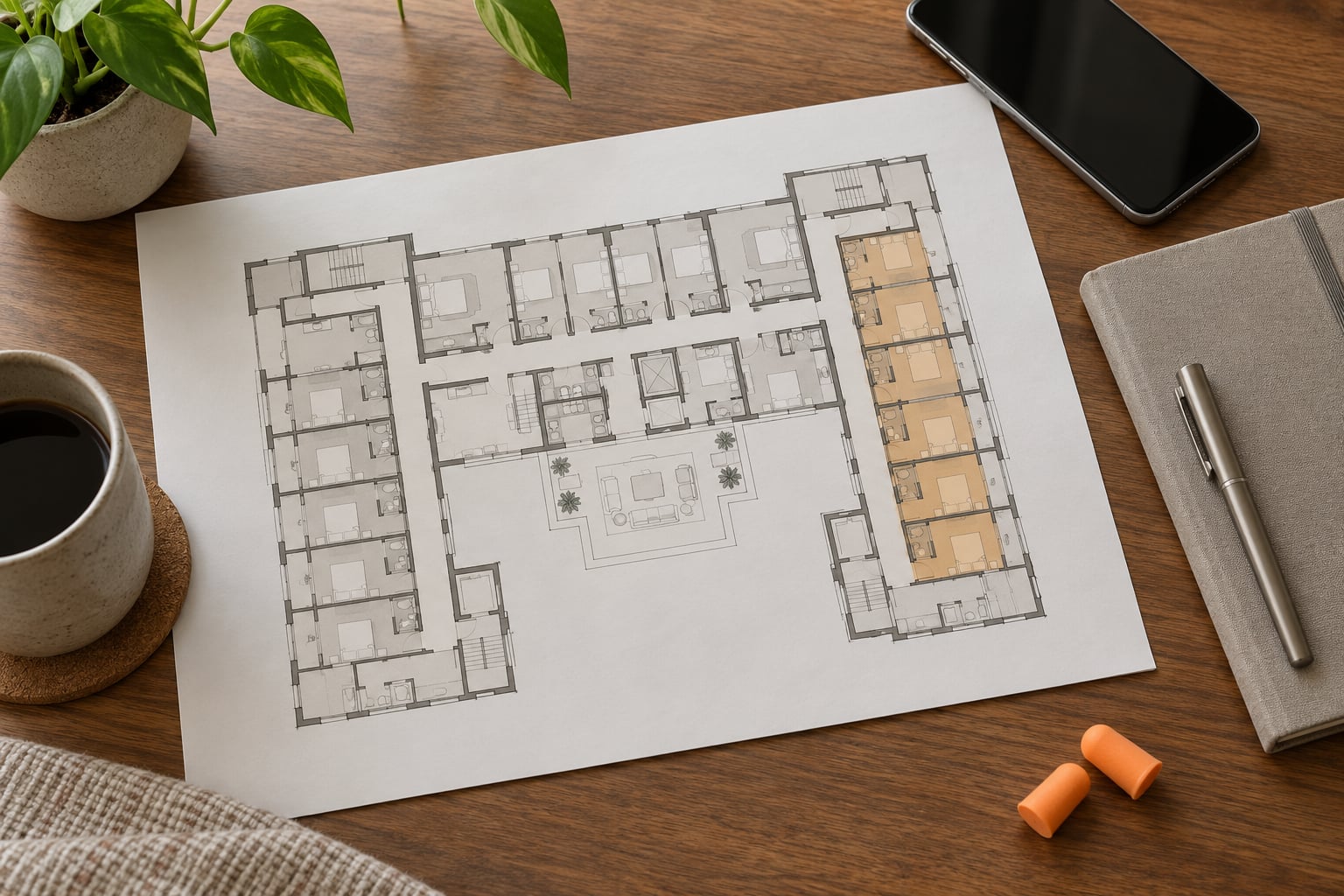
Hotel noise is structural. It comes from equipment, traffic flows and shared walls, and you can predict most of it from a floor plan before you book. Open the property map and look for where the elevator core sits, where the stairwell doors are, which corridor housekeeping uses, and what sits directly below the guest floors.
Then match each source to where it lives and what you ask for. This is the list worth memorising, because the same nine items show up in almost every urban hotel:
- Elevator bank — sits in the central core, often mid-building. It reaches you as a ding, door chatter and motor hum through the wall. Request a room several doors past the lift, on the side facing away from the core.
- Ice machine and vending — an alcove on each guest floor, often opposite housekeeping. The noise is mechanical hum plus ice dumping at all hours. Ask for the room as far from the alcove as the floor allows.
- Housekeeping corridor — one end of the floor, near the linen store. Carts, vacuuming and door-to-door chatter come with it. Request a room at the quiet end, away from the linen closet.
- Stairwell — usually at both ends, plus a fire exit door. Door slams and heavy footfall arrive late at night. Request a room set back from the stairwell door.
- Ballroom or meeting space — ground floor or second floor of large properties. Music, amplified speeches, setup crews and late trash runs travel upward through the structure. Request a floor well above the event space, and confirm no event falls on your dates.
- Bar, restaurant or kitchen — street level or courtyard. Music, glassware, extractor fans and early deliveries all run late. Request a courtyard-facing or rear room at the opposite end of the plan.
- Street, tram line or rail — whatever the frontage faces. Traffic, sirens, horns and overnight deliveries come in through the window. Request a rear or courtyard-facing room, higher up if the street is the issue.
- Roof plant and HVAC — top floor, plus the elevator motor room. Constant fan hum and vibration, worse in storms. Avoid the top floor and anything directly over the elevator machine space.
- Adjoining wall — every interior room shares two walls. Conversations, television and alarms all cross them. Request a corner room, or a room whose neighbours are families or business travellers.
Now pick a floor. The upper-middle floors, roughly four to six above ground in a mid-rise, are the sweet spot: far enough above the bar and the street to lose most of it, far enough below the roof plant to avoid fan hum. The top floor removes footsteps from above but adds wind, weather and machinery. Ground-floor rooms put you next to the lobby, the loading door and often a courtyard with extract fans running late.
Room numbering helps too. In most hotels the lift core and stairwells sit between the odd and even sides, so rooms on one side of the corridor face a wall where the other faces a window. End-of-corridor rooms with only one adjoining wall beat mid-corridor rooms with two.
Step 3: Read Reviews for Specific Noise Evidence
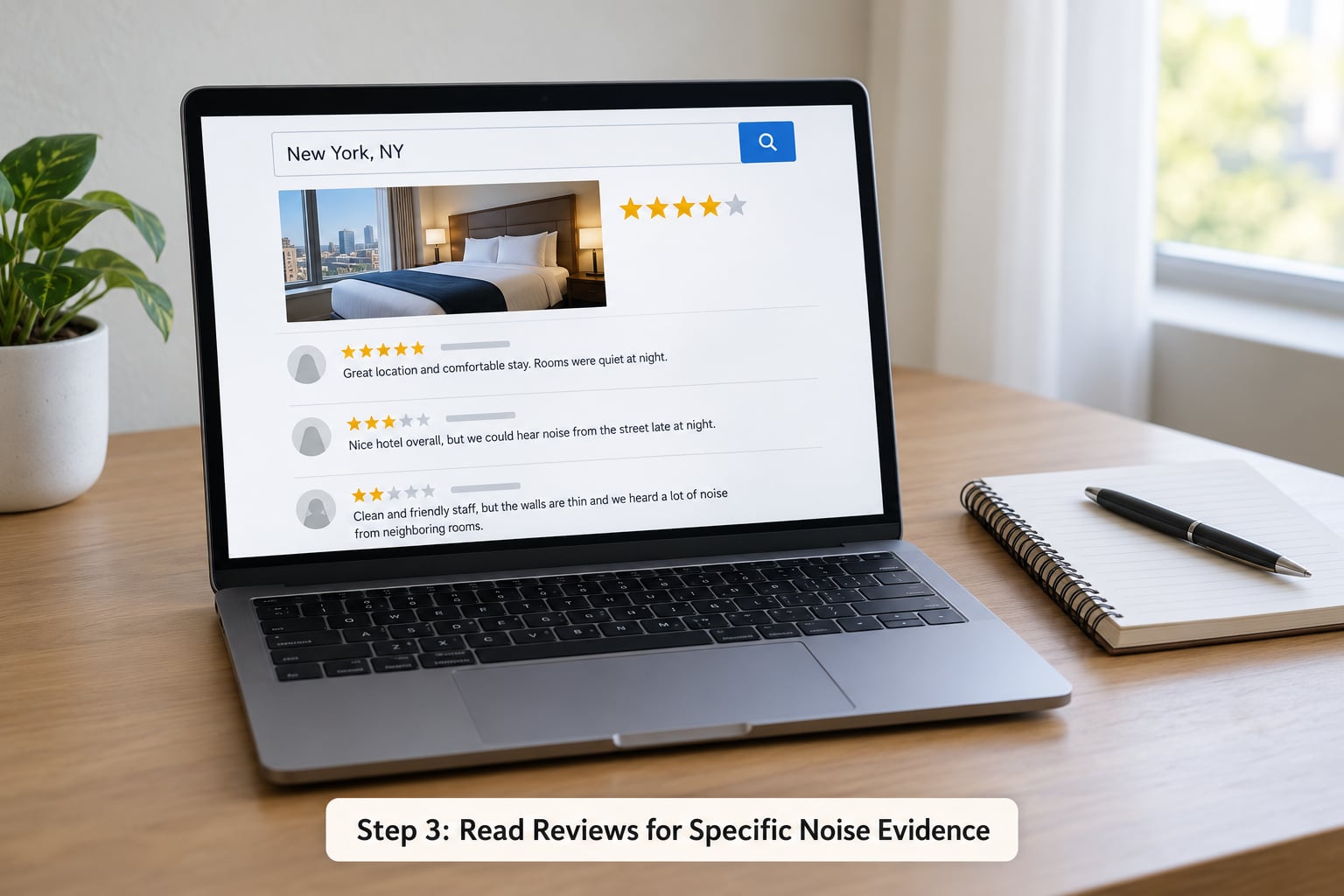
Guests rarely volunteer noise complaints unprompted, which means you have to search for them rather than skim. In the review box, search these phrases and read every hit:
- “thin walls”, “could hear everything”, “paper walls”
- “elevator”, “lift”, “loud ding”, “next to the ice machine”, “vending machine”
- “street noise”, “traffic”, “trams”, “train”, “bar”, “club downstairs”
- “AC unit”, “air conditioning”, “rooftop”, “hum”
- “quiet”, “peaceful”, “sleep well”, “noisy night”, “party next door”
Then read for pattern, not for adjectives. One review mentioning the elevator in a 400-review property is normal; the same phrase in eight reviews from the last six months is a mechanical problem the hotel has not fixed. Check the dates on the complaints and compare them to the dates of the praise. A property described as quiet a few years back and noisy in the last three months probably changed, often because a wing was renovated or an event space started running later.
Look at which rooms the complaints come from. When reviewers say “the room at the end of the hall was fine but ours was not”, that is a room-specific problem you can request around. When every complaint is spread evenly across the building, the problem is the building.
One more signal: recent reviews that mention a front desk that fixed something quickly are worth more than a guest saying the room was quiet. It tells you the property responds when you tell them.
Step 4: Contact the Hotel Before Booking
This is the step most people skip and it is where quiet rooms get locked in. Call the front desk, ask for the reservations or duty manager, and ask whether your room can be placed away from specific equipment. Travelers who call in advance say the front desk can note your name against a room number in the property management system, which is a far stronger signal than a note in a booking field.
Use this wording in the special requests box at checkout:
“I am a light sleeper. If a room within my booked category is available, I would greatly appreciate one away from the elevator, ice machine and any event or banquet space. Thank you.”
And this on the phone:
“Hi, I have a reservation under [name] arriving [date]. I am a light sleeper and I would be very grateful if you could place me away from the elevator and ice machines. Could you tell me which floor that would put me on, and whether there are any conferences or weddings in the building during my stay?”
Ask about renovation work, event bookings, a new bar or kitchen, and how often housekeeping runs that floor. Also ask whether any rooms on your floor have connecting doors, since a connecting door turns a stranger’s phone call into your alarm clock.
Keep the request to one priority and one fallback. Longer lists read as a problem waiting to happen, and staff triage requests that sound difficult.
Step 5: Book a Flexible or Refundable Rate
Noise is partly luck, and a refundable rate is the cheapest insurance against it. Free cancellation gives you a clean exit if the property turns out to host a conference on your dates or if the reviews show a new problem nobody has fixed.
Two other levers are worth pulling. Book a room category one step above your budget, since a move within a category is easier than an upgrade, and prefer properties with a genuinely quiet wing or a designated quiet zone if one is advertised, because those rooms are usually held back deliberately.
Be aware of timing. When a property is nearly sold out, staff have no room to move you to, so a weekday in a busy season is riskier than an off-peak weekend. In a quiet week, the same call that got you a request note can get you an actual room assignment.
Booking direct by phone also tends to work better than a third-party site for special requests, because the reservation lands with a person rather than an algorithm. The trade-off is that the flexibility you secured in step five is worth more than the small difference a discount site sometimes shows.
Step 6: Confirm the Room After Booking
Seven days out, and again two days out, check your confirmation email for the room number or floor, the special requests line, and any note about the stay being subject to availability. If the room number shows, read it against the floor plan. Numbers ending near the lift bank or the stairwell are a warning you can still act on.
Send a short confirmation so the request is in the system twice:
“Confirming my request for a room away from the elevator and ice machine, if one is available within my booked category. Thank you.”
If the reply says “subject to availability”, that is the honest answer and it means your request is a preference, not a reservation. Ask one useful follow-up: whether the property has a quiet zone or wing and whether you can be matched to it. That question often gets a concrete answer.
Step 7: Booking Mistakes to Catch Before You Pay
Run this list once before you complete payment. If any line applies to your booking, change something now, because it is far easier than changing later.
- Trusting the word “quiet” in the description. It usually describes the neighbourhood, not the room. Fix: map the building and read reviews for named equipment.
- Requesting “a high floor” as your only note. Top floors carry roof plant, wind and elevator motor noise. Fix: request distance from the specific source instead.
- Picking the lowest-priced room in a loud property. The cheapest inventory often sits next to the lift or the lounge. Fix: upgrade the category, or change property.
- Ignoring the events calendar. Ballroom turnover and late trash runs run between 2am and 5am. Fix: check the meetings page and call about your dates.
- Sending a twelve-item request list. Long lists get triaged and dropped. Fix: one primary request, one secondary.
- Booking a nonrefundable rate for a trip that matters. There is no exit if the room is wrong. Fix: take the refundable rate.
- Assuming a corner room is quiet by default. Corner rooms face two outside walls, so more street noise. Fix: trade the corner for two solid interior walls.
Common Mistakes
The biggest mistake is treating “quiet” as a property attribute rather than a room attribute. A building can be quiet and still hand you a room beside the lift, and a lively hotel can have a genuinely silent corridor. You are buying a specific room, so research at room level.
The second is asking for a floor instead of a distance. “High floor” is vague; “away from the elevator and ice machine” is actionable, and staff can honour it. Distance beats elevation almost every time.
The third is skipping the second contact. A request made at booking can be lost in a system between confirmation and arrival. One short follow-up email costs you nothing and closes the gap.
The fourth is treating a request as a guarantee. Hotels assign rooms based on occupancy, housekeeping and guest needs. Framed correctly, you get far more cooperation; framed as an entitlement, you get a polite brush-off.
Now the part nobody plans for: what to do if it is still noisy when you arrive. Do not unpack. Go to the front desk within the first ten minutes and ask for a move, ideally at check-in while your bags are still in the lobby. Be specific about the source rather than complaining about noise in general, because “the elevator is too loud” gets action while “I cannot sleep” gets sympathy. Front desk staff report that swaps work most of the time when guests ask politely and early, and most properties would rather move you than lose the review.
Ask for a room in the same category you booked. If none exists, decide before you start whether you would accept a downgrade, a partial refund, or leaving. Quiet hours are usually posted at reception, commonly from around 10pm to 7am, and staff can call the offending room directly, which is far more effective than knocking yourself.
Finally, be a good citizen yourself. Shoes off in the corridor, no calls at 6am, headphones in the room rather than speakers. The quietest room in a hotel is usually one whose neighbours behave.
Frequently Asked Questions
Is a quiet hotel room request guaranteed?
No. A request is a preference the property tries to honour, and most booking systems attach the words subject to availability to it. What you can secure is a specific room type booked deliberately, such as a room in a designated quiet wing. For everything else, your leverage is the room category you book, the refund policy you choose, and asking early and politely.
What floor is the quietest floor in a hotel?
For most mid-rise hotels, a floor in the upper-middle range, roughly four to six above ground, balances the trade-offs. High enough to escape a street-level bar or a busy lobby, low enough to avoid roof plant, wind and the elevator motor room. The top floor removes footsteps from above but adds fan hum and weather noise.
How do hotels pick which room you get?
Rooms are assigned by the front desk based on occupancy, room type, housekeeping status and guest needs such as mobility or connecting doors. Special requests recorded in the booking system are weighed alongside those needs. Calling the property before arrival, so your name can be noted against a specific room, tends to work better than a note left in an online field.
Does every floor of a hotel have an ice machine?
Most multi-floor properties place an ice and vending alcove on each guest floor, often opposite the housekeeping store. That alcove is a common source of mechanical hum and late-night ice dumping. Ask for a room as far from it as the floor allows, and mention it as your one primary request if it is the source that bothers you most.
What time should you be quiet in a hotel?
Quiet hours are set by the property and usually posted at reception, commonly running from about 10pm to 7am. Most hotels also have a broader noise policy that applies around the clock, especially during events. If a neighbour breaks quiet hours, call the front desk rather than knocking, because staff can reach the room far more effectively than you can.
Can I move to a quieter room after check-in?
Usually yes, especially within the category you booked. Ask at the front desk before you unpack, describe the specific noise source, and request a room away from the elevator, ice machine or event space. If the property is nearly sold out, options are limited, which is one more reason to keep a refundable rate in place.
Conclusion
Start with one sentence: name the noise that actually costs you sleep, whether that is voices through a wall, an elevator ding or a street. Then check where that source sits on the floor plan, mine recent reviews for the exact phrases, call the front desk with one specific request, and book a rate you can walk away from. That sequence takes about twenty minutes and it is the difference between hoping for a quiet room and knowing which one you are getting.