You can exercise a dog indoors with games built from ordinary household items, a few treats and short training drills, and you never need a yard or outdoor space to make it work. Most dogs get a solid session from 20 to 30 minutes of focused play, split into gentle warm-up movement, one or two active games, and a calm finish. Bad weather, an unvaccinated puppy or a building with thin walls is exactly why this matters.
So here’s the short version of how to exercise a dog indoors: clear a safe room first, then work through seven activities that need nothing more than a sofa, a hallway and a kitchen cupboard. Scent games sit alongside the running ones because a nose working hard tires a dog faster than cardio alone.
Our two dogs are the reason this guide exists. One is a 34-pound shepherd mix who can go all day, and the other is a 12-year-old with the hips of a much older animal, and they need completely different indoor plans. If you have a similar mismatch, this will save you a lot of trial and error.
Table of Contents
- 1What You Need
- 2Step-by-Step: How to Exercise a Dog Indoors
- 3Choose a Safe Indoor Exercise Area
- 4Start With Five Minutes of Gentle Movement
- 5Play Hide-and-Seek With Treats or Toys
- 6Try Indoor Fetch With Controlled Throws
- 7Build a Simple Obstacle Course
- 8Finish With a Calm Sniff or Settle Exercise
- 9Common Mistakes
- 10Quick Tips for How to Exercise a Dog Indoors in Small Spaces
- 11Frequently Asked Questions
- 12How long should I exercise my dog indoors?
- 13Are stairs safe for exercising a dog indoors?
- 14How can I exercise a puppy indoors?
- 15What indoor activities work for a senior dog?
- 16When should I stop exercising my dog indoors?
- 17Conclusion
What You Need
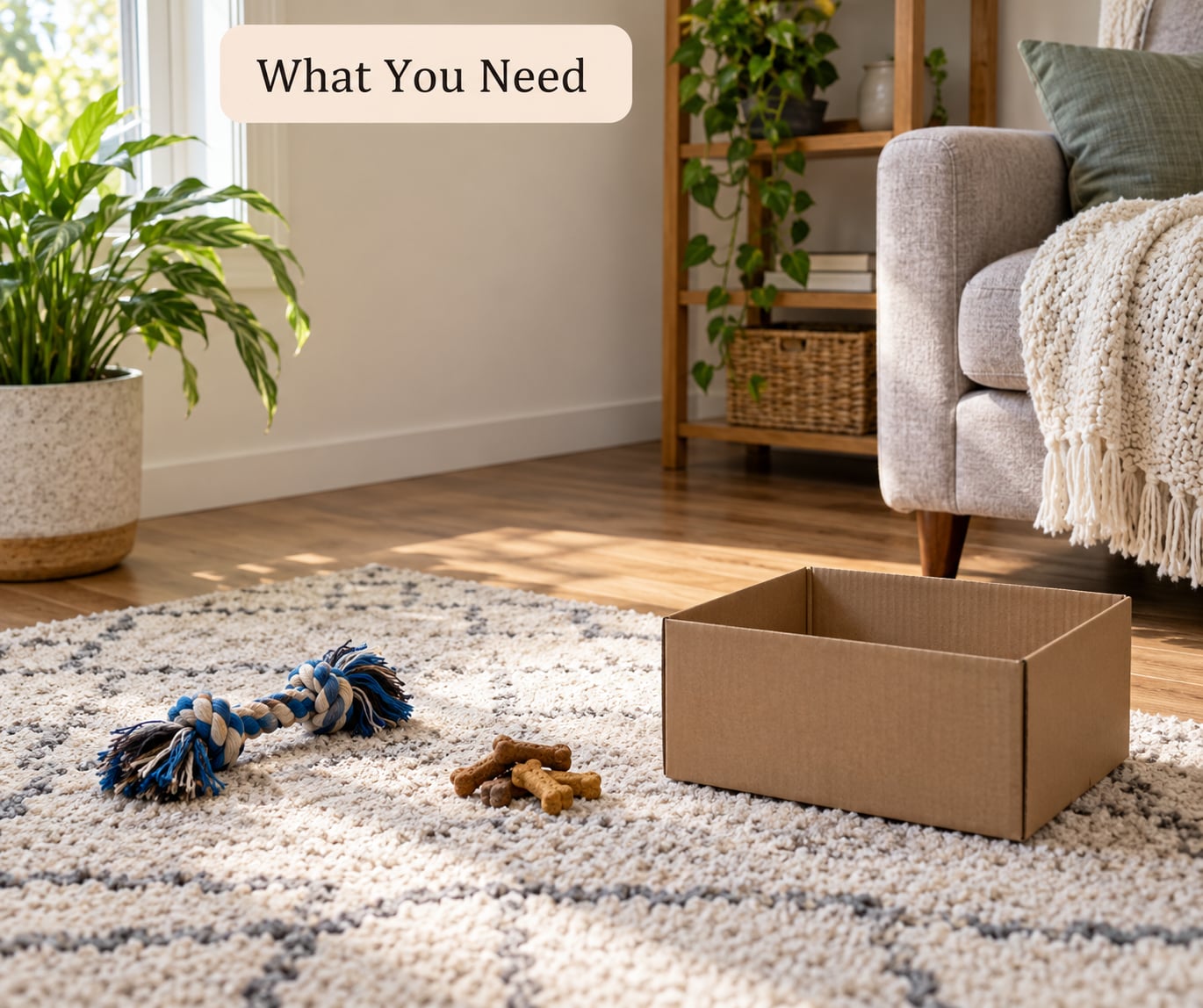
Nothing here is essential. That is the good news about this whole topic. Most of what you need is already in your house.
- A dog-safe indoor area with enough clear floor to move in a circle without knocking anything over.
- Clear floor space, ideally carpet or a non-slip mat if your dog is older or the flooring is polished wood or laminate.
- Two or three favorite toys, including one soft, low-bounce toy you can throw without wrecking anything.
- A few small training treats, kept to roughly a tenth of the day’s food if the games are treat-based.
- A hallway or corridor, which doubles as a fetch lane and a tunnel course.
- Optional low obstacles: cushions, a broomstick laid flat on the floor, cardboard boxes, a yoga mat rolled into a tunnel.
One rule overrides all of this: the space has to be free of hazards before your dog sets one paw in it. If you are starting from an empty-ish room, it takes about five minutes to make it safe.
Step-by-Step: How to Exercise a Dog Indoors
A useful indoor routine progresses from gentle movement to active play to a calm finish. Skipping straight to high-intensity games is the most common mistake, and it is also the easiest way to strain a joint or frighten a dog who has been cooped up all day.
Match what you pick to your dog’s age, fitness level, breed and the space you actually have. A fourteen-week-old puppy gets floor-level games and nap stops. A healthy adult gets the full set. A senior dog gets scent work and short directional drills rather than jumping and sprinting.
Choose a Safe Indoor Exercise Area
Clear the room before you start, and do it the same way every time so it becomes automatic. Move breakables off tables and shelves low enough to be reached. Pick up electrical cords, or bundle them behind furniture. Remove shoes, mail, small pens and anything else a dog could swallow. Wipe up anything spilled on the floor, and check houseplants, since lilies, philodendrons and pothos are all toxic to dogs if chewed.
Walk the space yourself at your dog’s height. If your shin would hit a table leg at dog height, that table leg is a problem. Close the door, or block the gap under it, so a bolt during a game does not send your dog out into the hall or the stairs.
Test the floor. Hardwood, tile and laminate are slippery, particularly for older dogs with weak hips, and a dog that slips mid-zoom usually ends the session early. A rug, a yoga mat or a cheap non-slip mat solves it. You will also want the room quiet enough that a bark from one room does not set off the neighbours.
Start With Five Minutes of Gentle Movement
Begin at walking pace in place. Your dog trots alongside you, and you change direction every few steps so they turn with you. From there, add shoulder rolls, where your dog’s nose follows a treat slowly around and back, and easy figure-of-eight turns on the rug.
Nose touches count here too. Guide your dog’s nose to the floor, to a cushion and to your knee, rewarding the contact. It looks like fussing about rather than exercise, and that is fine; it is a warm-up that ends with the dog already using its brain.
You will know it is working when breathing stays relaxed, movement is steady, and your dog is still looking for the next treat. That willingness to keep going is a better signal than a stopwatch. If the mouth is already open and panting hard in minute two, drop to a settle instead of pushing on.
Play Hide-and-Seek With Treats or Toys
Hide a treat in three or four approved spots first, with your dog in another room. Then release your dog with a cheerful “find it.” When they pick up the first treat, clap once and hide another while they are still working. A full session is five or six finds.
Toy version: put the toy under a folded blanket, behind a chair leg, or inside an open cardboard box that sits on its side. It is harder than it sounds. Your dog has to search a room rather than simply follow a scent trail, which is why it tires them so thoroughly.
Adjust the difficulty to the dog. Beginners start with visible placements, then you drop to behind furniture. Dogs with poor eyesight need louder cues, more hand signals and fewer, closer hiding spots. Older dogs do well with three easy finds and stop before they start forging around corners at speed.
Try Indoor Fetch With Controlled Throws
Use a soft, low-bounce toy and stand at one end of the hallway. Throw ten to twenty feet down the corridor, low to the floor so your dog is running flat rather than leaping up. When they bring the toy back, take it gently, reward, and release immediately for the next one. Change direction every few throws so they work both sides of the body.
For puppies, shorten everything. Five throws at five feet, ending while your dog is still having fun, teaches the habit far better than twenty tiring repetitions. A rolled-up towel works well as a substitute for a ball with a dog that gets over-excited.
Tug is the better swap when space is tight. Hold a rope toy at chest height, let your dog grab it, and let them pull and shake for a few seconds before you release. Never let your dog grab your fingers, sleeves or the collar area, and never lift them off the floor during a tug.
Skip stair sprints if your dog is a puppy with unfused growth plates, a senior, or a breed with hip or back problems. Two or three calm steps up and down is plenty on a staircase, and a carpeted stair is safer than a slick one.
Build a Simple Obstacle Course
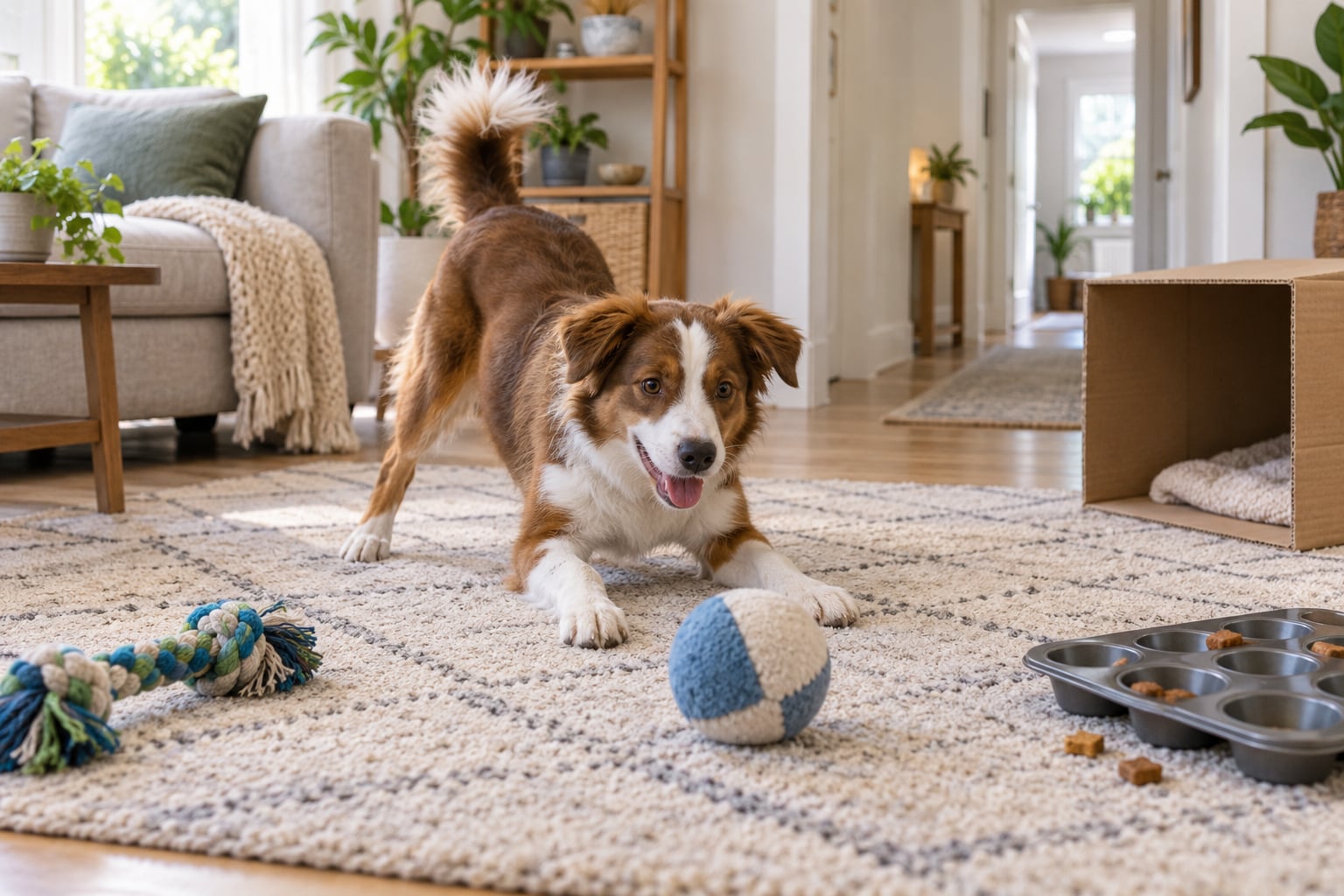
Keep it low and stable. Cushions on the floor, a broomstick laid flat to step over, cardboard boxes cut open at both ends as a tunnel, a yoga mat rolled loosely, and a hoop held flat against the floor work well. Lay it out in a single line through one room so there is only one route.
Walk the course yourself first and press down on every item. Anything that rolls, tips or slides gets taken out. Reward your dog for each step, not just at the end, so they learn to look where they are going rather than run at you blind. Finish with a calm lap on carpet.
For a five-minute version that needs almost no space, play a muffin tin game: set an ungreased muffin tin on the floor with a treat in a few of the cups and let your dog hunt them out. The same idea works with a folded newspaper, an empty egg carton or a shoe box.
Finish With a Calm Sniff or Settle Exercise
Cool down before you stop. Take your dog off the toy, sit down, and let them sniff the rug at their own pace. Scent work is a genuine mental workout, and a slow search at the end of a session is how you stop a dog bouncing off the walls afterwards.
A few minutes of quiet handling also helps: strokes along the shoulders and down the sides, a gentle range of movement in the hips, or a simple settle on a mat with the reward placed between the paws. End on a calm note and your dog learns that indoor play finishes in a good state, which matters when you have downstairs neighbours.
Stop the session if you notice heavy panting that is not settling, fatigue, staggering, glazed eyes, or any behaviour that is out of character. Indoor rooms get warm fast with a worked-up dog in them, and heat build-up is the reason a session ends early more often than you would think.
Common Mistakes
Starting with the hardest game first. High-intensity tug or full-speed fetch before the body is warm is how dogs pull a muscle on carpet. Fix it by keeping the first five minutes gentle, then building up.
Building a course out of furniture. Sofas, chairs and tables wobble or tip, and a dog jumping onto a slick surface can injure joints and floors. Fix it by using low, heavy, non-slip household items and nothing that moves.
Repeating one activity for the whole session. Ten minutes of fetch leaves most dogs barely warm. Fix it by alternating a physical game with a scent game; the change of task does more than the extra minutes.
Rewarding jumps onto and off furniture. Celebrating a dog leaping off a sofa onto hard floor teaches a risky habit, especially in a puppy. Fix it by rewarding four paws on the floor and putting a mat at the base of any step your dog uses.
Ignoring body language. Turning away, licking lips, a tucked tail or a dog that leaves the room all mean stop. Fix it by ending the session early twice a week instead of pushing to the finish line.
Quick Tips for How to Exercise a Dog Indoors in Small Spaces
Small apartments call for length rather than width: hallways, litterbox-clear corridors and the space between a sofa and a wall are all usable. High-energy breeds such as shepherds, huskies and border collies need longer scent sessions and harder search problems, not more fetch. Puppies do better with three five-minute blocks spread across the day than one long one, and puppies not yet fully vaccinated need indoor-only enrichment games because public ground carries parvo.
Rotate activities across the week so nothing becomes boring, keep sessions short enough that your dog wants the next one, and reward with positive reinforcement rather than fuss. Treats used across several games can quietly add up, so keep an eye on the daily total against the dog’s regular meals.
Ask your vet before starting or sharply increasing exercise if your dog has pain, breathing difficulty, a heart condition, joint disease or is recovering from surgery. Some conditions carry specific weight-bearing or leash restrictions, and a vet can also tell you what your dog’s healthy body condition should look like.
Frequently Asked Questions
How long should I exercise my dog indoors?
Most adult dogs do well with 20 to 30 minutes of focused indoor exercise, split into two or three sessions. Break it into a gentle warm-up, one or two active games, and a calm finish with scent work. Puppies need short frequent blocks of about five minutes, senior dogs need less movement and more searching, and high-energy breeds often benefit from a second session later in the day.
Are stairs safe for exercising a dog indoors?
Only for healthy adult dogs. Puppies should avoid stairs until their growth plates close, and senior dogs or breeds prone to hip and back problems can be injured on steps. Carpeted stairs are safer than slick ones, and keep sessions to two or three calm steps rather than repeated sprints, because most indoor stair incidents come from rushing up and sliding back down.
How can I exercise a puppy indoors?
Keep it simple: short floor-level games, a soft ball at close range, cardboard tunnels, hide-and-seek with a few visible treats, and frequent training reps of sit, down and name response. Keep sessions to about five minutes and end before the puppy tires. Puppies that have not completed their core vaccinations should stay off public ground, so indoor scent games and training fill the gap until your vet clears outdoor access.
What indoor activities work for a senior dog?
Scent-led activities suit seniors best: hide-and-seek with fewer and closer hiding spots, a muffin tin or egg carton search, and sniffing a mat with treats tucked in. Short directional drills work too, since a few minutes of training exercises recall and focus. Put down a non-slip mat, avoid jumping, fetching and stairs, and let an older dog set the pace.
When should I stop exercising my dog indoors?
Stop immediately if your dog shows heavy panting that will not settle, staggering, weakness, glazed eyes, reluctance to move, or any sudden change in behaviour. Move to a calm settle and cool the room if the dog seems warm, because indoor play heats up a room quickly. Also stop if your dog limps, seems painful, or shows breathing difficulty, and contact your vet.
Conclusion
Indoor dog exercise is a sequence, not a single trick: clear a safe room, start with five minutes of gentle movement, run one or two active games, then finish with a slow sniff or a settle on a mat. Pick the first activity your dog already likes, usually hide-and-seek or a treat search, and run that once before adding anything new.
Keep sessions short, reward what you want to see repeated, and vary the week so nothing becomes boring. Two reliable 20-minute sessions are better than one long attempt at a novel routine, and the same seven activities keep working when the weather turns and you have to work out how to exercise a dog indoors again. And if your dog has pain, joint disease, breathing trouble or is recovering from surgery, get your vet’s clearance before you change anything, because the rules for restricted exercise are specific and worth following exactly.