Before you hand over the keys, the questions to ask a mechanic before repairs are simple: what broke, how urgent is it, what will the fix cost in writing, what parts will you use, what covers the work if it fails, and how much am I allowed to spend before you call me. Six answers, and you can walk away from any shop that resists them. Most drivers never ask because the counter conversation moves fast and saying yes feels easier than sounding difficult.
I’ve been the person at the counter with a printout in one hand and a phone full of forum threads in the other, and the difference between a good visit and a bad one is almost never the price. It’s whether somebody explained the diagnosis before quoting the fix. This guide is neutral, not sponsored by any shop, and it is written to be read before you go, not while the service advisor is already walking away.
A couple of terms matter before you start. A diagnosis is what the inspection found. An estimate is what the work should cost based on that finding. A repair order is the document that gives the shop legal permission to work on your car. The invoice is what you owe at the end. People who blur those four words together are the ones most likely to be surprised by a bill, so keep them separate in your head and on paper.
Table of Contents
- 1Questions to Ask a Mechanic Before Repairs at a Glance
- 21. What Exactly Is Causing the Problem?
- 32. Is the Repair Urgent or Can I Wait?
- 43. Can You Show Me the Evidence Behind the Diagnosis?
- 54. What Happens if I Do Not Fix It Now?
- 65. Can You Give Me an Itemized Written Estimate?
- 7Questions to Ask a Mechanic About Your Repair Order
- 86. What Is the Cheapest Repair That Will Solve the Problem?
- 97. How Long Will the Repair and My Car Stay at the Shop?
- 108. What Type of Parts Will You Use?
- 119. What Warranty Covers This Repair?
- 1210. Will the Work Affect My Existing Manufacturer Warranty?
- 1311. Are There Other Problems You Noticed During the Inspection?
- 1412. May I Approve the Work in Writing and Receive the Final Invoice?
- 15Frequently Asked Questions
- 16Should I get a second opinion before accepting a mechanic’s estimate?
- 17Why is the diagnostic fee different from the repair estimate?
- 18Can a shop charge me for work I did not approve?
- 19How do I know whether aftermarket parts are appropriate?
- 20What questions should I ask before authorizing additional repairs?
- 21How should I handle a repair estimate that seems too expensive?
- 22Conclusion: Ask Before You Approve the Repair
Questions to Ask a Mechanic Before Repairs at a Glance
Here is the whole list in one place, with what each question is actually for. Bring it to the counter or read it down the phone. It costs nothing and it changes the conversation.
| Question | What it clarifies | Ask for in writing |
|---|---|---|
| What exactly is causing the problem? | The failed part versus the guess | A one-paragraph plain-language diagnosis |
| Is it urgent or can I wait? | Whether delaying risks damage or danger | A deadline, or a clear no deadline |
| Can you show me the evidence? | Whether the diagnosis is confirmed | Scan printout, photos, or the worn part |
| What happens if I don’t fix it now? | The real cost of delaying | A short and long-term outlook |
| Can I get an itemized estimate? | Where the money goes | Parts, labor, fees, each on its own line |
| What’s the lowest-cost fix that works? | Whether cheaper options exist | At least one alternative repair plan |
| How long will it take? | When the car comes back | A completion estimate and update plan |
| What parts will you use? | Part quality and markup | OEM, reman, or aftermarket, plus markup |
| What warranty covers this? | Who pays if it fails | Parts and labor duration and mileage limits |
| Does this affect my warranty? | Whether coverage survives | Claim number and paperwork retained |
| Did you find anything else? | Scope creep versus real findings | Urgent, monitor, and maintenance lists |
| May I authorize in writing? | Your spending limit and the final bill | A not-to-exceed amount and old-parts policy |
1. What Exactly Is Causing the Problem?
Ask them to describe the failure in plain language before quoting anything. A good answer names the failed component, the reason it failed, and the evidence behind it. A weak answer starts naming parts before you have heard a diagnosis at all.
Push for the difference between the confirmed cause and the things that might also be contributing. On a rough-idling complaint, for instance, a vacuum leak and a failing sensor can produce identical symptoms, and only one of them shows up on a scan. Ask which one the evidence actually supports and what would change their mind.
“You probably need the alternator” is not a diagnosis. “Your battery tested at 12.2 volts under load, which is below spec, and the alternator output measured 13.1 volts, so the charging system is not replenishing what the battery uses” is. You do not need to become a technician. You need to hear a cause, a reason, and a proof.
2. Is the Repair Urgent or Can I Wait?
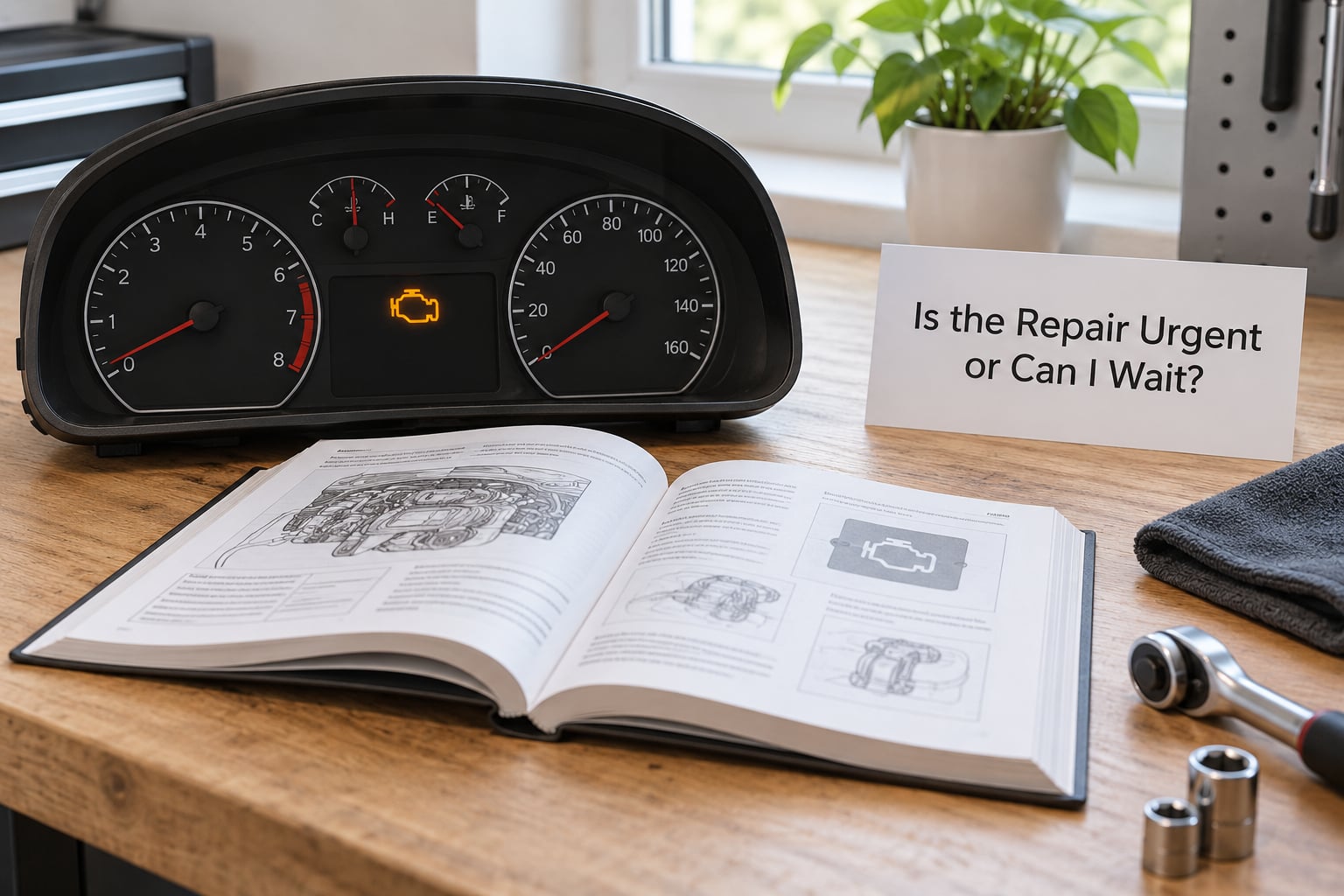
Ask directly whether the repair is safety-critical, whether it is getting worse with time, and how much driving you can do safely in the meantime. Three separate answers, because shops sometimes blur urgency and inconvenience together.
Loss of steering, brake, or braking-assist function is urgent. A tire below the wear bar is urgent. Fluid leaking onto hot exhaust is urgent, because it turns a mechanical problem into a fire problem. A failing air conditioning compressor on a hot day is annoying, not dangerous. Paint fade on a ten-year-old bumper is cosmetic, and a good shop will say so when you ask.
Regulars on r/MechanicAdvice get blunt about this: the same repair is an emergency in one month and a scheduled item in six months, and the shop should be able to tell you which one you are looking at. If you cannot get a clear answer about timing, assume you need a second opinion rather than a same-day decision.
3. Can You Show Me the Evidence Behind the Diagnosis?
Ask for the scan printout, photographs, a fluid sample in a clear cup, or the worn part itself. This is a reasonable request, and a shop that has actually diagnosed the problem will usually have something to show. On r/MechanicAdvice, the most common owner advice is to request the evidence and the old parts back before the vehicle leaves the bay.
Read the scan output with a beginner’s eye. Fault codes tell you what a circuit reported, not which part physically failed, and shops know that. A code plus a test result is evidence. A code alone is a starting point. Ask which one you are looking at.
Photographs work well for tires, brake pads, leaks, worn belts, and body damage. Take your own if the shop will not send theirs. A picture of the cracked belt or the puddle of fluid answers a question faster than an explanation does.
4. What Happens if I Do Not Fix It Now?
This is the question most drivers skip, and it is the one that gives you real leverage. Sometimes the honest answer is that nothing dramatic happens if you wait a month and save up. Sometimes it is that the repair gets significantly more expensive if you keep driving.
A small coolant leak that goes unnoticed can overheat the engine and warp the cylinder head, which is the difference between a hose and a motor. A worn CV joint can eventually let axle debris into the transmission. A failing alternator can strand you somewhere inconvenient and quietly drain the battery.
Ask for both horizons. What happens over the next two weeks if I keep driving normally, and what happens over the next six months if I do nothing at all? If the answer to both is nothing, you have leverage and a budget conversation to have. If the answer is cascading damage, the shop has told you why the repair is worth doing now, and you can weigh it on your own schedule instead of theirs.
5. Can You Give Me an Itemized Written Estimate?
Yes, in writing, with parts, labor, and fees separated. This is the single most useful document in the whole process, and it is the one most drivers never ask to see.
Questions to Ask a Mechanic About Your Repair Order
Each line should tell you what part, what operation, how long, and at what rate. The jargon is worth learning once.
| Line item | What it means | What to question |
|---|---|---|
| Part number | The specific part, including brand or remanufacturer | Is this OEM, reman, or aftermarket? |
| Labor operation code | A standardized code for how long that repair should take | Why does this job take longer than the guide says? |
| Labor hours | Bookkeeping time that is billed whether or not it was needed | Is this billed time or diagnostic time? |
| Labor rate | Hourly charge, which varies a lot by shop type | Is this shop rate or a special rate? |
| Parts markup | How far over the shop’s cost the part is billed | What is the markup percentage on this part? |
| Core charge | A refundable deposit on a rebuildable part such as an alternator | How and when is the core refund issued? |
| Shop supplies and fees | Small consumables and administrative charges | Is any of this chargeable on top of parts and labor? |
| Diagnostic fee | The charge for finding the problem, separate from the fix | Is it flat-rate or hourly, and does it apply to the repair? |
Ask what the shop’s labor rate is and whether it changes for complex work. Ask when the shop will call you before exceeding the estimate, and agree now that nothing above the written number happens without your verbal go-ahead. Then ask whether the diagnostic fee is charged whether or not you approve the repair, because in many states the shop keeps that fee either way. Agreeing to it at drop-off is much easier than arguing about it at pickup.
6. What Is the Cheapest Repair That Will Solve the Problem?
Ask for at least one lower-cost path, phrased as an alternative and not as a demand. Sometimes the honest answer is a quality aftermarket part instead of the dealer part, or a phased repair where the safety-critical part goes first and the rest waits. Sometimes the honest answer is that there is no cheap version of this particular job.
Say clearly that you want their recommendation first, and then ask what the alternatives are. Mechanics themselves online push back hard on customers who demand the cheapest option for engine or transmission work, because cutting corners there usually means paying twice. Ask what happens with the cheaper option in two years. That framing gets you a straight answer instead of a defensive one.
If the shop offers only one option and refuses to discuss any other, that is useful information on its own. A confident technician should be able to explain why the obvious alternative is worse for your car.
7. How Long Will the Repair and My Car Stay at the Shop?
Ask for a completion estimate and how you will hear about delays. Also ask about parts availability, because a single backordered part can turn a same-day job into a week, and that is almost never the technician’s fault.
Find out whether the shop calls or texts, how often, and who you should ask for by name. Then ask what your transportation or ride-around plan looks like if it runs long. Shops with loaners or shuttle service will happily tell you; shops without one will too, and you can plan around it.
If you need the car back by a specific day, say so at drop-off rather than at pickup. Deadlines stated up front sometimes change the order of the queue.
8. What Type of Parts Will You Use?
Ask the shop to label every part on the estimate as OEM, remanufactured, quality aftermarket, or rebuilt. The differences are real: OEM parts come from the vehicle manufacturer and usually carry the longest expected life, remanufactured parts are rebuilt to factory specification and often carry a warranty comparable to new, and aftermarket parts from a reputable supplier can meet or beat OEM specifications at a lower cost.
Ask about the parts markup, because parts are routinely marked up far more than labor. Ask whether the shop can quote you the part cost and the labor separately so you can see the real split. Ask about the core charge and how the refund works, since a core you never get back is pure loss.
On whether you can supply your own parts: most shops decline, and the reason is liability. If they install a part you bought and it fails, they are on the hook for the labor twice. A shop that will install customer-supplied parts, and states plainly that the parts carry no warranty, is doing you a favor, but it is uncommon.
9. What Warranty Covers This Repair?
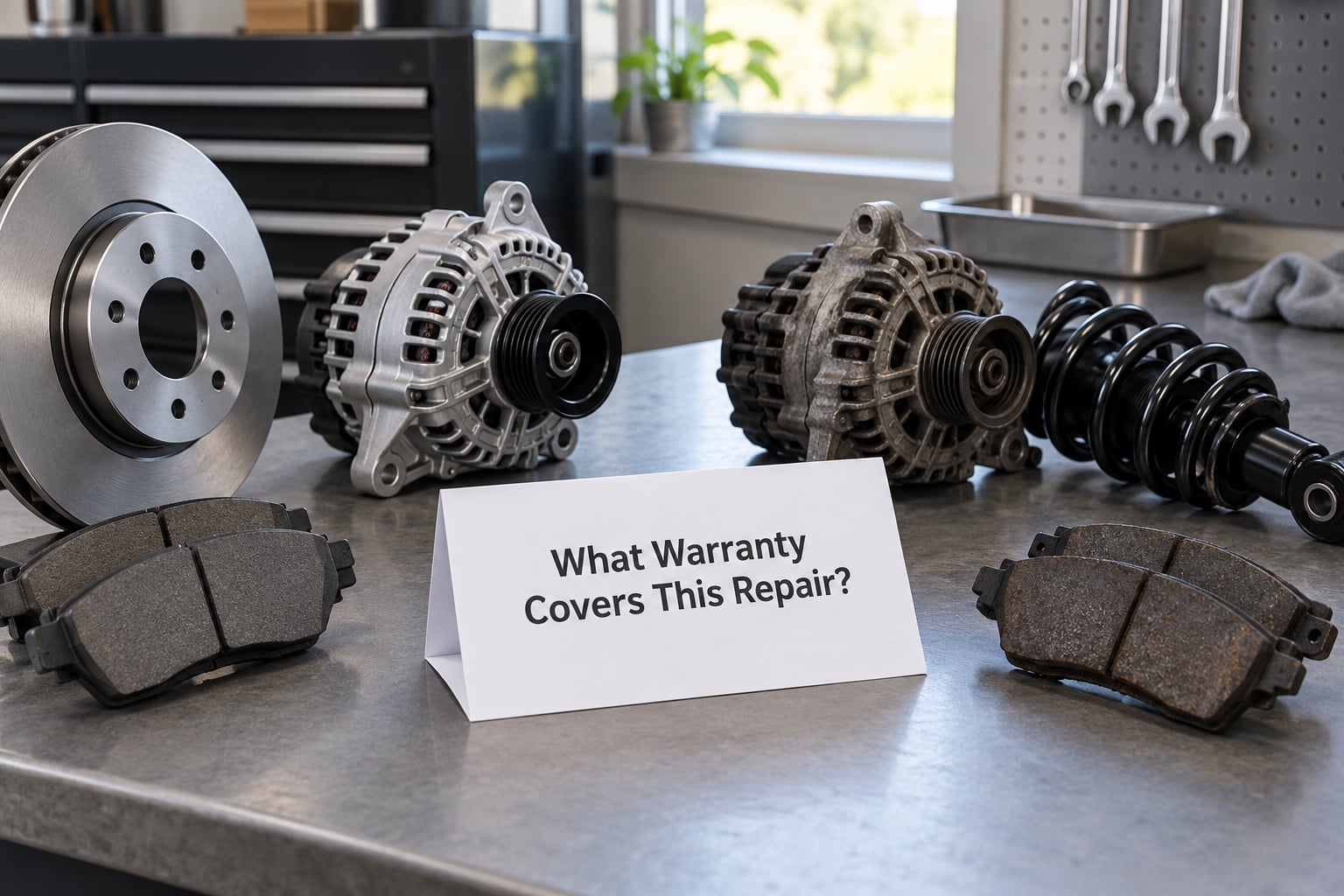
Ask specifically whether the warranty covers parts and labor or parts only, how long it lasts in months and miles, and whether the mileage or time limit starts when you pick the car up. Twelve months and twelve thousand miles is a common baseline, and 24-month or 60,000-mile warranties show up more often at stronger shops.
Then ask the harder questions. What is excluded, is the warranty transferable to the next owner, and if this repair fails on the same component, who handles the second visit? If the answer is vague, ask for the warranty terms in writing on the invoice.
Keep the invoice. Warranty coverage is easier to claim with a documented repair order than without one, and you may not remember in two years what was replaced.
10. Will the Work Affect My Existing Manufacturer Warranty?
Ask whether this repair touches a covered system. If your vehicle still has a powertrain or emissions warranty, an aftermarket part or an independent shop’s work sometimes changes what the manufacturer will cover later, depending on the terms. The shop should know which components on your vehicle are factory-warranty items.
Ask about open recalls and service bulletins that apply to your model. If the exact problem you are paying to fix is already covered by a recall or a customer satisfaction program, the repair may be free. Many owners pay for a fix that a manufacturer later absorbs, because nobody thought to check the VIN at drop-off.
Ask what documentation the shop provides and whether they keep the original failed part. Dealers, more than independents, often require the removed component to be returned to the manufacturer for a warranty claim, so do not authorize disposal on those jobs.
11. Are There Other Problems You Noticed During the Inspection?
Ask for a written list in three separate columns: needs attention now, monitor, and normal maintenance. That structure is the antidote to scope creep, which is the most common complaint in mechanic-advice forums. A tire visit that turns into a page of recommendations is usually a communication failure rather than a discovery, because the findings were never sorted by urgency.
Then sanity-check every item against your owner’s manual maintenance schedule. Shops sometimes recommend maintenance well before the manufacturer interval, which is a legitimate option but should be labeled as an option. Ask which items fall due within the next year and which are optional early maintenance. You can defer those without harm.
Ask which findings came from an actual inspection and which are from looking at the car. Some items on a report are simply that the fluid was not changed, not that anything is wrong.
12. May I Approve the Work in Writing and Receive the Final Invoice?
Ask to approve in writing with a stated spending limit, and ask the shop to call you before going over it. A number such as “not to exceed this amount without calling me first” turns an open-ended verbal promise into a bounded commitment, and it protects the relationship because it is not distrust, it is procedure.
Ask how you want to be reached during the day, who has that authority on the shop side, and what happens if you cannot be reached. Then agree on what to do with the old parts. Many drivers want to see the failed component, which is a legitimate request and often the only way to understand what actually failed.
Before you leave, ask what to watch on the drive home, whether a break-in period applies, and when the next visit should be. Ask what documentation you will get, and confirm that the technician’s name and the shop’s license or certification details will appear on the final invoice. A shop that objects to any of that has told you something useful about itself.
Frequently Asked Questions
Should I get a second opinion before accepting a mechanic’s estimate?
Get a second opinion on any estimate that runs into the hundreds or more, especially for transmission, engine, air conditioning, or steering work. Forum regulars treat a second opinion as standard above a few hundred dollars because diagnosis, not parts, is where the biggest disagreements happen. You usually still owe the first shop its diagnostic fee. Tell them you are getting another opinion up front, ask for the scan printout and itemized estimate, and take both to the second shop. Keep the car at the first shop if you like it there and simply decline the repair.
Why is the diagnostic fee different from the repair estimate?
The diagnostic fee pays for time finding the problem: testing, scanning, teardown, and inspection. The repair estimate pays for fixing it, once the cause is known. They are separate because a diagnosis has value even when you decide not to repair. Most shops charge a flat rate, some charge by the hour, and many waive or credit the fee if you approve the repair they diagnosed. Agree to the fee and its terms at drop-off, before the car goes back.
Can a shop charge me for work I did not approve?
No. Legitimate charges are limited to what you authorized in writing, and most shops are required to contact you before exceeding an agreed estimate. If you find unauthorized work on the invoice, do not pay it quietly. Ask for the itemized breakdown in writing, ask which authorization covers it, and escalate to the shop manager and, if it is not resolved, your state attorney general or automotive consumer board. Verbal approval claims are the ones worth challenging hardest.
How do I know whether aftermarket parts are appropriate?
Ask the shop to identify each part as OEM, remanufactured, or aftermarket, and ask what warranty comes with that choice. Good aftermarket parts from established suppliers are used in the industry all the time, and for wear items like brakes, filters, and batteries the difference often comes down to price. For safety-critical or long-life components such as airbags, sensors, and some electronics, OEM parts are the safer ask. Any refusal to label parts by source is a reason for concern.
What questions should I ask before authorizing additional repairs?
Ask four things: what exactly failed and how you know, what happens if I drive it as-is for two weeks, what is the itemized cost of the new work, and whether it is urgent or deferrable. Then set a new written limit for the added work, because approving one repair does not authorize the next. Ask the shop to add the items to a running total so you can see the running cost of the visit rather than learning it at the counter.
How should I handle a repair estimate that seems too expensive?
Ask for the itemized breakdown first, because a total is hard to argue with but a parts-and-labor line is not. Ask which portion is parts and which is labor, and call one or two other shops with the same vehicle and the same labor description to see what that labor runs in your area. Ask whether there is a lower-cost repair plan that handles the urgent part first. Then get a second opinion on the diagnosis itself, which is where the real differences usually live.
Conclusion: Ask Before You Approve the Repair
Start with the diagnosis, then urgency, then the itemized estimate, the parts, the warranty, and a written authorization with a spending limit. That sequence covers everything that goes wrong at the counter, and none of it requires you to become a mechanic. If a shop answers all six plainly, you have found a good one. If they resist any of them, walk out with your car and your keys.