To plan a bachelor party everyone enjoys, start with the group rather than the guest of honor: agree a per-person budget, match the activity level to how your guests actually spend a weekend, and give everyone free time. Most disappointing parties fail on logistics, not ideas.
A bachelor party is a celebration held for a man before he gets married, usually organized by his best man and attended by his groomsmen and closest friends somewhere between a few weeks and two months before the wedding. It goes by other names too, stag party or bucks party, and it ranges from a long dinner at home to a three-day trip. Scheduling it too close to the wedding is the single most common mistake, because the guest of honor is also juggling fittings, travel and a hundred family questions.
I have planned these more times than I would like to admit, and the pattern is consistent. The parties people remember are rarely the most expensive ones. They are the ones where nobody was dragged through something they hated, nobody spent an hour standing in a lobby waiting for a group that was running late, and there was one moment everybody talked about on the ride home.
Table of Contents
- 1What You Need
- 2Needed before you send invitations
- 3Useful to have, but not blockers
- 4How to Plan a Bachelor Party Everyone Enjoys: Step by Step
- 51. Start With the Guest of Honor’s Preferences
- 62. Set the Date, Location, and Guest List Together
- 73. Build a Balanced Activity Plan
- 84. Create a Realistic Budget and Payment Plan
- 95. Send Clear Invitations and Logistics
- 106. Assign Roles and Confirm Every Detail
- 117. Run the Party Without Micromanaging It
- 12Common Mistakes
- 13Planning for a generic crowd
- 14Booking before the key people confirm
- 15Overscheduling the day
- 16Ignoring dietary, access and transport needs
- 17Letting the budget drift
- 18Relying on one person for everything
- 19Having no backup plan
- 20Frequently Asked Questions
- 21What is a good number of activities for a bachelor party?
- 22How do you plan a bachelor party on a budget?
- 23What if not everyone knows the guest of honor well?
- 24Should you plan a surprise bachelor party?
- 25How do you include guests who do not drink alcohol?
- 26How far in advance should you plan a bachelor party?
- 27Conclusion
What You Need

You need seven things settled before invitations go out. Some are mandatory and some are nice to have, and mixing them up is how people end up booking a venue for fourteen people when eight are coming.
Needed before you send invitations
- A guest-of-honor profile. Favorite activities, things he avoids, how he feels about alcohol, and any hard limits. Twenty minutes of conversation saves the whole weekend.
- An approximate headcount. A range is fine at this stage, but a range you are willing to book for.
- A total budget and a per-person ceiling. Deciding this before you look at venues keeps the conversation about the plan instead of about money.
- A date shortlist of two or three options. Two is enough for a local party, three if you are booking travel or a destination weekend.
- A location shortlist. Local night, local weekend, or an overnight trip. Mixed groups argue against long travel.
- Your key attendees. Three to five people whose availability actually matters, usually the groomsmen and one or two people the guest of honor never misses an event for.
- A shared planning method. One group chat, one notes document, one person who owns it. Not three apps and four opinions.
Useful to have, but not blockers
- A short list of activity options the group already likes, so voting later is a choice rather than a brainstorm.
- Confirmation details for anywhere you intend to eat, since restaurant deposits move fast.
- A rough idea of whether anyone needs step-free access, a parking spot, or a lift from a station.
- A rough plan for dietary restrictions, at least at the category level.
Here is the pace that works for most groups, with roughly three to four months of runway.
| Time window | What to do | You are done when |
|---|---|---|
| 3 to 4 months out | Talk to the guest of honor, set the budget, pick the format and date | Everyone agrees on style, budget ceiling and two possible dates |
| 6 to 8 weeks out | Confirm key attendees, book the venue, accommodation and transport | Bookings have confirmation numbers and a cancellation deadline noted |
| 4 to 6 weeks out | Send invitations, open RSVPs, start collecting dietary and access needs | Every guest has the details in writing |
| 2 to 3 weeks out | Lock the headcount, pay deposits, vote on the activity plan | Numbers are final enough to order food and book cars |
| 72 hours out | Send the final itinerary, confirm timings with the venue, confirm the ride plan | Nobody is wondering where to be or when |
| Day of | Run the run sheet, keep one person free to solve problems | The party is happening without you touching everything |
How to Plan a Bachelor Party Everyone Enjoys: Step by Step
The process runs in seven stages. Each one has a test you can apply before moving to the next, so you catch problems while they are still a group-chat reply instead of a non-refundable booking.
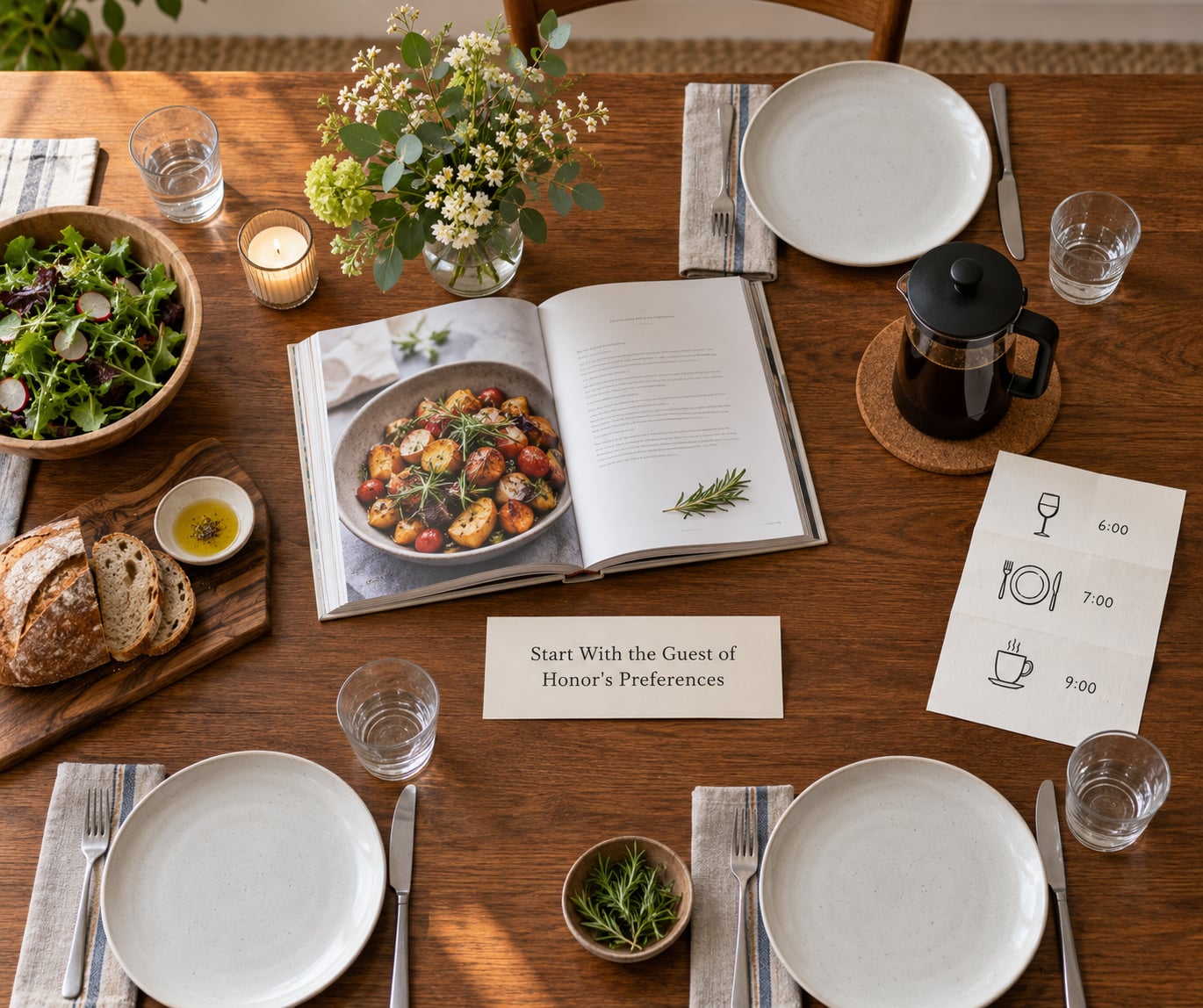
1. Start With the Guest of Honor’s Preferences
Ask before you assume. The most useful conversation is a specific one, not a vague “what do you want to do,” which gets you a polite shrug.
Try questions like: which activities would you genuinely drive an hour for, and which would you skip; do you want a night out, a weekend, or a trip; how do you feel about alcohol at the event; is there a theme you hate; are there foods you avoid; do you need to be home early for anything; and what did you enjoy most about the last celebration you went to?
The last question does more work than it looks. People describe parties they loved in detail, and the details tell you the format. Somebody who talks warmly about a long dinner with a few close friends is telling you the fifteen-person nightclub format will not land.
Then have the harder conversation with his partner, ideally all three of you in one place. The recurring question in wedding forums is not whether the party is fun, it is whether a strip club visit, lap dances, or anything that reads as flirting crosses a line that exists between the couple. Ask directly what is off the table, say plainly what you have in mind, and let the answer shape the plan rather than being negotiated on the night.
Keep the answers in the shared document. Planners report that groups who ask the guest of honor directly, sometimes with his partner in the room, end up with a better evening than groups attempting a big surprise, because the surprise is usually a version of what he already told people he would enjoy.
How to tell it worked: you can write one sentence describing the format without hedging. “Saturday afternoon cook class, dinner, then his friend’s bar” is a sentence. “Something fun but not too crazy” is not.
2. Set the Date, Location, and Guest List Together
Pick dates first, then check them against the handful of people who must be there. A date poll that includes thirty people gets answered by four and leaves you booking on hope.
Ask the key attendees for their non-negotiables in one message: a list of two or three weekends that work for them, and whether they can stay overnight. Then choose. Trying to find a date that suits everyone produces a party half the size of the one you planned for, which is the worst of both outcomes.
Decide local or destination before you book anything. A destination weekend works when the group shares an interest, has similar time off, and can absorb weather risk. It fails when the group is wide-ranging in age or fitness, when children are involved, or when the trip costs more than the per-person ceiling. For a mixed group, an overnight two hours from home is usually the sweet spot.
As names come in, sort them into three buckets: definite, maybe, and polite-invites-who-will-decline. Build the booking around the first two. Also flag anyone who needs step-free access, reserved parking, or a lift, because that is a conversation with a venue, not something to solve on the day.
How to tell it worked: you have a date, a format and a headcount range you would be happy to be stuck with.
3. Build a Balanced Activity Plan
The best plans have one anchor activity, one or two supporting options, and a decent stretch of unplanned time. Five scheduled activities is how you end up with a group that spends the afternoon waiting and the evening in a taxi.
Match the format to how the group actually behaves on a weekend.
| Group type | Best activity format | Watch out for |
|---|---|---|
| Mostly active, outdoorsy | One physical anchor such as a round of golf, a hike with a lunch stop, claybird shooting or a multi-level ropes course | Book a slower fallback for anyone with a knee, a back or a new baby |
| Mixed fitness levels | Small teams, seated options, or a cooking class where everyone works at their own pace | Anything where a slow team holds up a fast team |
| Non-drinking or mixed-drinking group | Long dinner, food-focused activities, a daytime anchor, then a bar segment for those who want it | A venue that is only fun if you drink heavily |
| Tight budget, under ten people | Cook at a house, play a tournament, run a home bar quiz, take a long walk somewhere scenic | Splitting a rental car costs more than it saves at small numbers |
| Wide age range | Something with a skill component rather than volume, like a cooking class, golf, or a whisky or wine tasting | Late-night formats that lose half the room by midnight |
| Groom who hates nightlife | Early start and early finish, good food, one memorable evening item | Booking a bar because it is the default answer |
Leave one genuine surprise in the plan, and make it something he will like rather than something he will have to endure. A framed photo, a cake from a place he mentioned once, a printed ticket from an event he loved as a kid. Pranks he has not agreed to are a different category, and they are the reason some guests stop coming to these.
Send the activity plan as a short vote with two or three options rather than an open question. People answer a menu and ignore a paragraph.
How to tell it worked: when you read the plan aloud to a friend, it sounds like a weekend rather than a schedule.
4. Create a Realistic Budget and Payment Plan
Decide how the money is collected before you book, because that conversation gets harder once people are committed. The usual convention is that the guest of honor does not pay, and his share is divided among the other attendees. Many groups now split everything evenly instead, which is simpler and works well when the guest of honor is paying for most of the wedding.
Whatever you choose, say it out loud in the invitation and again in the payment request. Groups that use one shared payment method for the whole event avoid the awkwardness of six separate restaurant bills and split fairly.
Split the total into these categories and set a share for each.
| Budget category | Share of total | Notes |
|---|---|---|
| Venue or accommodation | 30 to 40% | The largest line, and the one with the strictest cancellation terms |
| Food and drink | 25 to 35% | Book for final headcount plus about 10% for walk-ins and seconds |
| Transport and travel | 10 to 15% | Van rental, fuel, parking, and a ride-share budget for the night |
| Activities | 10 to 15% | One anchor activity usually consumes most of this |
| Decorations, favours and keepsakes | 5% | The cheapest way to make an ordinary evening feel deliberate |
| Contingency | 10% | Non-negotiable. Covers a broken boiler, a rained-out activity, or a late cab home |
Tell guests the per-person figure before they commit rather than after. Someone who learns the number on the way to the venue feels ambushed, and that feeling spreads through the group faster than any bad activity.
If money is tight, cut in this order: decorations, travel distance, and the length of the night. Never cut the ride plan, the food, or the anchor activity, because those three are what people actually remember.
How to tell it worked: every guest knows the number, knows when it is due, and knows what happens if plans change.
5. Send Clear Invitations and Logistics
Send one message that works on its own, and send it early. Group-chat threads bury details and nobody rereads them the morning of.
Include the date, the location with an address or map link, start and end times, a dress note, how to get there and where to park, what each person owes and how to pay, the RSVP deadline, a contact for questions, and what happens if the weather turns.
Something in this shape works well:
“Saturday 11 May, meet at 6pm sharp at the Rosewood on Ardmore, 14 Bridge Street. We’re cooking at 7, so eat beforehand. Parking is free behind the building and the number 6 bus stops outside. Total per person is set, payable by the 20th through the shared link. Let me know by the 10th if you are coming, plus any food restrictions or access needs. Dress is smart casual, nothing fancy. Out is at 1am, rides back are covered. Questions to me on this thread.”
Ask for dietary restrictions, access needs and whether anyone is bringing a plus-one in the same message. Three separate requests get three partial answers; one request gets you a complete list. Set a hard RSVP deadline around two weeks out, because bookings with cancellation terms need real numbers.
Add a weather line whenever anything happens outside. People who know the plan has a rain version show up far more relaxed.
How to tell it worked: you can send the message to a guest who has never met you and they will know exactly what is happening.
6. Assign Roles and Confirm Every Detail
Divide the work into named jobs with named owners. The single most common failure in the research is one person carrying everything and burning out before the day arrives.
- Bookings owns venue, food and transport confirmations.
- Money owns the payment link, tracking who has paid, and the contingency fund.
- Logistics owns parking, rides, the run sheet, and the plan for anyone arriving separately.
- Supplies owns anything bought on the day, plus the cake, decorations and favours.
- Photographs owns a phone and a plan for collecting and sharing pictures afterwards.
- Cleanup owns the end state of the venue and whether anyone is getting paid out for overtime.
Confirm everything 72 hours before. Re-check reservation names and times, the number of guests with the venue, the final headcount with the restaurant, the ride arrangement, and the payment status of anyone who has not settled up. This is also when you confirm a backup plan for the anchor activity, which matters more outdoors than anywhere else.
Ask the venue what happens if you run over, and pay for it in advance where you can. A room charge you did not anticipate is the most common way a planned budget breaks.
How to tell it worked: every booking has a confirmation number saved in the shared document, and every guest has paid or told you they cannot.
7. Run the Party Without Micromanaging It
Your job on the day is to hold the shape of the evening and stay out of the way. Write a run sheet with times, the person responsible, and a buffer between blocks.
A typical one: 4pm arrivals and check-in, 5pm anchor activity begins, 7pm food, 8.30pm free time, 9.30pm second activity, midnight last drinks or dessert, 1am departures. A 30-minute gap between blocks is what stops a group from spending half the evening in transit.
Name a point person for the day, and a second person who is explicitly not the organiser. When the cake arrives wrong or a guest needs a lift, someone has to handle it, and the point person is the only person who should not be dealing with it.
Keep the itinerary loose after the first block. Late arrivals, early leavers and a group that wants to stay out longer are all normal. Move the anchor activity only if the weather or the venue forces it, not because someone is 20 minutes behind.
Have the ride plan written down and shared before anyone leaves the venue, not announced casually at the door. Budget a ride-share allowance in advance so nobody has to decide in the moment whether to spend their own money on getting home.
Afterwards, send one message asking how people got home safely, share the photos in a group everyone can access, and thank anyone who drove, cooked, cleaned or covered a cost. Settle any leftover money promptly. Small follow-through is what gets you invited to the next one.
How to tell it worked: the evening ran itself, nobody was pulled aside to solve a problem, and everybody got home.
Common Mistakes
These are the failures that come up again and again, each with a fix that costs nothing but a bit of planning time.
Planning for a generic crowd
The plan sounds good but suits nobody specifically. Fix it by writing one line per guest about what they actually enjoy, then checking that your activity list has something for at least one thing each person cares about.
Booking before the key people confirm
You book a table or a house for twelve and six can come. Fix it by confirming your five key attendees, and paying a deposit you can absorb, before you commit to a non-refundable booking.
Overscheduling the day
Five activities in eight hours leaves everyone tired and slightly resentful. Fix it by keeping one anchor, one optional extra, and at least two hours of unstructured time. Free time is what turns a schedule into a celebration.
Ignoring dietary, access and transport needs
These get discovered on the day, when they are most awkward. Fix it by collecting all three in the RSVP, then passing them to the venue in writing a week ahead.
Letting the budget drift
Small upgrades compound until nobody is happy with the number. Fix it with the ten percent contingency and a rule that spending above it requires a group message, not a judgement call on the night.
Relying on one person for everything
The organiser ends up hosting instead of attending. Fix it by assigning the six roles above, and by accepting help early rather than after you are overwhelmed.
Having no backup plan
Rain, a closed venue, or a group that finishes a meal early and the night stalls. Fix it by naming the backup activity in advance, deciding who makes the call, and keeping a phone charged with the alternatives to hand.
Two habits cover most of this. Get the guest of honor’s answers in writing early, and put every detail in one shared place that the whole group can see. Everything else on this list is downstream of those two things.
Frequently Asked Questions
What is a good number of activities for a bachelor party?
Two is usually right: one anchor activity everyone does together, plus one optional extra. Add a third only if there is a genuine gap in the day, such as a long afternoon with nothing to do. Five or more activities is where groups tire out. Leave generous gaps of at least 30 minutes between blocks so people are not spending the evening in transit.
How do you plan a bachelor party on a budget?
Set the per-person ceiling first and protect three things: food, the ride plan, and one good anchor activity. Cut decorations, travel distance and length of night before anything else. Cooking at a house, playing a home tournament or running a quiz costs almost nothing and works better with mixed groups. Keep the 10% contingency, and tell guests the figure before they commit.
What if not everyone knows the guest of honor well?
Ask him directly. Twenty minutes of specific questions about what he enjoys, what he avoids and how he feels about alcohol gives you more than any amount of guessing. Where a guest knows nothing about him, assign them a role rather than leaving them to improvise. A short list of two or three options for the group vote also keeps uninvolved guests from feeling left out.
Should you plan a surprise bachelor party?
Usually keep the format and the date known and surprise him with a detail, such as a cake, a framed photo or a printed ticket from something he loved. Full surprises mean guessing his comfort level with alcohol, with activities and with money, which is where most of them go wrong. Planners consistently report better results when the guest of honor has a say in the format.
How do you include guests who do not drink alcohol?
Lead with activities and food rather than bars. A cooking class, golf, a quiz night or a long afternoon somewhere scenic works for everyone and needs no alcohol to succeed. If part of the evening is bar-based, make it one block rather than the whole night so nobody is standing outside for four hours. Never book a venue that is only fun if you drink heavily.
How far in advance should you plan a bachelor party?
Start three to four months ahead for anything involving travel or accommodation, and six to eight weeks for a local party. Under six weeks works if you keep it simple, because venue availability gets tight around holiday weekends. Whatever the lead time, send the details with a firm RSVP deadline at least two weeks before, so you have real numbers for bookings.
Conclusion
Start with three things this week: have the conversation with the guest of honor and his partner, agree a per-person ceiling with your key attendees, and put two or three possible dates in front of them. Everything after that is logistics.
The method to plan a bachelor party everyone enjoys is not more activities or a bigger budget. It is knowing who is in the room, matching the format to what those people enjoy, leaving room for free time, and holding everyone to one shared highlight. Get those right and the evening works even when something small goes wrong, which it always does.