To save money on a big purchase, decide the all-in cost first, subtract it from what you actually have, then divide the gap by the number of weeks until you want the thing. Move that amount out of every paycheck automatically before you spend anything, and buy only when the fund is full.
The hard part is not the arithmetic. It is holding the number steady while prices drift, a deadline gets invented, and a friend buys the same thing first. A written plan survives that better than good intentions do.
Table of Contents
- 1What You Need to Save Money on a Big Purchase
- 2Step-by-Step: How to Save Money on a Big Purchase
- 3Set a Total-Cost Budget
- 4Research Before You Shop
- 5Compare the Total Price, Not Just the Sticker Price
- 6Look for Incentives and Price Drops
- 7Negotiate or Ask for a Better Deal
- 8Make the Final Decision With a Checklist
- 9Common Mistakes
- 10Frequently Asked Questions
- 11Is it cheaper to pay cash or finance a big purchase?
- 12When is the best time of year to make a big purchase?
- 13Do coupons and cash-back offers actually save money?
- 14How do I check a price history before buying something expensive?
- 15Is a sale ever a genuine deal or just marketing?
- 16Is buying used or refurbished worth it for a big purchase?
- 17Conclusion
What You Need to Save Money on a Big Purchase
Most overspending on large items starts before the shopping begins, when nobody wrote down what the purchase actually costs. Get these five things sorted first.
- An all-in number. Sticker price plus tax, delivery, installation, accessories, financing charges and the running costs nobody mentions until after you own it.
- A short list of features you will genuinely use. Three items, written down. Anything else is a want.
- At least three real quotes for the same specification, from different sellers, in writing.
- A written spending limit for the month. A number on paper, not a feeling at the till.
- A date you are willing to wait for. Rushed purchases cost more, and the saving usually does not.
If you are saving while carrying a credit card or loan balance, note the rate on it now. That number decides whether your monthly payment is going toward the purchase or toward interest.
Step-by-Step: How to Save Money on a Big Purchase
Set a Total-Cost Budget
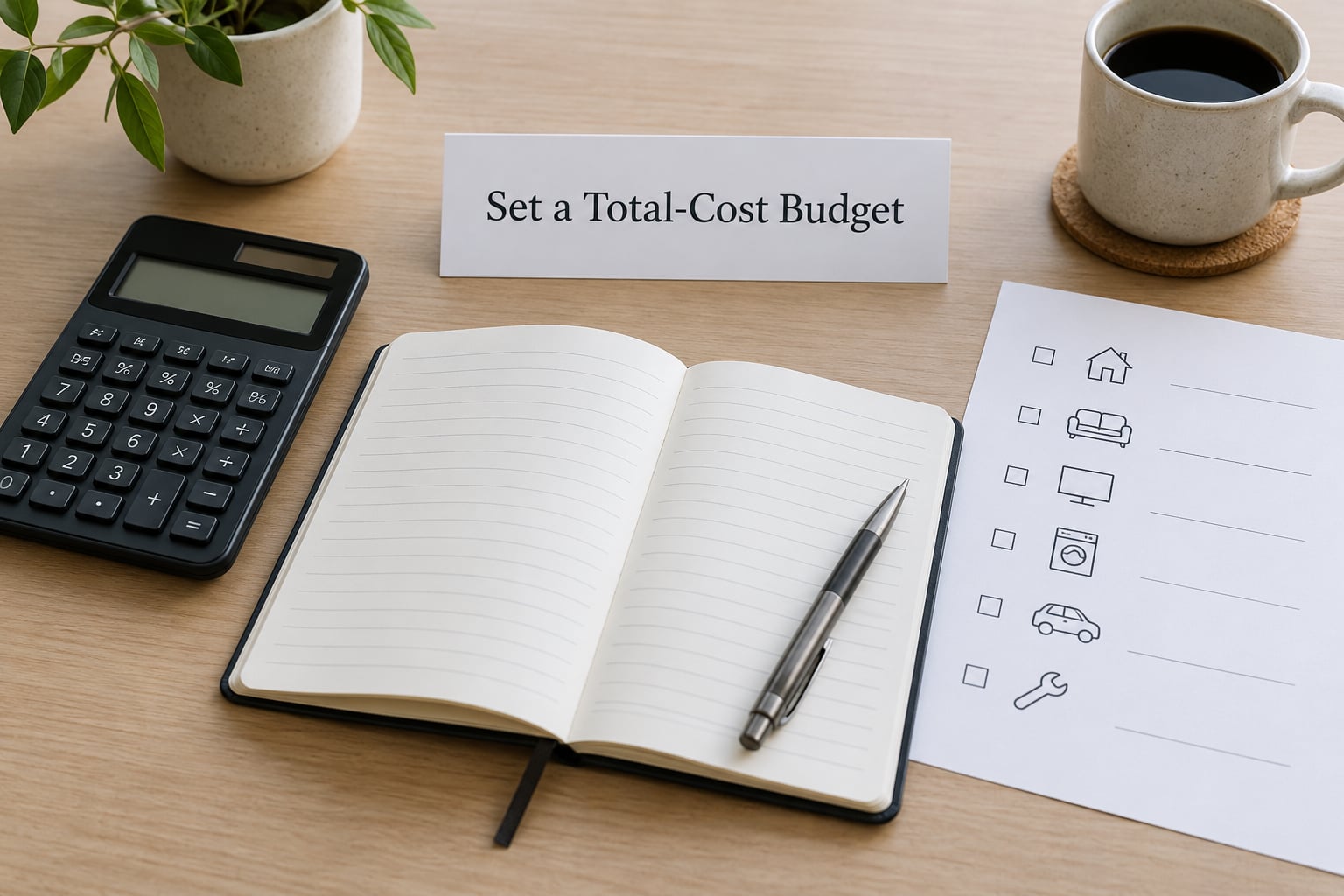
Write down the total you will actually pay, not the number on the advert. A car is the obvious case: the price on the forecourt is not what leaves your account over five years.
| Cost to include | What people forget |
|---|---|
| Sales or VAT | Added at the till, not in the headline |
| Delivery and installation | Distance, stairs, removal of the old unit |
| Registration, plates, permits | A one-off the seller passes on |
| Insurance | Runs for the whole ownership period, not the purchase |
| Fuel, electricity or consumables | Cheap per week, heavy per year |
| Maintenance and repairs | Budget roughly 1 to 3 percent of value a year for vehicles |
| Financing interest and fees | Add it before you sign, not after |
| Accessories you will need | Cables, adapters, cases, wall mounting |
| Less resale value | Depreciation is a real annual cost, not a bonus later |
Then subtract what you already hold. The gap is your real target, and it is usually smaller and more reachable than the price tag suggests.
Research Before You Shop
Write the three must-have features from the previous step and check every candidate against them. Read independent reviews written by people who owned the item for a year, not the first-week impressions on the sales page.
Look up reliability ratings and recall history for the model, then read the warranty terms properly: length, what it covers, whether labour is included, and whether transferring it to a new owner is allowed. A cheaper unit with no parts availability can cost more in year three than the price gap saved in year one.
Then set the date. Retailers discount at predictable moments, and there is no penalty for waiting out a price drop window unless the item is genuinely time-limited.
Compare the Total Price, Not Just the Sticker Price
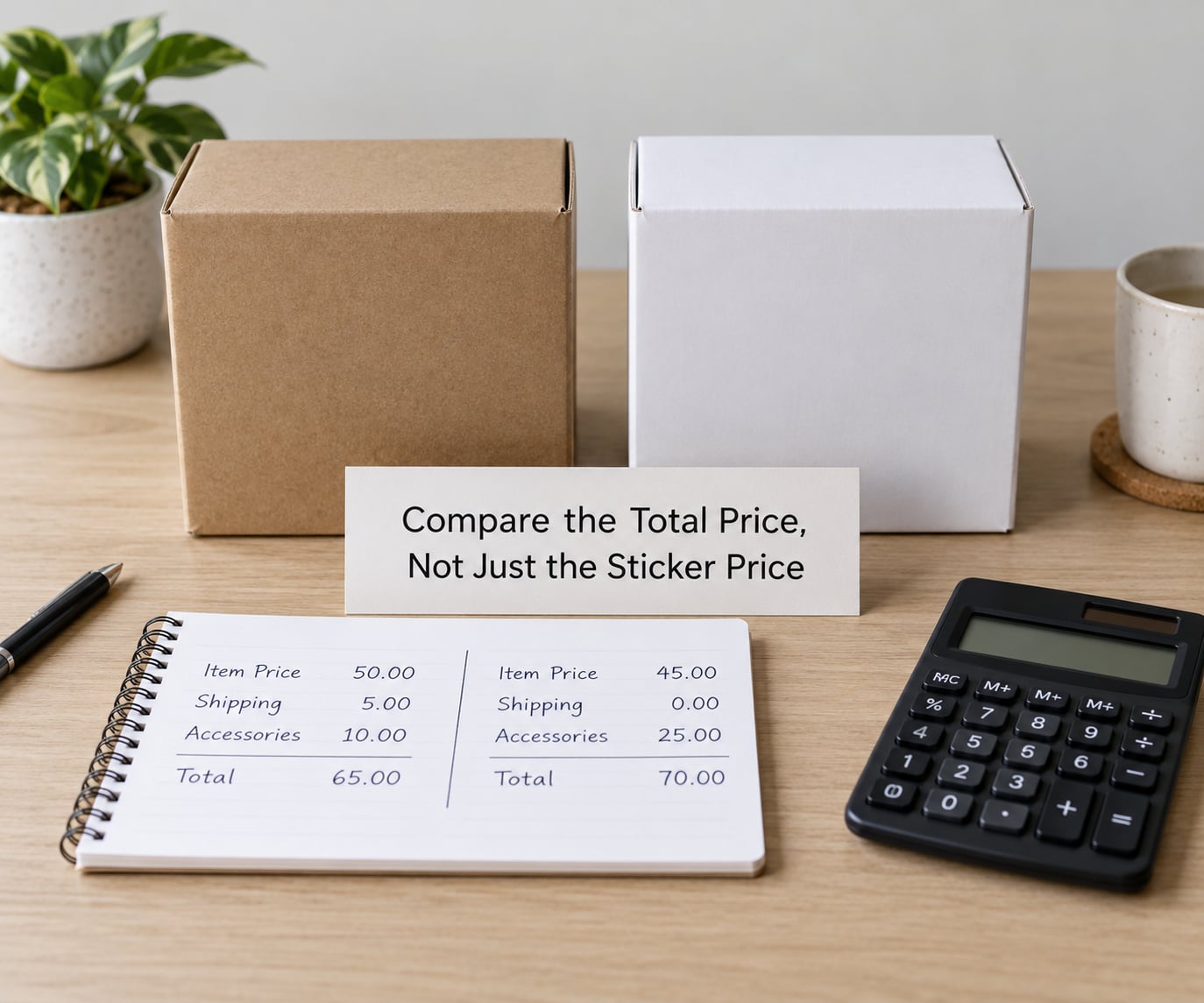
Compare like with like. A basic and a premium version of the same product are not comparable until you know exactly which specification you are paying for. Line up the features side by side on paper and mark the ones that change the price.
Divide the gap between your savings and your target by the weeks remaining. This is the whole mechanism, and most people skip it because the number looks uncomfortable. Run it anyway.
| Target amount | Timeframe | Monthly saving | Weekly saving |
|---|---|---|---|
| 5,000 | 6 months | 834 | 193 |
| 5,000 | 12 months | 417 | 96 |
| 5,000 | 24 months | 208 | 48 |
| 15,000 | 6 months | 2,500 | 577 |
| 15,000 | 12 months | 1,250 | 288 |
| 15,000 | 24 months | 625 | 144 |
| 30,000 | 6 months | 5,000 | 1,154 |
| 30,000 | 12 months | 2,500 | 577 |
| 30,000 | 24 months | 1,250 | 288 |
Small amounts in many rows of a spreadsheet survive contact with real life. One large monthly figure rarely does, because one missed payment resets the whole timeline.
Look for Incentives and Price Drops
Stack what you are entitled to, in this order: manufacturer rebates, seasonal promotions, coupon codes, and card or bank cash back. Apply a coupon last, since some retailers refuse to honour both.
Student, military, first-time buyer and employer programmes cut the price further and are widely missed. Check eligibility before you assume you qualify, and note the expiry date on every offer, because unclaimed rebates are the most common way people lose money on an otherwise good deal.
Track the price for a few weeks before committing. If it drops steadily, the discount is real. If the same price appears everywhere, including the manufacturer, you are looking at a marketing number rather than a reduced one.
Negotiate or Ask for a Better Deal
Negotiation is reasonable where the price is high, the margin is wide, and the seller wants the sale: vehicles, furniture, electronics installed for you, home improvements, and any local service with labour in the price. It is not worth the effort on a 40 dollar accessory.
Be polite, be concrete, and go in cash-ready. Something like: “I am ready to pay today and I have three quotes at this level. What can you do to meet me closer to it?” Ask about a price match, a bundle discount, free delivery, or a better warranty rather than only a lower number. A free add-on often costs the seller less than a discount costs you in future value.
Buy the item you negotiated for. Trading a negotiated discount for an upgraded model is how people leave with a better product than the one they priced.
Make the Final Decision With a Checklist
Run these before you pay: the fund covers the all-in figure, all three must-have features are present, the warranty length suits how long you will keep it, the return policy gives you time to live with it, delivery timing works for your space, and nobody is applying time pressure you created yourself.
How you pay is the last real decision, and it carries a cost most people never calculate.
| Method | What it costs | Watch for |
|---|---|---|
| Cash from savings | Nothing, and you keep negotiating leverage | Money sitting in a weak account earning almost nothing |
| Credit card, 0 percent introductory APR | Usually a fee if you miss the window | The promo ends on a fixed date, and the rate after is high |
| Installment loan | A fixed rate over a fixed term | Origination fees and an early payoff penalty |
| Buy now pay later | Interest often accrues from the purchase date | Multiple active plans, and a missed payment downgrades the next one |
Rule of thumb: if the promotional rate is 0 percent and you can clear it before the window closes, financing costs nothing. Otherwise, saving and paying cash wins, provided the amount you need is within reach of a fixed deadline.
Common Mistakes
- Believing a deadline. A countdown that resets when you refresh the page is not a deadline. Genuine scarcity does not need a timer.
- Comparing different sizes or specs. Checking prices across a base model and a top-spec version tells you nothing.
- Ignoring the return policy. A long policy is worth real money on a large item you cannot test properly in a shop.
- Signing without reading the total. Look at the full amount repayable and the annual rate, not the monthly figure.
- Over-buying features. The upgrade that looks persuasive in the showroom rarely gets used, and it is what you trade away when negotiating.
- Raiding the fund for something temporary. One emergency withdrawal usually restarts the timeline from zero.
- Letting the target move. If the price rises 3 percent a year, either add to the monthly amount or push the date. Decide which, in writing.
Frequently Asked Questions
Is it cheaper to pay cash or finance a big purchase?
Usually, yes. Paying from savings costs nothing beyond what your money earns elsewhere, while financing costs the full interest amount over the term. The exception is a genuine 0 percent promotional rate that you clear before it ends, which makes card financing effectively free. Compare the loan’s annual rate against what your savings earn and the value of keeping the cash.
When is the best time of year to make a big purchase?
Most categories discount at predictable moments: late summer and early autumn for vehicles, November for electronics, and the shoulder season for travel. Mattresses, furniture and appliances are marked down when the season turns. Price tracking over a few weeks tells you whether a sale is genuine. Buy off-cycle and you can often negotiate rather than wait.
Do coupons and cash-back offers actually save money?
They do, in small numbers, provided you were buying the item anyway. A 2 percent cash-back rate beats a coupon that makes you buy something you did not need. The catch: many coupons are excluded from sale prices, and rebates must be claimed within a window. Apply a coupon last, check the fine print, and never let a discount pull you forward into a purchase you had not planned.
How do I check a price history before buying something expensive?
Use a browser price-tracking extension, then check the manufacturer’s own site and a couple of large retailers. You want to see whether the current price has been steady or is genuinely reduced. A price that has fallen repeatedly means the discount is real. One that sits at the same figure everywhere, including the manufacturer, is a marketing price with no reduction behind it.
Is a sale ever a genuine deal or just marketing?
Both, and the difference is measurable. A genuine reduction shows a lower price than the item’s recent history, not just a higher crossed-out figure. Crossed-out prices are often inflated before the sale to make the discount look larger. Check what the item sold for over the previous three months. A 15 percent drop from a stable price is a deal; 40 percent off an inflated one is not.
Is buying used or refurbished worth it for a big purchase?
For vehicles, furniture, tools and appliances it usually is, provided you check condition and warranty terms first. Depreciation does the heavy lifting: a one-year-old item has already lost the steepest part of its curve. Avoid it for items with poor resale value, unknown service history, or where a failure costs more than the discount saved.
One note before you start: rates, tax treatment and consumer rules differ by country and state, and they change. Treat the figures here as a method rather than advice for your situation.
Conclusion
Start with the all-in number, not the advertised price. Subtract what you already have, divide the gap by the weeks remaining, and move that amount automatically before you spend anything else. Research, stack the incentives you genuinely qualify for, negotiate where margin is wide, and buy only when the checklist comes back clean.
Nobody needs this article to be told to spend less. They need one figure that cannot be argued with.