Most reproductions give themselves away in the small stuff, not the big picture. A convincing copy of a 1940s dining chair or a first-year trading card can hold up at arm’s length across a dealer’s table, then fall apart once you measure the joints, count the screw types and look at where the wear sits. Here is the short version of how to tell if a collectible is a reproduction: check the materials, the construction, the wear pattern and the paperwork, in that order.
Budget about fifteen quiet minutes for a single piece, more if you own a small collection. You do not need expensive equipment, and you do not need to be an expert in the category. You need a method that produces a verdict you can write down.
In short:
- An item made from materials that did not exist when it is said to have been made is a reproduction, full stop.
- Genuine age shows up as wear concentrated where hands, cloth and gravity actually touch, not evenly across every surface.
- Machine-perfect joinery, dead-uniform distressing or an oddly weightless piece all point the same direction.
- Marks and serials can be checked against dated photographs of documented originals from the same maker and run.
- Seller behaviour carries as much weight as the object. Walk away from anyone who cannot answer a simple question about where it came from.
- A price far below the market for that category, with no explanation, is itself evidence of something.
Table of Contents
- 1What You Need
- 2Step-by-Step
- 31. Examine the overall shape and finish
- 42. Inspect the materials and manufacturing details
- 53. Look for maker marks and reference numbers
- 64. Check the underside, back, and hidden areas
- 75. Compare it with documented originals
- 86. Review provenance and seller information
- 97. Use targeted tests without damaging the item
- 108. Get a second opinion before paying premium prices
- 11Common Mistakes
- 12Frequently Asked Questions
- 13What evidence actually proves a collectible is genuine?
- 14Can reproductions be valuable to collectors?
- 15How should I judge an online listing before buying?
- 16Which collectibles are hardest to authenticate?
- 17Can an expert tell if something is a reproduction from photos?
What You Need
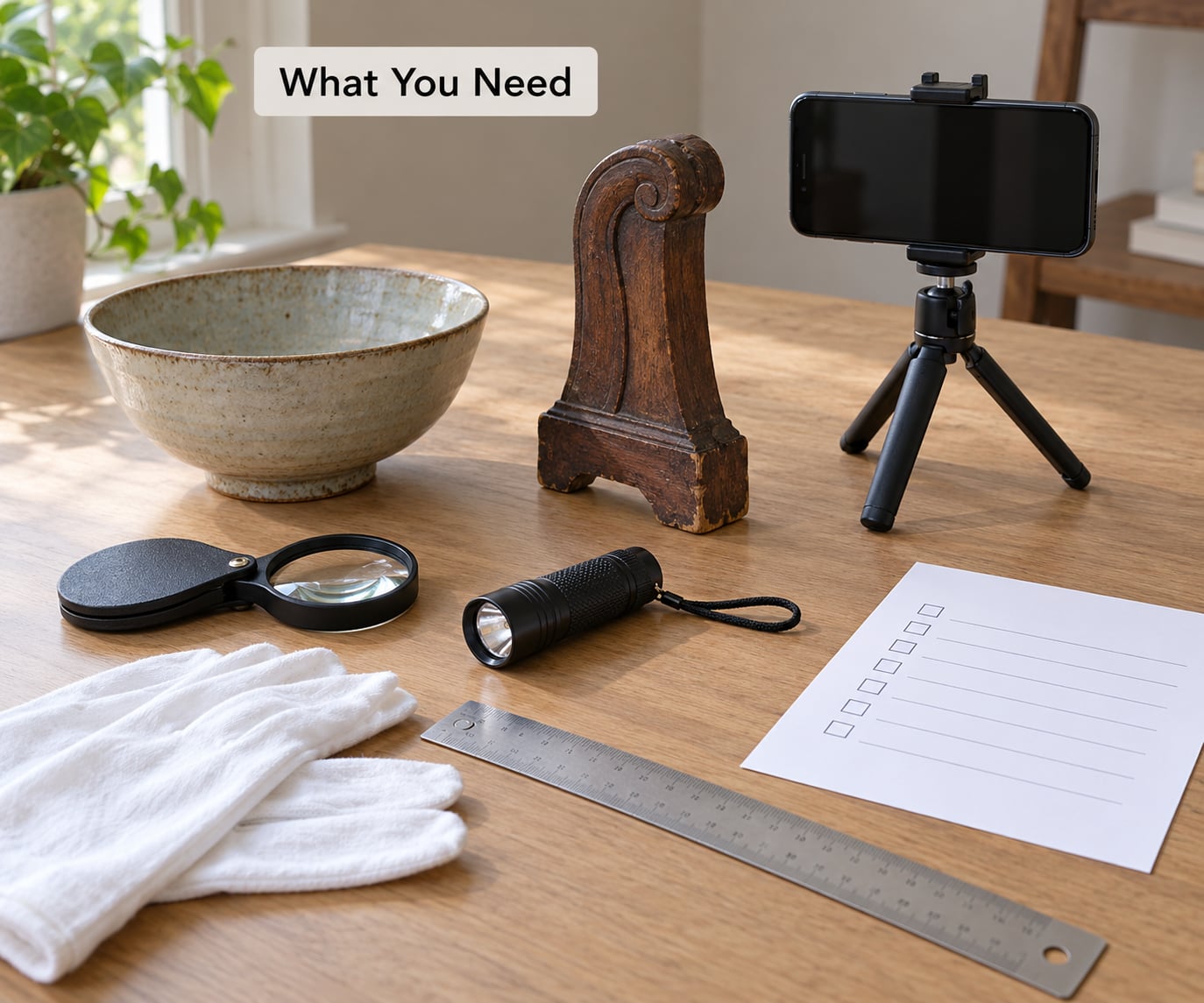
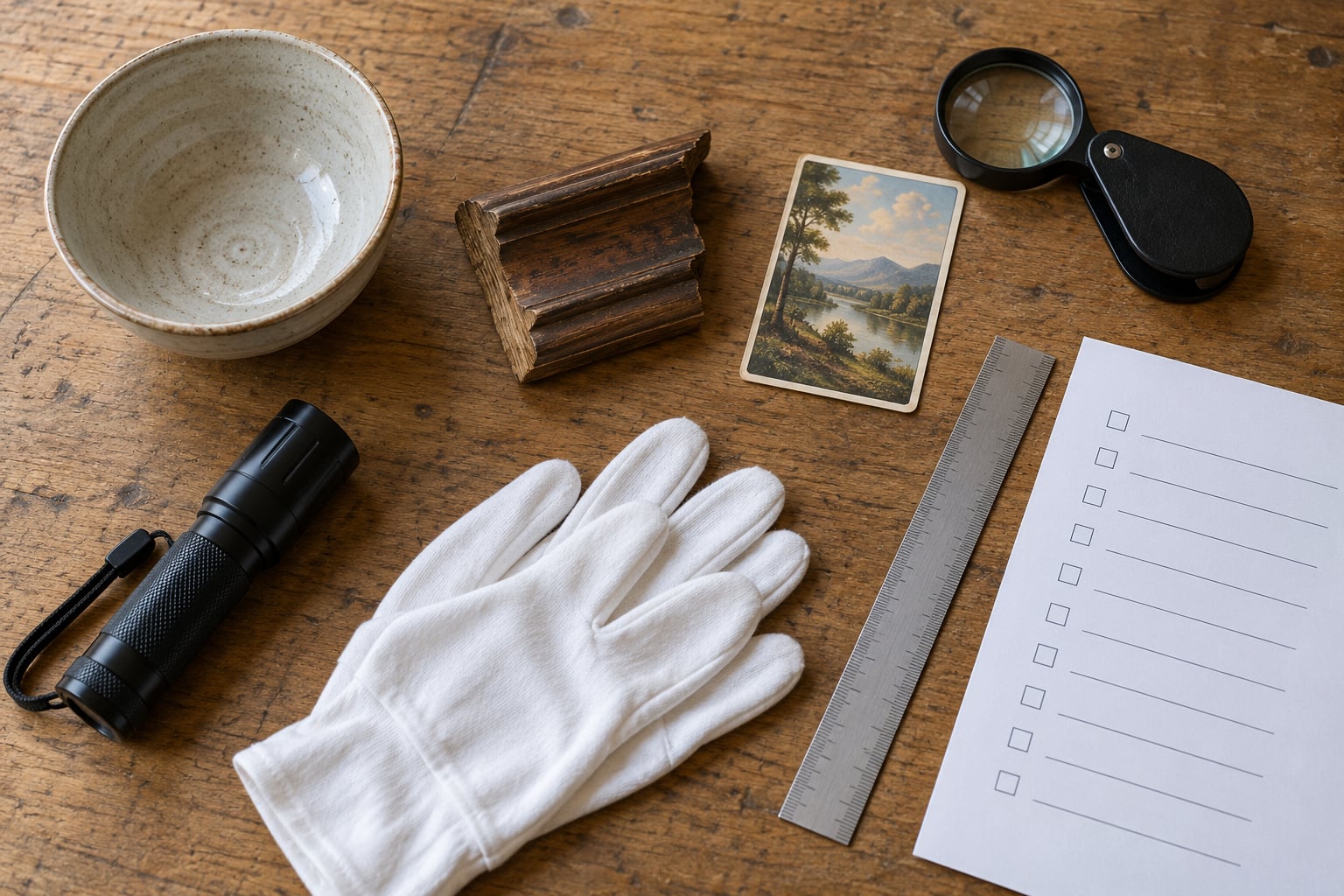
A bright, indirect light source and a 10x loupe do most of the work. Everything else supports those two. Assemble your kit before you go shopping, because the inspection happens in the ten minutes before you pay, not later at home.
- Bright light. A window, a daylight lamp, or a flashlight angled low across the surface so texture and tool marks cast shadows.
- Magnification. A folding loupe or a jeweller’s loupe at 10x. Beyond about 10x you get blur and heat instead of detail.
- A UV torch. Cheap and useful on paper, labels, plastics and modern adhesives.
- A steel rule or calipers. For plate thickness, card dimensions, joint spacing and anything sold as a specific size.
- Cotton or nitrile gloves. For anything you plan to handle closely, and to keep oils off the surface while you inspect.
- A smartphone camera. For your own reference shots before you buy, and for asking the seller for more pictures.
- Known-genuine comparison pieces. Even two or three examples in the same category teach you more than any article, including this one.
- A printed checklist. The eight steps below, so you work the same sequence in every shop.
One caution before you start. No single check proves anything. Every one of these clues can be explained away, and several can be faked deliberately. What convinces me is the same thing that convinces experienced collectors: two or three independent failures pointing in the same direction.
Step-by-Step
Here is how to tell if a collectible is a reproduction, worked as eight checks in the order that saves the most time. Work them top to bottom, and stop buying the moment two of them fail hard.
1. Examine the overall shape and finish
Start with proportion, because makers had habits and copies rarely share them. Compare the piece against a photograph of an undisputed example of the same maker, model and period: leg height to seat height, rim thickness to overall width, the spacing of a row of handles.
Then read the finish. Genuine hand-work leaves slight variation between two supposedly identical parts. A chair back panel and its frame were cut days apart by different hands and will differ by fractions. Uniformity is the warning, especially on paint, where a reproduction often shows one exact shade across every face with no fade, no handling gloss and no overspray.
Turn it over and look at seams and joins. Mold seams on glass and ceramics, parting lines on cast metal, and stitching on leather or fabric should sit where the original process would put them, and they should be subtle. A proud ridge or a sanded flat that catches a fingernail means the surface was finished after casting rather than formed once.
What worked: you can name the specific proportion or finish point that differs from documented originals, and it is not a variation that period makers commonly produced.
2. Inspect the materials and manufacturing details
Material is where reproductions run out of room, because the maker had to use something available today. Particle board, MDF, plywood laminates, ABS and polycarbonate plastics, synthetic resins, and post-1950 textile blends did not exist in a piece dated to 1890. Solid wood shows growth rings, checking and grain running continuously across a joint; a laminated panel shows a repeating layer edge and a seam where two sheets meet.
Look at how it was assembled. Hand-cut dovetail or mortise-and-tenon work shows small irregularities in spacing, and the pegs or nails vary. Machine work repeats exact spacing, uses identical machine-made fasteners, and often leaves uniform screw holes with no thread wear. In metalwork, hand-forged hardware has slightly irregular surfaces and forge-scale texture; cast copies are smooth, identical and full of the same casting gate mark.
On paper items, weight and texture matter more than appearance. A genuine vintage card has a specific thickness, a slightly soft fibrous surface and rounded corners from decades of handling. Modern reprints are thinner, brighter, and under a loupe show a regular dot or hex-dot printing pattern with optical brighteners that fluoresce under UV.
What worked: the material or production method you found cannot exist in the claimed period, or the piece is measurably lighter, thinner or more uniform than known examples.
3. Look for maker marks and reference numbers
Find the mark first: a logo, a signature, a stamp, a label, a serial number or an edition number. Then check three things about it, because these are what counterfeiters get wrong most often.
- Placement. Marks live in documented spots. A trademark on a base, a stamp inside a case, a serial on the chassis. A mark in the wrong spot, or on the part a maker never marked, is a problem.
- Style and spelling. Letterforms, spacing, punctuation and even errors are brand-specific. Collectors have built whole checklists around tiny letterforms, like a logo where one letter uses a round dot where the original uses a rectangular one.
- Consistency. A genuine piece’s marks agree with each other and with the documented run. Cloned certification numbers, re-cut labels and re-engraved plates leave mismatched fonts, depths and spacing.
Do this under the loupe with the light raking across the surface, and photograph the mark before you leave. A maker’s mark is usually the fastest single piece of evidence you can gather, because the reference images exist for popular lines and stay free online.
It is worth adding that a missing mark is not proof of anything. Marks get lost to refinishing, wear or restoration, and plenty of genuine folk art and military pieces never had one.
What worked: the mark’s placement, spelling or letterforms disagree with dated photographs of authentic pieces from the same maker.
4. Check the underside, back, and hidden areas
A quick viewing never covers these surfaces, which is exactly why forgers count on them. Flip the piece over and work methodically: underside, back panel, interior, inside a case or lid, fasteners, attachment points, and any battery compartment or access panel.
Look for one consistent manufacturing method. A cabinet with hand-cut dovetails on the front and machine staples or Phillips screws at the back has been assembled in more than one era, and that is a problem no amount of surface patina fixes. Check labels glued inside drawers and dates stamped into hardware. Battery compartments, filled solder joints and modern adhesives in an item claimed to predate them are decisive.
On trading cards, the reverse is where the real evidence sits. Off-centre printing, pock-marking, uneven colour and margin notes along the back edge are all described by collectors as classic tells of a cheap fake, and none of them appear on a genuine card that spent decades in a box. On toys, open a battery pack and look at the screws and wires. On figures, check the mould number on the base or back of the head against known production runs.
What worked: hidden areas show either a fully modern construction or a mix of incompatible methods, and that mix is the tell.
5. Compare it with documented originals
This is the step that settles arguments, and it is also where most buyers skip ahead. Hold the piece against a verified example of the same maker, production period and market, or against dated photographs from auction archives, dealer catalogues and museum collections.
Not every online image is reliable. Buyers have been burned by listing photos lifted from old auction records, so check that the comparison image genuinely shows a sold piece and that it carries a date and provenance. Never authenticate against the seller’s own photos alone, and never against a marketplace listing, because listings reproduce each other’s pictures.
Build your own small reference shelf over time. Three or four pieces you have confirmed become more useful than any checklist, and they let you calibrate your eye for weight, colour and finish. Several collectors on collector forums describe exactly this as the point where their confidence came from: not a rule, but having handled real examples.
What worked: you compared against at least two documented examples, and any differences are either common period variations or genuinely unexplained.
6. Review provenance and seller information
Provenance is the recorded history of ownership and it is difficult to invent well. Old receipts, dated correspondence, service records, photographs of the item in an earlier home, exhibition labels and prior catalogue entries all add weight. A one-line story with no supporting detail adds nothing.
Paperwork deserves its own scepticism. Certificates of authenticity are printed in seconds, and a certificate number that does not resolve on the issuer’s own verification page is worth nothing. Graded cards come with tamper-evident holders, but those can be cracked, re-labelled or paired with a cloned number, so run the number yourself and confirm the label’s font, weight and print pattern against other holders from the same grading service.
Seller behaviour is part of provenance. Ask four questions: where did it come from, when did you acquire it, is it documented, and can I return it if a qualified appraiser disagrees. The answers should be consistent and specific. Vagueness, deflection, pressure to pay before you can inspect, or a refusal to allow a return window all count as evidence. Sellers who disclose reproduction status are not the problem; sellers who list a reproduction as an original are, and that is straightforward fraud rather than a grey area.
What worked: the documentation and the seller’s answers line up with each other and with the object’s actual condition, or the gaps are acknowledged openly.
7. Use targeted tests without damaging the item
A few tests are safe and worth doing. Others are myths or destructive, so know which is which before you start.
- Weight and balance. Compare against a known example. Genuine pieces often feel denser than expected, partly because of accumulated wear, filled joins and aged materials.
- Magnet response. Useful on steel and some plated metal, unhelpful everywhere else. A magnet tells you the metal is steel; it does not date the object.
- Magnification. The highest-value test available to you, and the safest. Casting pits, print dots and tool chatter only show up under magnification.
- UV inspection. Shows modern optical brighteners, fluorescent inks, and synthetic adhesives holding a supposedly pre-industrial object together.
- Movement and battery testing. For clocks and electronic toys, listen and observe rather than opening the case. Fine, even ticking and a smooth beat read better than a stutter.
Skip anything involving scratching, heating, soaking, solvents or chemical stripping. Beyond the risk to the piece, most home tests cannot distinguish a genuine chemical patina from an induced one anyway. If you find yourself reaching for a blade, you have gone past the end of what a beginner should attempt alone.
What worked: the non-destructive tests agree with the claimed material and date, and none of them contradict the physical evidence from earlier checks.
8. Get a second opinion before paying premium prices
Appraisal is worth paying for when the item is expensive enough that a mistake hurts, when the category has a documented forgery problem, or when your checks are inconclusive rather than negative. A few hours of an appraiser’s time is cheap against a mistake worth hundreds, and most appraisers will tell you honestly when a piece is not worth pursuing.
Know who to ask. A qualified appraiser who works in your category, a specialist dealer who buys that specific type regularly, the manufacturer’s archive or historical society for that maker, or a recognised collector organisation. Give them the seller’s photographs first, along with your own notes, and ask specific questions rather than “is this real”.
Be suspicious of authentication offered free by the seller. Circular logic, no accountability and no written statement are all reasons to walk. For graded items, use the grading service’s own verification and a third-party holder check before completing a purchase.
What worked: an independent expert confirms the item in writing, or you accept the ambiguity and pass on the piece.
Common Mistakes
Treating age as proof. A seller telling you something is from 1890 means nothing about whether it was made last month. Ask what in the object supports the date, then check whether the answer survives step two.
Judging from online photographs. Cropped, filtered, re-used and flat-lit images hide more than they show. A genuine piece photographed badly looks fake, and a reproduction photographed well looks real. Ask for unedited pictures in daylight, plus the back, the underside and the marks.
Believing seller confidence. Sellers often believe their own story because they inherited it from the person who sold it to them. Certainty is not evidence. Track answers that change under follow-up questions.
Expecting perfect condition. Genuine old items carry honest wear, small losses, replaced parts and repairs. A piece sold as untouched and flawless is a reason for more questions, not fewer. Equally, a replacement part does not condemn a piece; it changes value.
Stopping at one cosmetic clue. The single worst habit in this hobby. One odd detail has a dozen innocent explanations. Weight the physical evidence together: materials, construction, wear, marks, documentation.
Before you hand over money, walk through this short list:
- No material on the piece postdates the claimed date.
- Construction is consistent from one end to the other.
- Wear is concentrated in plausible places and uneven in strength.
- Marks match documented originals in placement and letterform.
- Documentation exists or its absence is acknowledged.
- Every certification number checks out on the issuer’s own site.
- The seller answered all four provenance questions consistently.
- A return window exists, and a refund covers a failed third-party authentication.
- You have compared the piece against at least two documented examples.
- You have a second opinion whenever the money involved justifies it.
If two of those fail, the answer is usually no. Walking away from a piece you cannot verify costs you nothing but the search for the next one.
Frequently Asked Questions
What evidence actually proves a collectible is genuine?
No single clue proves authenticity. Genuineness rests on several independent signals agreeing at once: materials that existed in the claimed period, construction consistent with that period’s methods, wear that matches how the object was actually used, marks matching documented originals, and documentation or provenance that holds up under questions. A reproduction usually fails two or three of these at the same time. One odd detail alone proves nothing, which is why experienced collectors weigh the whole picture rather than hunting for a single dead giveaway.
Can reproductions be valuable to collectors?
Yes, and quite often. A high-quality reproduction has appeal as decorative decor, as a usable substitute for a fragile original, and occasionally as a reference piece for people studying the form. What a reproduction is not is an antique. Collectors pay for reproductions at reproduction prices, not original prices, and the market treats a piece as an original only when it genuinely is. Buying one on purpose is perfectly legitimate; paying original prices for one is not.
How should I judge an online listing before buying?
Ask for unedited photographs in daylight showing the front, back, underside and every mark or serial. Cross-check the images against dated auction records, because listing photos are frequently copied from old sales. Look for a consistent story across the description, the photos and the seller’s history, run any certification number on the issuer’s own verification page, and confirm there is a return window. Listing polish tells you nothing; listing specificity tells you a lot.
Which collectibles are hardest to authenticate?
The hardest are categories where value concentrates on a few famous names and the physical item carries little information. Pop culture pieces, modern trading cards, art prints signed by well-known artists, and signature jewellery fall into this group, as do coins with high-value varieties. The reason is simple: a copy of a widely documented object can be checked against documentation, but a copy of something rare may have no reference at all. Difficulty rises further when a piece has been heavily restored.
Can an expert tell if something is a reproduction from photos?
Sometimes, and a good expert is honest about which check a photo cannot support. Sharp close-ups of a mark, a joint, a printing pattern or a surface can settle a question quickly, and several appraisers will give an initial opinion from images before quoting a full inspection. But weight, sound, texture, thickness feel and UV response are all lost in a photograph. For a purchase of real consequence, treat a photo opinion as a screening step and pay for an in-person look before you commit.
If you take one habit from this guide, make it running checks one through three in order, every time, without exception. Materials and construction fail fastest and cost nothing to test, and a hard failure there ends the inspection before you spend money on an appraiser or lose an evening on a piece that was never going to be right.
After that, use your own eyes as much as anyone else’s. Handling known genuine pieces, keeping dated reference photographs, and walking away from anything you cannot verify is how you learn to tell if a collectible is a reproduction faster than any rule printed on a page.