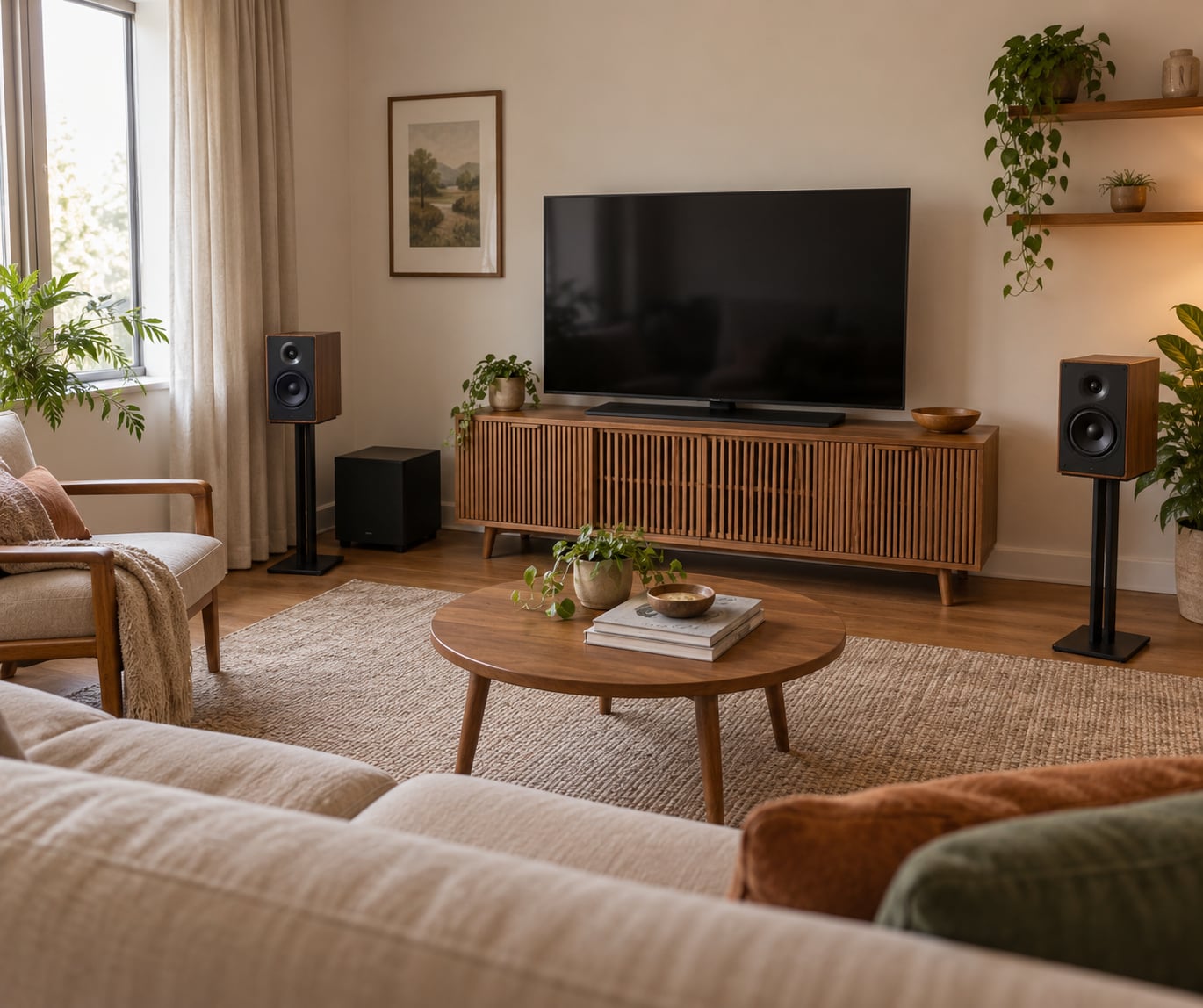
To set up surround sound in a small room, place a 5.1 speaker system so the center channel sits directly under the screen, the front left and right speakers angle 20 to 30 degrees toward your seat, the surrounds sit beside or slightly behind you above ear level, and the subwoofer goes near a front corner. Then wire everything to an AV receiver and run the calibration sweep. Budget an afternoon and nothing more than a tape measure and a pencil.
Small rooms are awkward for one reason: everything is close. Speakers that sit 3 feet from your ears reveal every placement mistake that a 20-foot theater hides. Bass piles up, dialogue disappears under effects, and the soundstage collapses into a point between your head and the sofa.
None of that is a reason to skip surround. It is a reason to be deliberate about layout, speaker size, and cable routing. Here is the process that works when the room, the furniture, or the lease says you cannot build a theater.
Table of Contents
- 1What You Need to Set Up Surround Sound in a Small Room
- 2Step-by-Step
- 3How to Set Up Surround Sound in a Small Room: Measure and Map the Listening Area
- 4How to Set Up Surround Sound in a Small Room: Choose the Right Speaker Layout
- 5How to Set Up Surround Sound in a Small Room: Position the Speakers
- 6How to Set Up Surround Sound in a Small Room: Connect the System Safely
- 7How to Set Up Surround Sound in a Small Room: Set Levels and Calibrate the Sound
- 8How to Set Up Surround Sound in a Small Room: Test and Fine-Tune the Result
- 9Common Mistakes and How to Fix Them
- 10Frequently Asked Questions
- 11Is 5.1 surround sound good for a small room?
- 12Should surround speakers be behind the couch or beside it?
- 13Do I need a subwoofer for a small living room?
- 14Are soundbars better than surround speakers in small rooms?
- 15How do I reduce echoes and boomy bass in a small room?
- 16Can I set up surround sound without running wires through the walls?
- 17Conclusion
What You Need to Set Up Surround Sound in a Small Room
Gather the gear before you start moving furniture. Renting or borrowing the wrong size of speaker is the expensive mistake, because a floorstanding tower in a 10-by-12-foot room eats the space your surrounds need.
- An AV receiver with at least 5 channels, or a soundbar with a wireless surround and wireless subwoofer kit if you cannot run cables.
- Five speakers: front left, center, front right, and two surrounds. Bookshelf or satellite speakers are the right call in a small room.
- A subwoofer if the system supports one, or a wireless sub kit if you rent.
- HDMI cables for the TV to receiver link, plus optical or digital audio as a backup for an older TV or set-top box.
- Speaker wire for any hardwired speakers, a roll of baseboard cable channel, and cable clips.
- A tape measure, a pencil, and graph paper for sketching the layout.
- A phone or laptop for test content, room correction downloads, and the setup microphone that ships with most receivers.
Before ordering anything, measure the room. If the narrowest dimension is under 12 feet, skip floorstanders entirely and buy compact bookshelf speakers on stands or shelves. If you are in a rental, decide now whether you are running cable along baseboards or going wireless, because that choice shapes the whole layout.
Step-by-Step
Work in this order. Each step depends on the one before it, and moving a speaker after calibration means recalibrating.
How to Set Up Surround Sound in a Small Room: Measure and Map the Listening Area
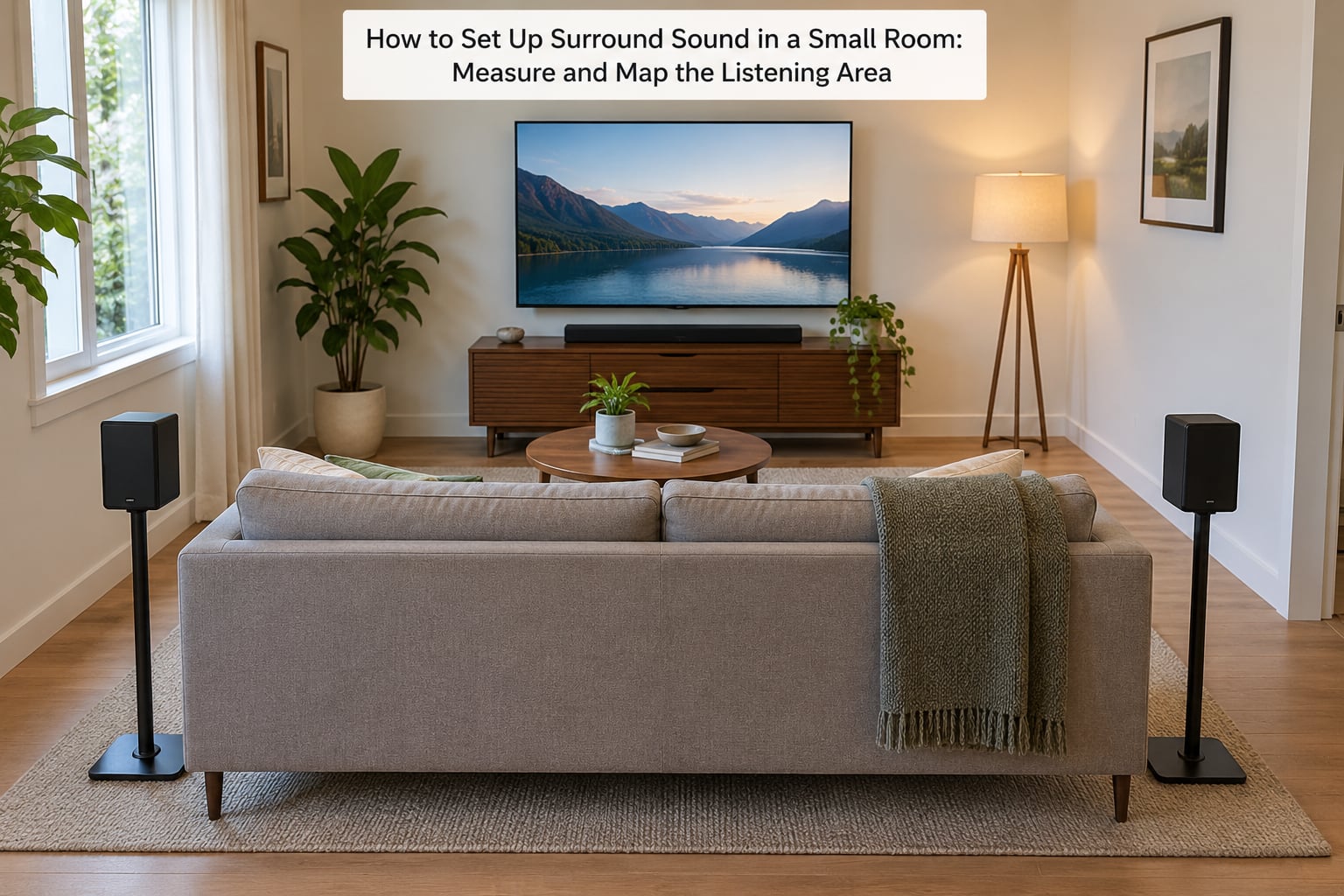
Measure width, depth, and ceiling height, then write down where the sofa sits and how far the screen is from the front row. That distance is your listening distance, and every placement rule that follows is measured from it.
Most people sit about 12 to 16 inches back from the back cushion, so treat that spot, not the wall, as your reference point. If your sofa is pushed flat against the back wall, mark how much depth you can win by pulling it forward. Forum regulars on r/hometheater treat about 12 inches of clearance as the minimum useful gain, and it is usually the difference between behind-the-listener placement and beside-the-listener placement.
Sketch the room to scale before you move anything: screen, sofa, doors, walkways, windows, bookshelves. Speakers cannot sit in a doorway or across a walking path, and finding that out on paper takes five minutes instead of an hour of shuffling.
You know the map is right when every speaker position is at least 10 inches from a wall corner and clear of furniture, with at least 3 feet between each speaker and your ear. That is the goal. Steps four and five cover what to do when the room refuses.
How to Set Up Surround Sound in a Small Room: Choose the Right Speaker Layout
Most small rooms want 5.1 channels and nothing more. Adding rear back speakers to a room where your sofa is 10 inches from the wall mostly adds reflection and cost. Heights are a different story, because overhead effects come from above rather than from behind you.
| Layout | Speakers you need | Small-room fit | Verdict |
|---|---|---|---|
| 5.1 | Front left, center, front right, two surrounds, subwoofer | Works from about 10 by 12 feet up | The default for most small rooms |
| 7.1 | Adds two rear back speakers behind the sofa | Needs real space behind the seat | Skip unless the sofa sits 3 feet off the wall |
| 5.1.2 Atmos | Adds two height speakers above the front pair and surrounds | Works in low ceilings with on-ceiling mounts | Worth it if you already have 5.1 |
| 7.1.2 Atmos | Full bed layer plus four heights | Asks a lot of a small room | Usually over-specified |
| Soundbar with wireless rears | Bar, two wireless surrounds, wireless sub | Best when you cannot run cable | Renter-friendly option |
On the Atmos question, the consensus surfacing on AVS Forum is that four height speakers give the most convincing overhead movement, but two gets you most of the way in a small room. Do not buy a 5.2.4 layout for a 10-by-12-foot space just because the spec sheet lists it.
You have picked correctly when you can point at every speaker and say where it goes without blocking a walkway or a door. If you cannot, the layout is too ambitious for the room.
How to Set Up Surround Sound in a Small Room: Position the Speakers
Start with the center channel. It goes directly below the screen or directly above it, never off to one side, because dialogue is mixed into that channel and a few inches of offset shifts voices away from the face on screen.
Next, the front pair. Place them so the screen and the two speakers form roughly an equilateral triangle with your ears at the top corner. Toe them in toward the listening position until the center image locks to the screen. Start at 20 to 30 degrees of toe-in; more than that in a small room usually narrows the soundstage instead of sharpening it.
The 83% rule is the shortcut people cite when they want a number: in a 12-foot-wide room, place the front speakers about 10 feet apart, or 83% of the width, rather than pushing them to the side walls. It is a starting point, not a law, and it keeps the front stage from sounding stretched thin.
Surrounds belong beside you and slightly behind, or above and behind, at roughly 0.6 to 2.1 meters off the floor and angled at the main listening position. Two things change that plan in a small room. If the sofa is against the back wall, move the surrounds forward to your shoulder line rather than behind your head. If you end up with surrounds closer than about 1 meter to your ears, switch to diffuse bipole or dipole models, because direct-radiating speakers that close collapse into your head.
That dipole-versus-direct-radiating choice is the single most debated decision in small-room setups. On r/hometheater, users in tight spaces argue that speakers aimed straight at the listening position keep effects from smearing, while others prefer dipoles so nothing attaches itself to your ears. My rule of thumb: below 1 meter, diffuse; above that, direct. Either answer works as long as you can explain which one you picked.
For the subwoofer, start in a front corner. Low bass builds up where the room’s width, length, or height is a whole number of half-wavelengths, and corners add the most gain. Since a 40 Hz wave has a wavelength of about 4.3 meters, a room dimension near 5.4 meters lines up with that mode and can produce a deep null right where you sit. Push the sub along the wall a foot or two at a time and listen; you will hear the null fill in as you move.
Placement is finished when dialogue sits at the screen, bass is even rather than one-sided, and nothing sounds like it is coming from inside the cabinet. If a speaker buzzes or booms constantly, move it away from the wall in 6-inch increments rather than reaching for the volume knob.
How to Set Up Surround Sound in a Small Room: Connect the System Safely
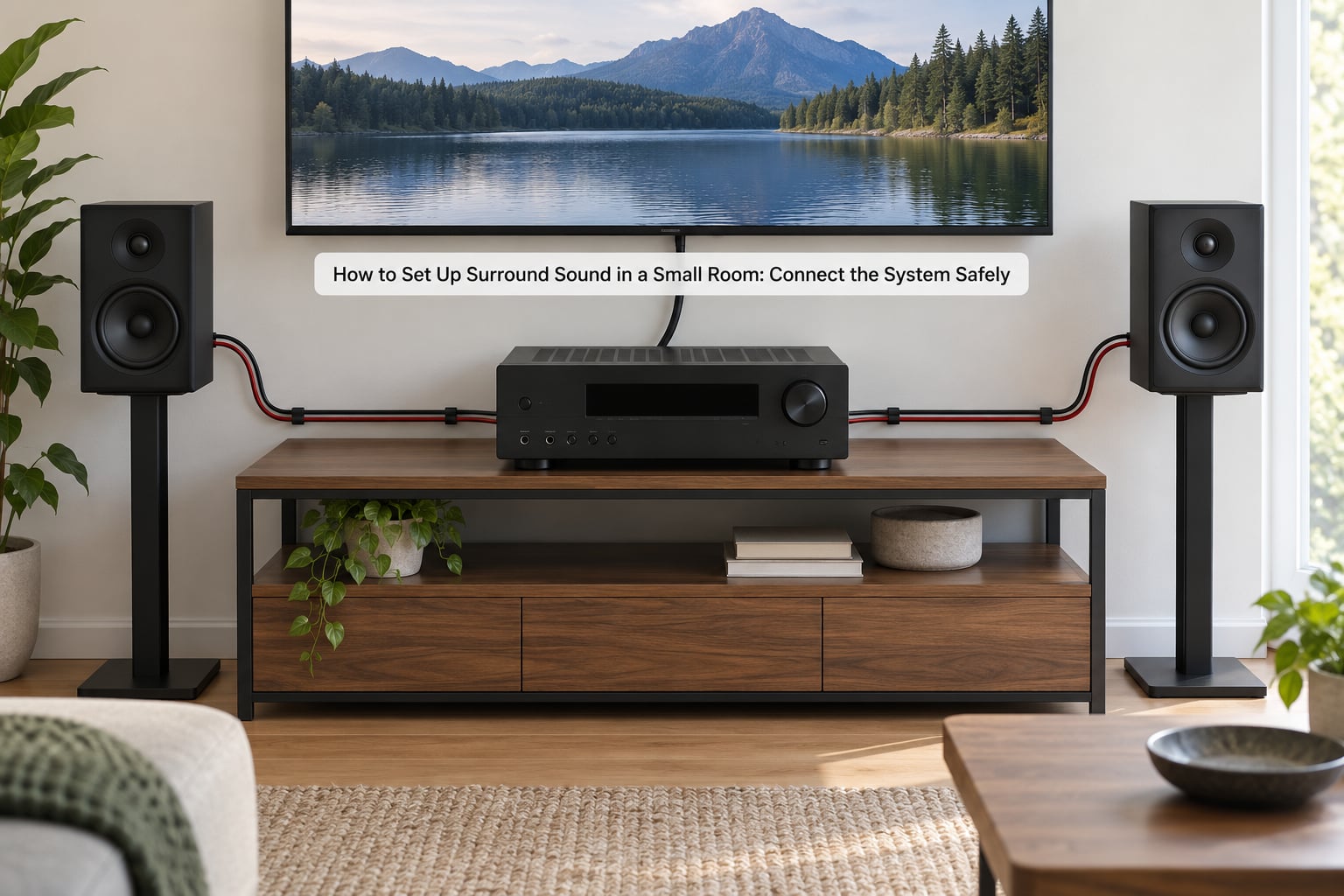
Wire the speakers to the receiver before you power anything on. Match the label under each terminal to the speaker, then match the polarity: positive to positive, negative to negative. Most spring-clip terminals are too stiff for the wire if you strip it bare; leave about half an inch of insulation on so the copper cannot touch the neighboring post and short the channel.
Connect the TV to the receiver with HDMI. If your TV only has HDMI ARC or eARC, plug the receiver into that port and the audio returns over the same cable. Otherwise run an optical or digital audio cable from the TV’s audio out to the receiver’s input. Follow the manual for your specific ports, and never force a connector that does not fit.
Route cables along the baseboard, not across the floor or a walkway. Cable channel with a lid runs along a baseboard cleanly and disappears when the vacuum hits it. For in-wall or in-ceiling runs, that is electrician and drywall work, so hire it and check your lease first. Where drilling is not an option, wireless rear speaker kits or a soundbar-based system are the honest answer, not a workaround.
Keep power cables separate from speaker wire wherever they cross, and leave a hand’s width of slack at both ends so you can reposition a speaker without unplugging the receiver. Nothing is connected until every terminal is tight and the speaker channel matches the physical speaker.
How to Set Up Surround Sound in a Small Room: Set Levels and Calibrate the Sound
Now open the receiver’s setup menu. Assign each channel to the speaker you actually placed, set speaker size to small for anything smaller than about 6.5 inches, and let the receiver handle the bass management. Getting channel assignment wrong is the reason people hear no surround at all.
Enter the real distances for every speaker and the subwoofer. The receiver uses those numbers to delay each channel so sound arrives from all of them at the same moment. Use the 83% rule number only as a starting point here; the measured distance is the one that belongs in the menu.
Set the crossover. 80 Hz works for most small systems, and 120 Hz is the usual ceiling recommended for compact bookshelf speakers so they are not asked to move low bass. If your subwoofer has no separate LFE input, feed it from the sub out and let the receiver take the signal from any speaker.
Run the room correction with the microphone at your actual listening position, at ear height, on the seat cushion, not beside it. A sweep takes about 15 minutes. Then do a manual level trim: play pink noise or a dialogue scene and match each channel to the center by ear, dropping the surrounds and height speakers a few dB if effects call attention to themselves.
Calibration is done when dialogue stays steady across a whole scene and you can raise the volume without any single channel jumping forward. If the receiver corrects low frequencies downward, that is normal, not a fault.
How to Set Up Surround Sound in a Small Room: Test and Fine-Tune the Result
Test with content you know. Watch a dialogue-heavy film scene, play a track with a wide stereo image, and run a film with a long action sequence. Each one tests something different: clarity, soundstage width, and whether effects follow properly around you.
Listen for the three usual failures. A channel that arrives late or not at all means a distance entry is wrong. A bloated, boxy soundstage means a surround is bouncing off a bare wall or sitting inside a corner. Muffled dialogue means the center is aimed low or buried under effects.
Fine-tuning is mostly small moves. Slide the subwoofer along the wall in 12-inch steps until bass evens out. Pull the front pair inward toward the 83% mark if the stage feels wide and thin. Angle the surrounds a few degrees toward your seat if effects seem to pass behind you instead of around you.
Add soft furnishings before you spend money on panels. A rug on a bare floor, curtains instead of blinds, and a couch that is not hard against the wall cut reflections more than most people expect. When you are done, the test is simple: from the sofa, no speaker should sound like the source.
Common Mistakes and How to Fix Them
Almost every small-room mistake comes from one of these. Work down the list and fix them in order.
- Surrounds placed too far behind you. If they are behind your head, effects never reach your ears. Move them forward to shoulder level, or raise them above and slightly behind you.
- Surrounds too close. Direct-radiating speakers under about 1 meter make a soundstage that collapses into your skull. Pull them apart if you can, or switch to diffuse bipoles.
- Front speakers crowded together. Spacing them to 83% of room width gives dialogue a place to sit. Pushing both speakers against the side walls makes the stage sound hollow.
- Oversized equipment. A floorstanding tower in a small room steals the depth you need for surrounds and adds bass the room cannot handle.
- Subwoofer buried in a corner without testing. Corners add gain, but a room mode can leave a null exactly where your sofa is. Move along the wall and listen.
- Ignoring reflections. Bare side walls send a second copy of dialogue back at you. A rug, curtains, or a bookcase on the reflection path costs less than moving speakers and works nearly as well.
- Misassigned channels. If the receiver thinks your surrounds are the front pair, the layout will feel wrong no matter how good the speakers are.
- Cables across walkways. Tripping over a cable is the fastest way to end a home theater project. Use baseboard channel or wireless rears.
- Skipping calibration. Manual level trimming alone often outperforms an uncalibrated receiver with default settings.
Two habits cover most of the rest. Measure before you buy, and recalibrate after every move. A speaker shifted 8 inches can change which room mode you are sitting in, and your old correction settings will now be fighting the room instead of helping it.
Frequently Asked Questions
Is 5.1 surround sound good for a small room?
Yes, and in most small rooms it is the right answer. Five channels spread sound across and behind you without asking the room to hold rear back speakers it has no space for. Add two height speakers later if you want overhead effects. Buy speakers you can actually place at correct distances, not the largest pair on the shelf.
Should surround speakers be behind the couch or beside it?
Beside it, slightly behind, at roughly 0.6 to 2.1 meters above the floor and angled at your seat. Behind-the-couch placement only works when the sofa sits at least 3 feet off the back wall. If it is flat against the wall, move the surrounds forward to your shoulders or mount them above and behind you.
Do I need a subwoofer for a small living room?
You do not need one, but most people want one. Small rooms lose low bass fast through furniture and soft surfaces, so a compact sub adds impact the satellites cannot reach. Keep it small, start in a front corner, and move it along the wall in 12-inch steps until the bass is even from your seat. A room with a low ceiling tolerates a modest sub better than a large one.
Are soundbars better than surround speakers in small rooms?
A soundbar with wireless surrounds wins when you rent, cannot run cable, or want no visible speakers. A 5.1 system wins on dialogue clarity and the sense that sound moves around you. Bars are simpler to set up because the processing is automatic. Speakers take an afternoon but give you placement control the bar does not offer.
How do I reduce echoes and boomy bass in a small room?
Start with soft surfaces: a rug on bare floor, curtains instead of blinds, and a bookcase or shelf near any wall directly reflecting sound to your seat. For bass, cut the sub’s level, move it away from the corner, and check the crossover is at or below 120 Hz. Pull the sofa 12 inches off the back wall if you can.
Can I set up surround sound without running wires through the walls?
Yes. Run speaker cable along baseboards with cable channel, or use wireless rear speaker kits and a wireless subwoofer that transmit from the receiver. Soundbar systems do the same thing with fewer boxes. Avoid in-wall or in-ceiling cable unless you own the wall, since cutting and patching drywall is a trade job and your lease may forbid it.
Conclusion
Start with the tape measure, not the speakers. Map the room, find your real listening distance, and decide whether your sofa has enough clearance behind it for behind-the-listener placement or whether the surrounds belong at your shoulders.
Then buy small: a 5.1 set of compact bookshelf speakers, a modest subwoofer, and if you are renting, wireless rears. Place the speakers before you run a single cable, route cable along the baseboard, set the crossover at or below 120 Hz, enter the true distances, and run the calibration sweep from your actual seat. Finish with a rug and curtains before you consider anything else.
That sequence takes an afternoon and it is the difference between surround sound that works in your room and surround sound that fights it. Updated for 2026, and still the best advice I can give anyone with 12 feet of wall.