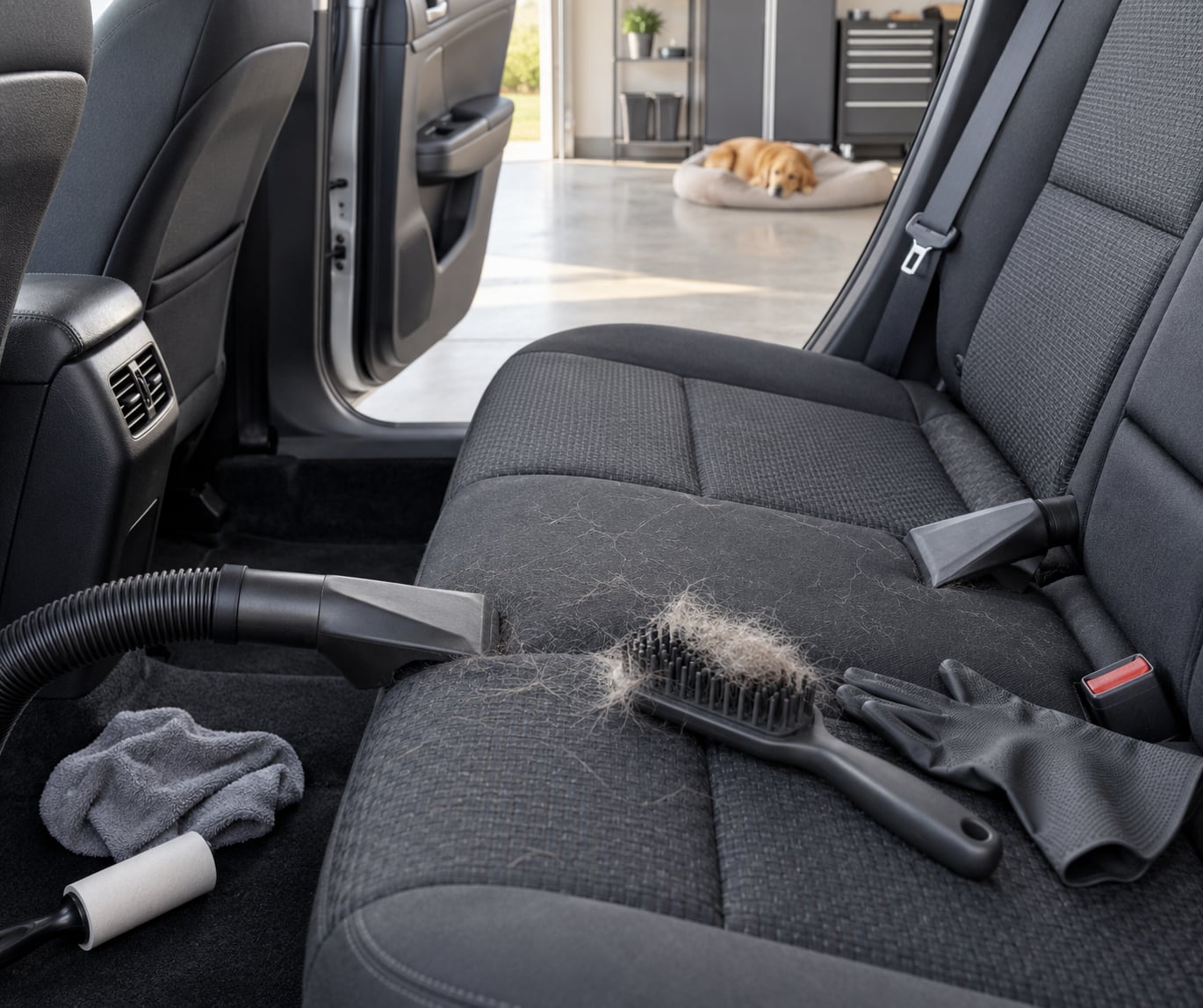
Learning how to get dog hair out of car seats comes down to three moves in the right order: break the static that anchors the fur, gather the loose hair with a rubber brush or damp rubber glove, then vacuum it out. Do them out of order and the hair goes straight back onto the floor.
Most people start with the vacuum, which is why most people give up. Hair that has worked its way between the seat fibres is held there by static cling and friction, and suction alone just sucks up the top layer.
Effective removal methods, in order of what they fix:
- Rubber bristle brush or squeegee: the rubber grabs hair through static and rolls it into clumps you can lift off in one piece.
- Damp rubber glove: a nitrile or latex glove, lightly damp inside, pulls loose hair off upholstery and off your hand in a single stroke.
- Diluted fabric softener mist: two or three teaspoons in a spray bottle of water softens the fibres and loosens hair that is wedged deep in the weave.
- Vacuum with an upholstery or crevice attachment: the extraction step that picks up every clump the rubber tool produced.
Table of Contents
- 1What You Need
- 2Step-by-Step
- 3How to Remove Loose Dog Hair with a Vacuum
- 4How to Get Dog Hair Out of Fabric Car Seats
- 5How to Remove Dog Hair from Leather Car Seats
- 6How to Use Rubber Gloves or a Rubber Brush
- 7How to Get Dog Hair Out of Car Seats with Baking Soda
- 8How to Keep Dog Hair from Building Up Again
- 9Common Mistakes
- 10Frequently Asked Questions
- 11What is the best tool for removing dog hair from a car?
- 12Can I use Dawn dish soap to clean car seats?
- 13Does vinegar dissolve pet hair?
- 14How do I get dog hair out of car seats without a vacuum?
- 15How do I remove dog hair smell from car seats?
- 16How often should I clean dog hair out of my car?
- 17Conclusion
What You Need
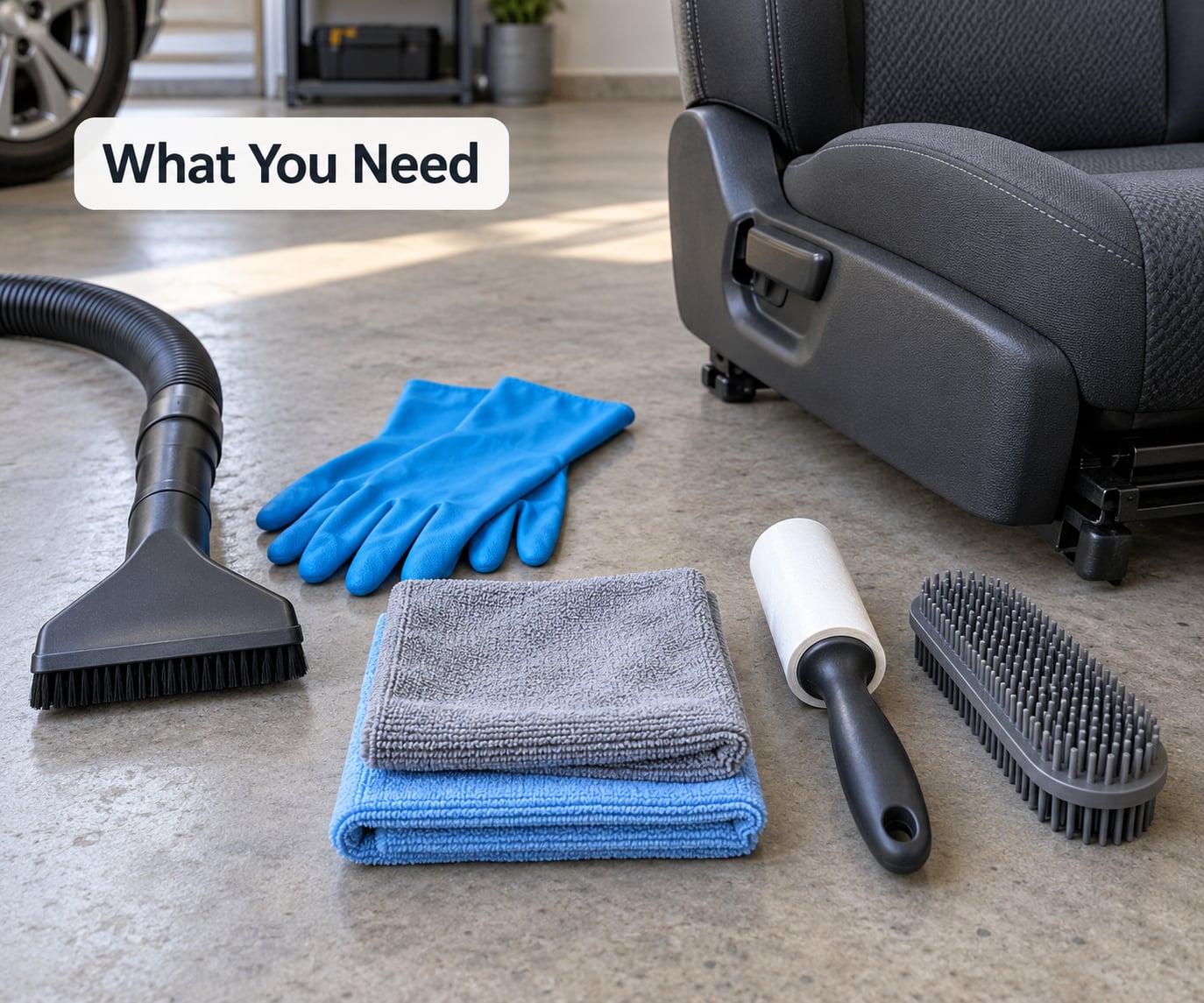
Six things cover almost every seat material, and all of them are ordinary household or car-care items. The only one most people are missing is the rubber glove.
- A vacuum with an upholstery or crevice attachment. A hose-end or brush head fits between the seat bolster and the squab. If you have no vacuum at all, a handheld car vac works, just expect more passes.
- Rubber gloves. Nitrile is the safer pick for anyone with a latex allergy. They cost almost nothing and are the single most useful item on this list.
- A rubber brush or squeegee. The small rubber-bristle detailing brush used for dashboards works well. A rubber-edged shower squeegee is the budget substitute and does the same job on flat seat surfaces.
- Microfiber cloths. One damp cloth for leather and vinyl, one dry cloth for finishing.
- A lint roller for the glove-box stash. Good for the dashboard, console and seatbelt slots between full cleans.
- Optional: baking soda or a pet-safe upholstery cleaner. Baking soda handles lingering smell. A cleaner marked safe for pets and for automotive upholstery handles stains, and it must never be one containing bleach or ammonia.
Rubber tools suit fabric, leather, vinyl and car carpet. The lint roller and microfiber cloth suit leather and vinyl best, where hair sits on the surface. On suede or alcantara, drop the squeegee and the stiff rubber brush and work with a barely damp cloth and a soft brush instead.
Step-by-Step
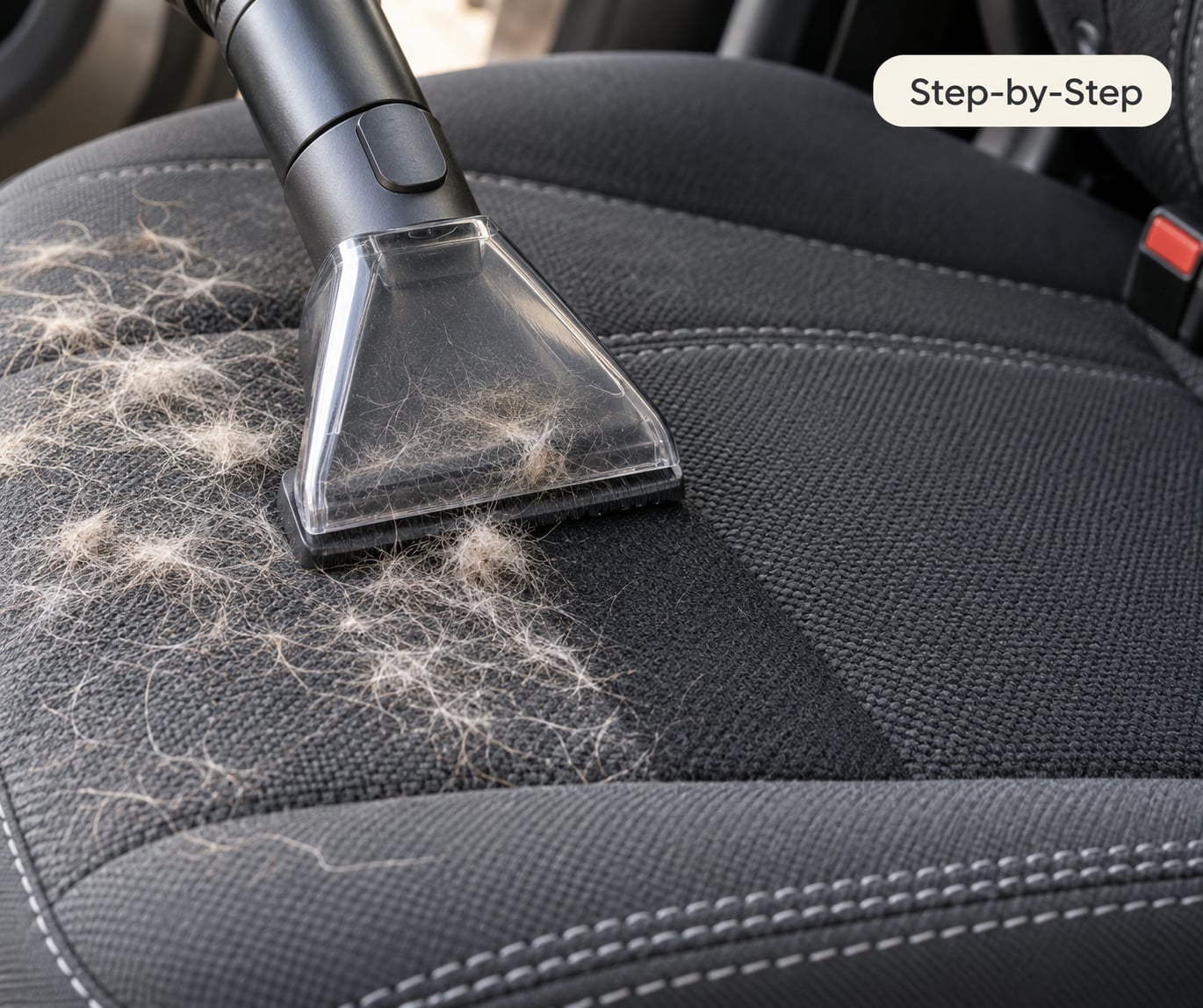
Work in this order: check the care label, loosen the hair, gather it, extract it, then let the seat dry fully. Skipping the loosening step is what turns a ten-minute job into a weekend one.
How to Remove Loose Dog Hair with a Vacuum
The vacuum is the last step, not the first. Once the rubber tool has pulled the hair into loose clumps, the vacuum lifts it without dragging any of it further into the weave.
Use short overlapping passes rather than one long sweep, and go back over the same area from a different angle the second time. Hair sitting at a slight angle to the nap gets picked up on the second pass. Work down into the seams, around the seatbelt buckle, and along the gap between the seat and the centre console.
You know it worked when the seat looks clean and running a bare palm across the fabric finds no grit and no loose hairs coming loose.
How to Get Dog Hair Out of Fabric Car Seats
Fabric is where embedded hair causes the most complaints, and the short-haired dogs are usually the worst offenders. Fine, needle-like fur from breeds like dachshunds, pugs and terriers wedges between the fibres instead of sitting on top, which is why owners of smooth-coated dogs often have the worst back seats.
Start with the care label under the seat or on the seatback. Test any cleaner on a hidden spot first and leave it to dry fully before judging the result. Mist a little diluted fabric softener onto the damp area, let it sit for a few minutes, then work the seat with the rubber brush in overlapping strokes, always in the same direction.
Blot when you wet clean, never scrub. Saturating cloth upholstery pushes water and cleaner into the foam and can leave a permanent water ring. For a mark, dampen a microfiber cloth with warm water and a drop of mild detergent, blot from the outside inward, and let the seat dry with the door open.
How to Remove Dog Hair from Leather Car Seats
Leather is the easiest surface of all, because the hair sits on top of a smooth finish rather than sinking into a weave. Vacuum first, then wipe with a microfiber cloth barely dampened with plain water, and dry the surface immediately with a second cloth.
Skip household cleaners, solvents, bleach and ammonia. They strip the protective finish and leave leather stiff and cracked within a season. Condition the leather only as the manufacturer directs, and never saturate a perforated seat or a seat with seatbelt sensors built into the bolster.
How to Use Rubber Gloves or a Rubber Brush
Rubber works because of the static it generates in the opposite direction to the charge holding the hair down, so the hair transfers onto the rubber and leaves the fabric. Wear the glove or hold the brush and stroke from the top of the seat cushion downward, towards the floor, overlapping each pass.
Peel the collected clump off the rubber after every few strokes and drop it straight into a bag. Keep going in one direction, then repeat from the opposite angle, because hair lying across the pile needs a second pass. This is the fastest method on short-haired dogs and smooth seat surfaces, and it does nothing for hair that is woven in tight.
How to Get Dog Hair Out of Car Seats with Baking Soda
Baking soda does not pull hair out of a seat. It is worth using for a stale dog smell and for light residue, once the hair itself has gone. Check the upholstery label and the vehicle’s care instructions first, and keep the powder away from any vent openings.
Sprinkle a thin layer over the dry seat, leave it for 30 to 60 minutes, then vacuum it out thoroughly. For odour rather than hair, a pet-safe enzymatic cleaner applied after vacuuming works better, because it breaks down the urine proteins that baking soda only masks.
How to Keep Dog Hair from Building Up Again
Weekly maintenance beats a monthly deep clean every time. A few minutes a week stops hair from ever anchoring into the weave, and it takes far less time than pulling it out later.
- Weekly: rubber brush or glove over each seat, then a vacuum pass. Wipe leather and vinyl with a damp microfiber cloth at the same time.
- Before every trip: run a rubber grooming brush over the dog, or at least brush the seats and back door area before they get in. Outdoors loses far more hair than the seat ever catches.
- Monthly: lint roll the seatbelt slots, console and footwells, where hair packs in unnoticed.
- Long term: a washable seat cover or a backseat blanket, fitted so it cannot interfere with the seatbelt, the seatbelt pretensioner or the side airbag. Never wedge a cover into the side of the seat.
Common Mistakes
Almost every failed attempt traces back to one of seven mistakes, and each has a simple correction.
- Vacuuming hair that is still embedded. The suction grabs the loose layer and leaves the anchored hairs in place, which reads as the vacuum not working. Loosen the hair with a rubber tool first, then extract.
- Using a beater bar on upholstery. The spinning bristles cut and pull the fabric. Use a rubber-bristle head or detach the beater bar and vacuum on suction alone.
- Saturating cloth upholstery. Water soaks into the foam and dries as a ring. Use a damp cloth, blot, and dry with the doors open.
- Cleaning without reading the care label. Many factory cloth seats are code-clean only, meaning no water-based cleaner at all. Check first.
- Using human shampoo or a harsh cleaner. Residue attracts dirt, and bleach and ammonia damage fabric and trim. Use a product labelled safe for pets and automotive upholstery.
- Scrubbing leather hard. Aggressive scrubbing wears through the finish. Wipe, blot, dry, and condition only as the maker instructs.
- Fitting a seat cover that blocks a safety system. A cover loose around the side airbag or tucked into the seatbelt track is a safety problem, not a cleaning one. Use a cover made for your vehicle.
One last tip: if the hair is truly woven in after all of this, dampen the seat lightly and agitate it with a stiff-bristled toothbrush, then vacuum again from several angles. When that fails, a professional detail with hot-water extraction is the cheapest fix.
Frequently Asked Questions
What is the best tool for removing dog hair from a car?
A rubber pet hair removal brush or a squeegee is the best tool, paired with a vacuum for the pickup. The rubber generates a static charge that pulls hair off the fabric and rolls it into a clump you can lift away. A damp rubber glove is the free alternative and works almost as well on smooth seat surfaces. Skip the lint roller for embedded hair; it only removes the top layer.
Can I use Dawn dish soap to clean car seats?
It strips oils well, but it is not a good choice for upholstery. Dish soap leaves a sticky residue that traps dirt, and on fabric it can fade the dye and dry out the fibres. It also does nothing about hair, only grease and grime. If a spot needs cleaning, use a product labelled safe for pets and automotive upholstery, and patch test it first.
Does vinegar dissolve pet hair?
No. Vinegar does not dissolve hair and will not pull it out of a seat. What it does is cut through the static bond holding hair down and neutralise odour, which makes a diluted vinegar mist a useful pre-treatment before you use a rubber brush. Use it sparingly, test a hidden spot first, and never on leather, where it dries the surface out.
How do I get dog hair out of car seats without a vacuum?
Work the seat with a damp rubber glove or a rubber squeegee, moving in overlapping strokes from the top of the cushion downward. Peel off the clump each time and seal it in a bag. A lint roller works for loose surface hair, and a second pass from the opposite angle catches what the first pass missed. Expect two passes on heavily embedded seats.
How do I remove dog hair smell from car seats?
Vacuum the hair out first, because trapped hair holds odour and keeps damp fabric damp. Then apply a pet-safe enzymatic cleaner to the damp seat rather than a surface mist. Enzymatic cleaners break down the proteins that cause the smell instead of masking them. Baking soda left on for 30 to 60 minutes helps a little, and air the car dry afterwards.
How often should I clean dog hair out of my car?
For a dog that rides regularly, a weekly rubber brush pass followed by a vacuum is enough to stop hair building into the fabric. Wipe leather and vinyl with a damp microfiber cloth at the same time. Lint roll the seatbelt slots, console and footwells once a month. A heavy shedder in dry winter air, when static cling is worst, may need two passes a week.
Conclusion
Start with the rubber brush or a damp glove, stroke the seat from top to bottom, and vacuum up what you collect. That order, loosen then gather then extract, is the whole technique.
A weekly pass takes a few minutes and stops hair from ever anchoring. Test anything you spray on a hidden spot, follow the upholstery label, and use pet-safe products only.