A steady check engine light on a car that starts, shifts, and pulls normally is not a contradiction. Your engine control module logged a fault in a sensor, the fuel system, the ignition, or an emissions component that has not yet grown large enough to change how the engine drives. The bulb is the computer reporting a code, not a verdict on the engine.
That gap between what the code says and what you feel is why this question comes up so often. The short version: read the code first. It tells you whether the drive to the shop is an ordinary one or a tow-truck one.
Table of Contents
- 1Why Is My Check Engine Light On but the Car Runs Fine?
- 2What Does a Check Engine Light Mean?
- 3Why Can the Car Run Normally with a Fault Code?
- 4Common Reasons the Check Engine Light Comes On
- 5A loose or worn gas cap is the cheapest cause and the most common one
- 6An oxygen sensor that has gone lazy
- 7A catalytic converter working below threshold
- 8A mass airflow or MAP sensor reading wrong
- 9Weak spark plugs or a failing ignition coil
- 10A lean running condition from a vacuum leak
- 11A failed EVAP purge valve
- 12Damaged wiring, corroded connectors, bad grounds
- 13Can You Drive with the Check Engine Light On?
- 14How to Diagnose the Problem Before Visiting a Mechanic
- 15What Should You Do First?
- 16Frequently Asked Questions
- 17Is it safe to drive if the check engine light is on?
- 18Why did my check engine light come on but the car seems normal?
- 19What does it mean if the check engine light is blinking?
- 20Should I drive to a mechanic with the check engine light on?
- 21Does resetting the check engine light fix the problem?
- 22How much does it cost to diagnose a check engine light?
Why Is My Check Engine Light On but the Car Runs Fine?
Because the check engine light reports a stored fault code, not a loss of performance. Those are two different measurements, and only one of them is happening yet.
Most of the systems that throw codes govern fuel delivery and exhaust cleanup rather than power. A loose gas cap, an aging oxygen sensor, a purge valve that sticks slightly open: the ECU sees the deviation, records it, corrects around it, and lights the lamp. What you may or may not notice is fuel economy a few percent lower, a slightly rougher idle, or a faint burnt-eggs smell now and then.
Running fine is a lagging indicator. By the time you feel a stumble or hesitation, the fault has usually been there for weeks. Ignoring a small sensor fault is also how a cheap part becomes an expensive catalytic converter, because unburned fuel and excess oxygen passing through the exhaust eventually cook it.
What Does a Check Engine Light Mean?
Three different warnings share your instrument cluster, and only one of them is the check engine light.
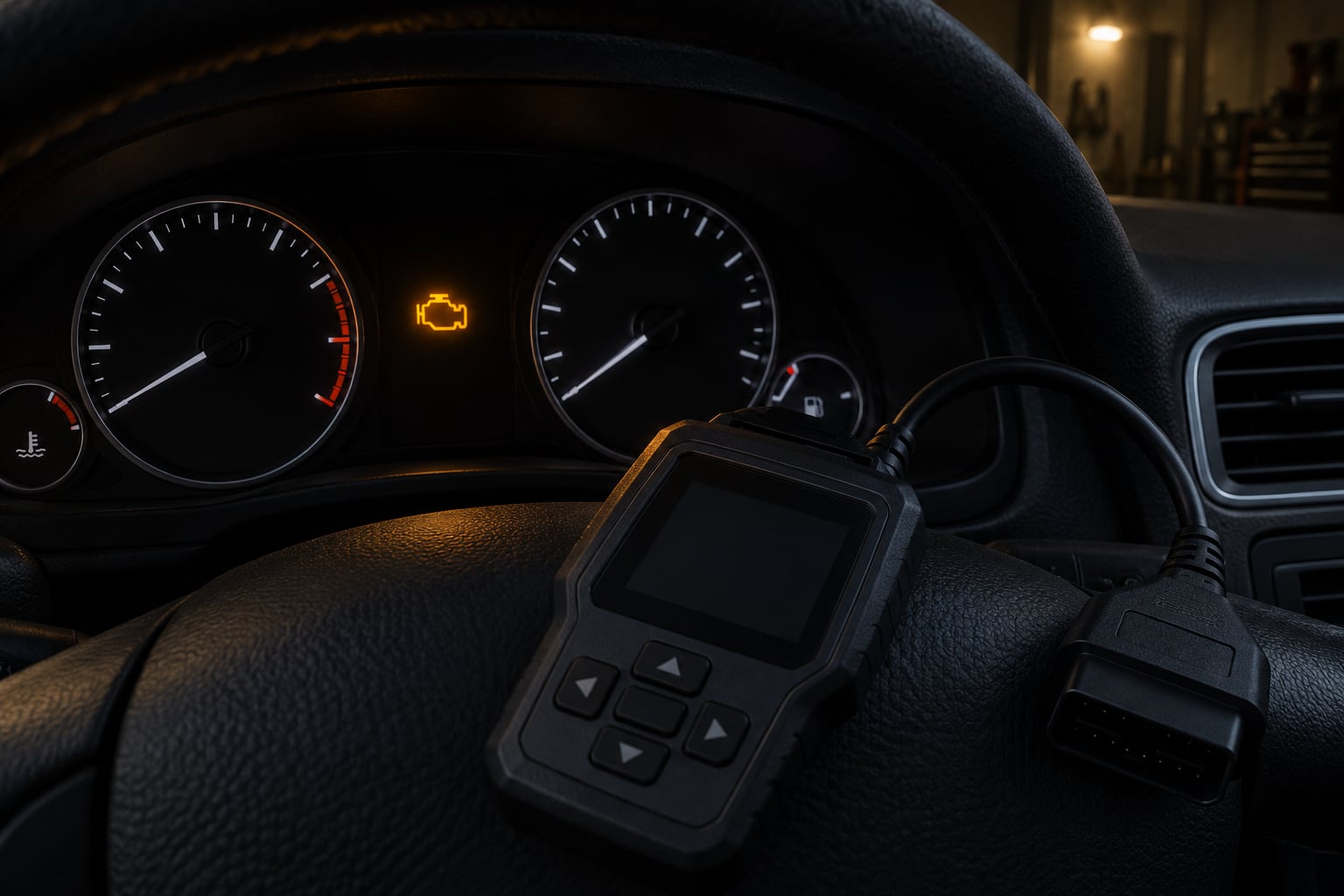
A steady yellow bulb is the malfunction indicator lamp. A code is stored, the fault is being compensated for, and the car will usually drive. This is the normal case, and the reason most of these questions are still answerable with a phone call and a code reader rather than a tow truck.
A blinking yellow bulb means the fault is active right now. On most cars that means an active misfire, sending unburned fuel into the exhaust where it can damage the catalytic converter in a short drive. This is the one you stop for.
A red light for oil pressure, temperature, charging or brakes is a separate system with a different urgency. It gets your attention, not the check engine light, and it should be read before any code scanning.
The key difference is stored versus active. A stored code is a record of something that happened; an active fault is happening as you read this. Since 1996, every car sold in the US has carried the OBD-II standard, which is why any scanner can read these codes on any year of car.
Why Can the Car Run Normally with a Fault Code?
Modern engines run on redundancy, and that is exactly why a fault can sit there for weeks without you noticing it.
Redundant readings. The ECU watches several sensors measuring the same thing. When one disagrees, it can average the others and keep running.
Substitute values. If a cam-position signal drops out, the ECU estimates from crank position and oxygen readings. The engine runs, just not perfectly.
Emission monitoring. The evaporative and catalyst systems are judged on capturing vapor and cleaning exhaust, not on output. A leak there changes almost nothing about how the car feels from the seat.
Design margin. Engineers expect sensors to drift. Fuel trims adapt until a reading crosses a threshold the ECU is not allowed to tolerate, and then the code sets. That is the moment the light appears, usually long after the fault began.
Freeze-frame data. The module stores engine speed, temperature, and load from the instant a fault appeared, which is why a light that came on randomly and went away still leaves a record behind.
Common Reasons the Check Engine Light Comes On
The code tells you which system to investigate. The light on its own never does, and the symptom you would expect is often the one you do not have.
A loose or worn gas cap is the cheapest cause and the most common one
Codes P0442 or P0455. The EVAP system recycles fuel vapors, and a cap that will not seal fails the leak test. Frequently the light appears right after you refuel, and there is no symptom at all.
An oxygen sensor that has gone lazy
P0131 through P0135. The O2 sensor measures what is left in the exhaust so the ECU can trim fuel. A slow or dirty one still returns a number, so power holds, while fuel economy drops and the ECU flags the drift.
A catalytic converter working below threshold
P0420. The ECU compares the upstream and downstream O2 signals to estimate how well the converter is working. Slightly low efficiency sets a code and nothing else. Converters are pricey because they sit at the end of the chain, and the real cause is often upstream.
A mass airflow or MAP sensor reading wrong
P0101 or P0102. The MAF measures intake air to set fuel delivery. A dirty sensor still senses air, so the engine runs, but the ECU keeps adding or trimming fuel to compensate.
Weak spark plugs or a failing ignition coil
P0300 for random misfires, P0301 to P0308 for a specific cylinder. A misfire at idle can be invisible; the same misfire under load, uphill or at highway speed is not. That is how a car feels fine in the driveway and shudders on the freeway, a pattern forum threads about older Volkswagens, Mazdas and Dodges are full of.
A lean running condition from a vacuum leak
P0171 or P0174. Unmetered air past a cracked hose or a failed intake gasket makes the mixture too lean, and the ECU adds fuel to compensate. Power stays, fuel economy slips.
A failed EVAP purge valve
P0440 to P0446. When the valve that sends vapors to the engine sticks open, you get a fuel smell, a rough idle, or nothing noticeable at all.
Damaged wiring, corroded connectors, bad grounds
These produce the codes that come and go with no pattern. This is the most common reason a light appears randomly on an otherwise healthy car, and oil or moisture around engine bay connectors is usually to blame.
Can You Drive with the Check Engine Light On?
Usually, yes, when the light is steady and the code is not a misfire or a knock. Here is the decision table I would read straight off the dash, rewritten as a list so it reads on a phone in a parking lot.
- Steady yellow light, car drives normally. Means a stored code, fault compensated for. Drive to a parts store or shop for a scan, and note your fuel economy.
- Steady yellow light, fuel economy clearly down. Means a sensor or fuel delivery fault. Get it read this week rather than next month.
- Blinking yellow light. Means an active misfire pushing unburned fuel into the exhaust. Pull over safely, switch off, arrange a tow or roadside assistance.
- Light plus shaking, rough idle, or hesitation under load. Means a misfire or vacuum fault that will not stay compensated. Drive gently and directly to a shop, no long trips.
- Any red light, overheating, burning smell, or loss of power. Not a check engine light situation. Stop safely and do not drive the car.
Keep the drive short and unbothered. Skip long highway runs at speed, trailer towing, and repeated hard acceleration while the light is on, since those are the conditions most likely to turn a stored fault into an active one.
Watch for the light changing from steady to blinking, a new vibration, or any new smell. If one of those shows up, the answer changes.
How to Diagnose the Problem Before Visiting a Mechanic
You can narrow this down before anyone charges you anything.
Write down when it happened. First thing in the morning, only when warm, right after refuelling, or under load at highway speed. That pattern often tells a technician more than the code does.
Check the gas cap. Press it down until it clicks and holds, and look for a cracked neck, a perished seal, or a missing tether cap.
Look for what the code would produce. A burnt-eggs smell, a hose hanging off a port, a visible crack, an exhaust heat shield loose, oil or coolant around a connector.
Get the code read. Most auto parts stores scan for free and will read the code back to you; a home OBD2 reader does the same job. Photograph the code before you do anything else with it.
Use the freeze-frame data. Engine speed, coolant temperature, and load at the moment the fault appeared narrow an intermittent problem more than the code alone.
Then get a real diagnosis. A code names a circuit, not a failed part. P0132 can be a dead sensor, a corroded connector, or a broken wire, and replacing the sensor on the code alone is the most common way to spend money twice.
What Should You Do First?
Tighten the gas cap, get the code read, then decide how quickly you need to be somewhere. That sequence costs you almost nothing and rules out the most frequent cause immediately.
If you refuelled shortly before the light appeared, the cap is the first suspect. Click it until it latches, drive a few trips, and see whether the lamp goes out on its own.
Clearing a code is not a repair. It erases the record but not the cause, so the light comes back when the fault does, and you lose the freeze-frame data a technician needs. Clearing also wipes the readiness monitors that tell an emissions tester whether the fix actually worked. Some codes clear themselves once the repair is done and the car has been driven through a few cycles; others need a scan tool to reset.
On emissions testing, rules vary by state and change over time, but the general pattern holds. A vehicle with a lit check engine light and incomplete or failed monitors will not pass a state emissions or smog check, which can block a registration renewal until the code is repaired and the monitors reset.
And on a car close to the end of its life, get the code first, then weigh the quote against what the car is worth to you. Shops will give you a straight answer once they know the code. The code is what turns a vague worry into a decision.
Frequently Asked Questions
Is it safe to drive if the check engine light is on?
A steady yellow light on a car that starts, shifts, and pulls normally is usually fine to drive to a repair shop. Keep the trip short, drive gently, and avoid towing or sustained high speed. A blinking yellow light is the opposite case: it signals an active misfire sending unburned fuel into the exhaust, and you should stop safely and call roadside assistance.
Why did my check engine light come on but the car seems normal?
Because the light reports a stored code, not a loss of performance. The engine control module noticed a sensor, fuel, ignition, or emissions fault that it can still compensate for, so acceleration and idle stay normal. You may notice nothing at all, or only a small drop in fuel economy. Get the code read before the compensation stops being enough.
What does it mean if the check engine light is blinking?
Blinking means the fault is active right now, and on most cars it means an active engine misfire. Fuel that did not burn is flowing into the catalytic converter, which can overheat and fail within a short drive. Pull over somewhere safe, switch the engine off, and arrange a tow or roadside assistance rather than driving it to a shop.
Should I drive to a mechanic with the check engine light on?
Yes, if the light is steady and the car behaves normally, as long as the drive is direct and short. No, if it is blinking, if the engine is shaking or hesitating under load, or if you notice overheating, a fuel smell, or a loss of power. When in doubt, take a photo of the cluster and describe it to the shop before you set off.
Does resetting the check engine light fix the problem?
No. Resetting erases the stored code and the freeze-frame data a technician needs, but the underlying fault is still there, so the light usually returns within a few drive cycles. It also wipes the readiness monitors that show an emissions tester whether a repair actually worked. A code should be cleared only after the cause has been repaired.
How much does it cost to diagnose a check engine light?
It varies widely by region and shop. Many auto parts stores scan a car free and read the code back to you, which is enough to get started. Shop diagnostic time is usually billed as a flat fee, often credited toward the repair. Get the code before you shop around, so you know which system and part are in question.
The car running fine means the fault is still being compensated for, not that there is nothing wrong. Check the gas cap, get the code read, and let the code decide how quickly this needs a shop.