A cold engine runs on extra fuel until it warms up, and a good chunk of that surplus exits the exhaust as unburned vapor. That is why your car smells like gasoline right after a startup and then goes quiet once it reaches operating temperature. The same odor can also come from a loose fuel cap, a weeping injector seal, or a cracked vapor hose, and those are worth catching early.
The difference between the two cases is mostly about strength and duration. A faint whiff that fades within seconds as the engine warms is ordinary on most cars. A smell that hangs around, blows through the dashboard vents, or comes with a wet patch under the car is a fault, and it deserves a shop appointment this week rather than next month.
Table of Contents
- 1Why Does Your Car Smell Like Gas When You Start It?
- 2Is a Brief Gas Smell During Startup Normal?
- 3Common Causes of the Gas Smell
- 4Rich air-fuel mixture on a cold engine
- 5A weeping fuel injector O-ring
- 6A loose, cracked, or worn fuel cap
- 7Cracked or disconnected EVAP hoses
- 8A fuel pressure regulator that has failed
- 9A tank, fuel line, or quick-connect fitting leak
- 10Moisture or debris in the cabin air filter
- 11What the Smell Can Tell You
- 12How to Diagnose the Odor Safely
- 13Why Does the Smell Happen More in Cold Weather?
- 14Is It Safe to Drive with a Gas Smell?
- 15What to Tell the Mechanic
- 16Frequently Asked Questions
- 17Is it normal for my car to smell like gas for a few seconds after starting?
- 18Can a loose gas cap cause the smell to come through the vents?
- 19What does the EVAP system warning light mean on my car?
- 20Can I drive to a mechanic if my car smells like gasoline?
- 21Could the odor be coming from something other than the fuel system?
- 22What to Do First
Why Does Your Car Smell Like Gas When You Start It?
Two systems explain nearly every case. The first is the fuel system itself, where a small amount of fuel or fuel vapor escapes somewhere it should not. The second is the engine’s own cold-start fueling strategy, which deliberately sends an overly rich mixture into the cylinders until the oxygen sensor and catalytic converter are hot enough to work properly.
The second one is why the odor is strongest in the first ten to twenty seconds, when you turn the key, the fuel pump primes, the engine sits at a high idle, and the exhaust flow is low. Once the engine is warm, the mixture is leaned back and the extra fuel simply burns inside the catalytic converter. That pattern — strong at startup, gone when warm, no warning light — is the single most reported one on owner forums, and on most vehicles it is normal.
A faint fuel odor right after a fill-up is a different situation. Fuel vapors collect in the tank, and a cap that is not clicked fully closed lets them out near the filler neck. That smell tends to be strongest at the rear quarter panel and shows up for a day or two after refueling.
Is a Brief Gas Smell During Startup Normal?
Usually yes, if four conditions are true at once: the smell is faint, it comes from the exhaust area rather than the cabin, it fades within about a minute of idling, and nothing else is wrong with the car. Miss any one of those and it stops being the normal cold-start signature.
Think of a quick comparison. A harmless startup smell behaves a certain way; a suspicious one behaves differently in nearly every measurable respect.
| What you notice | Probably normal | Worth a shop visit |
|---|---|---|
| Strength | Faint, only at the exhaust | Strong enough to notice from the curb |
| Duration | Gone within 10-20 seconds of warm-up | Still present after driving 20 minutes |
| Where you smell it | Behind the car, outside | Inside the cabin, through the vents |
| Ground under the car | Dry | Wet patch or a puddle that grows |
| Engine behavior | Steady idle, normal power | Rough idle, misfire, hesitation, low power |
| Warning lights | None | Check engine light or a fuel system code |
| Fuel economy | Unchanged | Noticeably worse |
Drivers on r/MechanicAdvice describe almost exactly this pattern when they ask whether a cold start that reeks of gas is bad: the odor shows up after the car has sat overnight, then it disappears once the car is warm. Forum mechanics answer that the engine computer is running rich while the catalyst is cold, and that the extra fuel burns off once everything is up to temperature. That consensus is a useful baseline, but it only holds if your car matches every row in the left column.
Common Causes of the Gas Smell
Each of these is a real component with a specific job, and knowing which one is misbehaving saves a lot of guessing.
Rich air-fuel mixture on a cold engine
Cold-start fuel enrichment is the most common and least alarming cause. The engine computer adds extra fuel because the oxygen sensor reads inaccurately when cold and the catalytic converter needs heat before it can oxidize exhaust gases. The surplus that does not burn in the cylinder comes out the tailpipe as vapor. Nothing here is broken; the smell is the system working as designed for the first few minutes.
A weeping fuel injector O-ring
Injector seals are rubber rings at each fuel injector where it meets the intake manifold. When they are stiff with age, they weep a small amount of fuel during the first seconds after startup, when rail pressure spikes and the seals have not relaxed. Owners of Subaru Forester, Outback, Corolla, and Honda Fit models report this pattern repeatedly on forums — a cold-start gas smell, no visible puddle, no warning light, and a shop that finds nothing without pulling the intake apart.
A loose, cracked, or worn fuel cap
The fuel cap seal is a vapor seal, not a pressure seal. A cap that clicks loosely lets tank vapors escape from the filler neck, and you will notice it most right after refueling or when the tank is warm. A worn cap gasket on an older car can do the same thing without ever having been overtightened.
Cracked or disconnected EVAP hoses
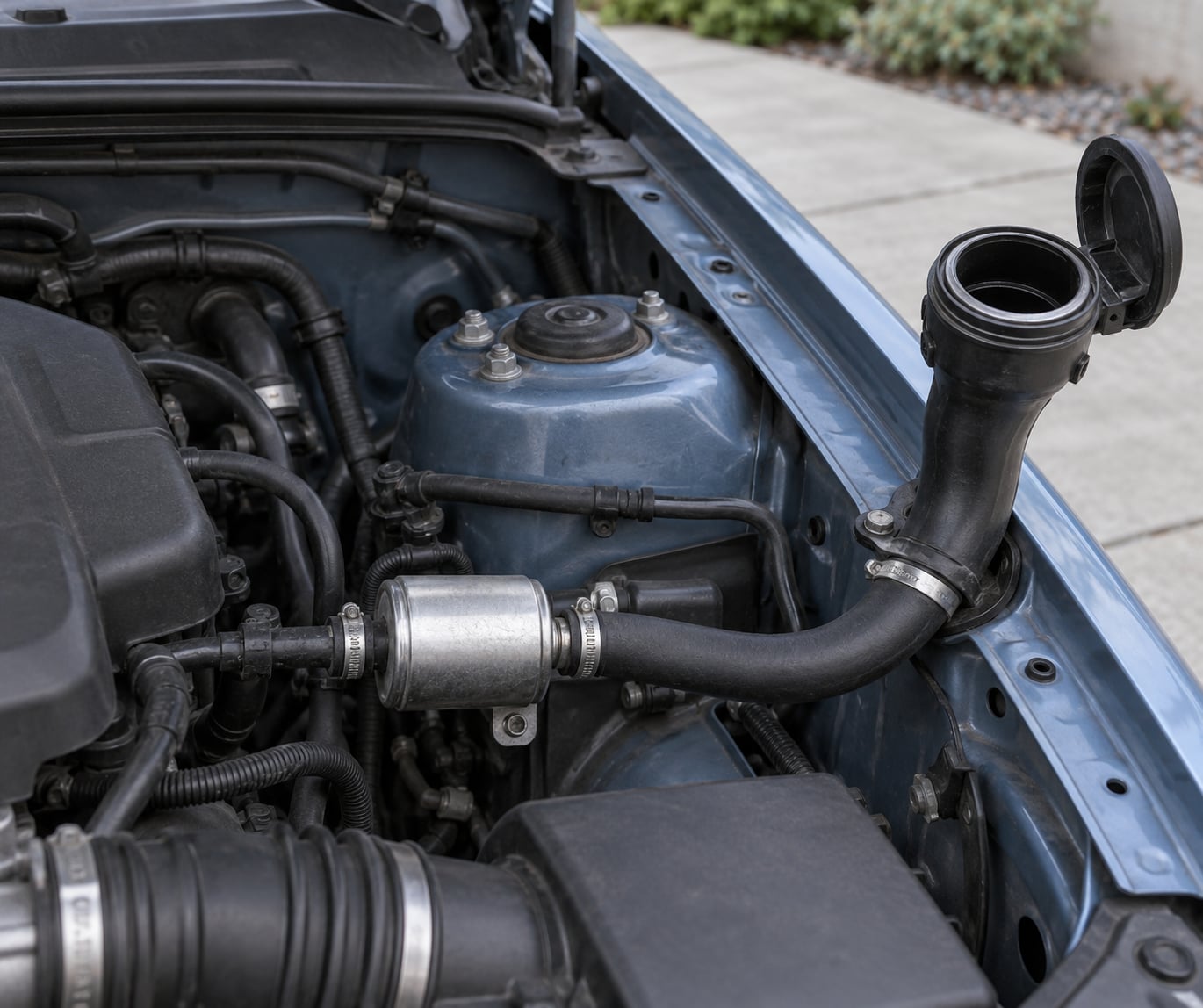
The EVAP system — the evaporative emission control loop — is a sealed set of hoses, a charcoal canister that stores vapor, and a purge valve that moves vapor into the engine to burn it. Cracked hoses, a disconnected vent line, or a canister that has taken on fuel are common on high-mileage cars. Vapors escape the hosework rather than being contained, and the odor appears at or near the rear of the car and often creeps into the cabin through the fresh air intake.
A fuel pressure regulator that has failed
The fuel pressure regulator holds rail pressure at a set value by diverting excess fuel back to the tank. If its diaphragm fails, pressure climbs higher than designed, and fuel can push past seals and fittings. The smell tends to be stronger than the cold-start baseline and often comes with a rough idle or a pressure-related trouble code.
A tank, fuel line, or quick-connect fitting leak
Steel lines and quick-connect fittings corrode, and flexible sections harden and crack. A slow leak often shows up as a wet patch under the car that grows while the engine sits, or as a sharp odor in a garage after the car has been parked. This is the failure mode that moves quickly from an annoyance to a hazard, which is why visible leakage belongs at the top of any urgent list.
Moisture or debris in the cabin air filter
The HVAC fresh air intake pulls outside air — including fumes from the engine bay — through the cabin air filter before it reaches the dashboard vents. A filter that is waterlogged or packed with debris holds onto fuel vapor and releases it into the cabin, so the smell seems to come from inside while the actual source is outside. A plug leak near the intake can do the same thing.
What the Smell Can Tell You
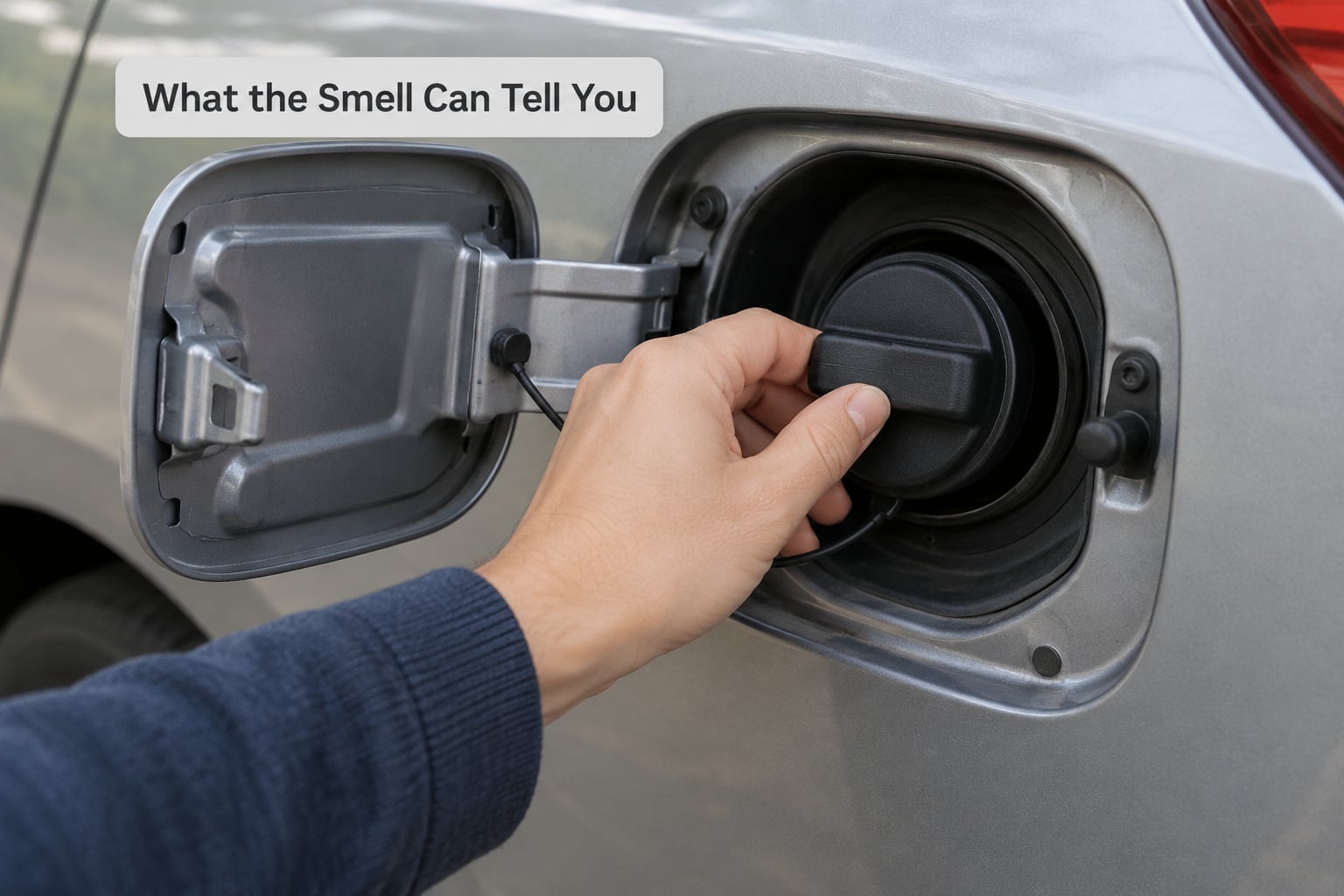
Where you smell it, and when, narrows the field faster than any other clue.
| Smell pattern | Most likely source | Urgency | Safest next action |
|---|---|---|---|
| Faint, at the tailpipe, gone when warm | Normal cold-start fueling | Low | Note it and keep watching |
| Around the rear quarter panel after refueling | Fuel cap seal or filler neck | Medium | Check the cap clicks and reseats evenly |
| Stronger at the pump than while driving | Loose cap or EVAP hose | Medium | Tighten the cap fully; book a cap and EVAP check |
| Inside the cabin through the vents | Injector seep, EVAP vapor, engine-bay leak near the intake | Medium-high | Drive in open air only; have the intake and EVAP system inspected |
| Fuel odor close to the vehicle while parked | Line, fitting or tank leak | High | Do not start the engine; arrange a tow |
| Visible wet patch or pooling | Active leak | Urgent | Switch off, move away, call fire services if the odor is strong |
Two useful side notes. First, a cap cannot explain a smell at the front of the car on a cold start — the myth that the gas cap is always the culprit confuses a rear-of-car vapor leak with a startup odor that comes from the engine bay. Second, a smell that is strong when the car is merely sitting still is a different problem from a cold-start smell, and it deserves attention on its own terms.
How to Diagnose the Odor Safely
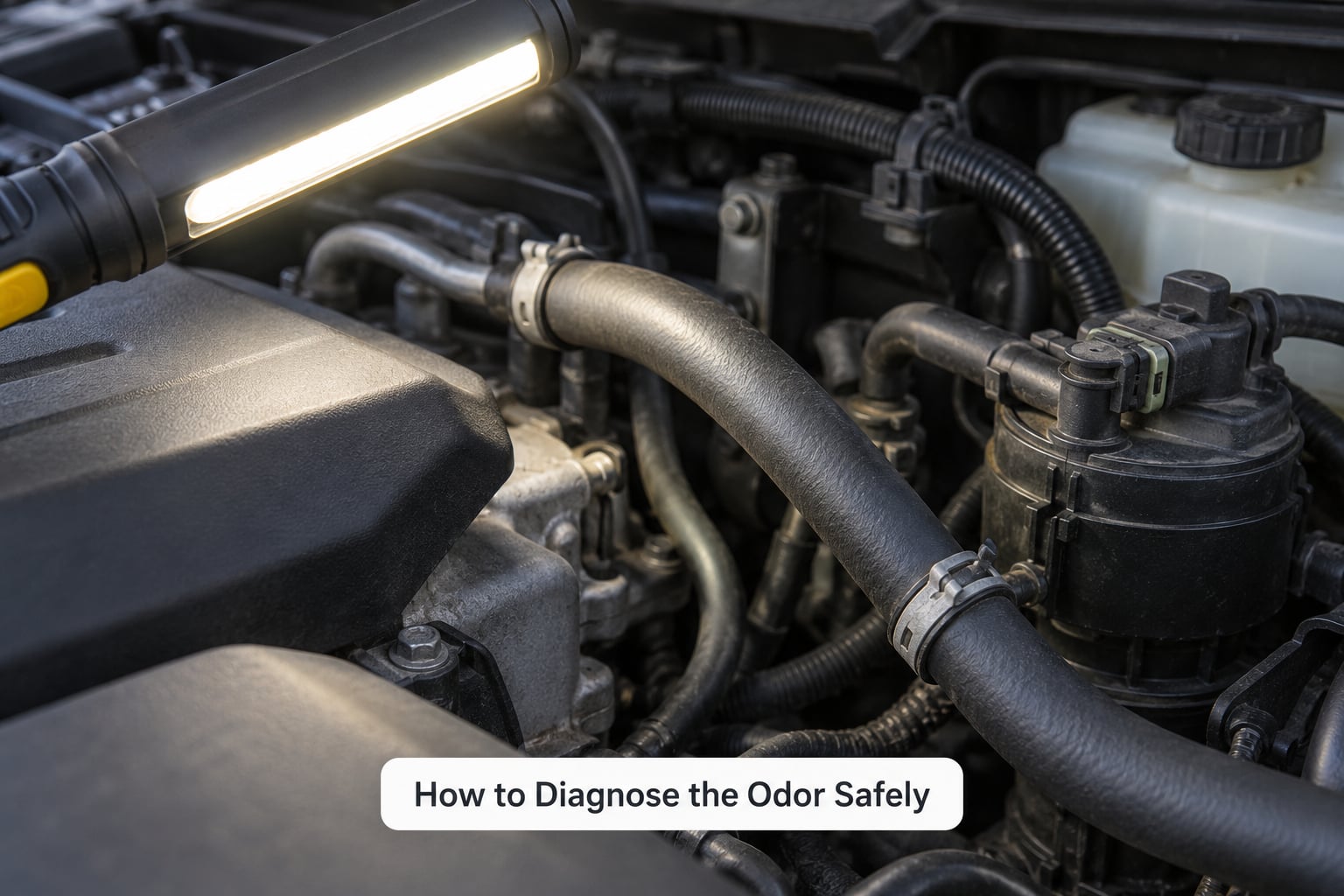
Work in order from cheapest and most likely to most expensive and least likely. The list below is ordered that way on purpose.
- Stop if there is fuel on the ground. Do not start the engine, do not run the starter, and do not use any electrical device near the spill. The fuel pump primes the instant you turn the key, and a running pump sprays a leaking fitting.
- Look before you touch. Check beneath the car, around the fuel door, along the rocker panels, and in the engine bay for a wet patch or a dark stain. Do not put your hands on hot exhaust parts or on any line that looks damaged, swollen or crimped.
- Verify the fuel cap. Open the fuel door, turn the cap clockwise until it clicks, and confirm it sits squarely on the filler neck without a gap or a wavering feel. Recheck after a short drive.
- Note the pattern before it disappears. Write down whether it happens only on the first start of the day, whether it follows refueling, whether it comes through the vents, and how long it lasts. An intermittent cold-start smell is very hard to demonstrate to a technician without notes.
- Check the owner’s manual and any warning lights. A check engine light or stored EVAP code changes the conversation completely. Codes such as P0442 (small evap system leak), P0455 (large evap system leak), P0171 (system too lean), and P0300 (random misfire) all point directly at this area.
- Book a proper inspection. A technician can pressure-test the evap system, smoke-test the hoses to find the exact leak point, test the cap’s seal, and check fuel pressure against specification.
Some things not to do: no smoking or open flame anywhere near the car, no spraying any fluid into the engine bay to hunt for the source, no loosening fuel-system fittings to test for a leak, and never idling a car in a closed garage. If the smell is faint and you need to move the car, open the windows and run the fan on high with the recirculation button off so fresh air, not cabin air, comes through.
Why Does the Smell Happen More in Cold Weather?
Cold fuel is denser and evaporates more slowly, but the real driver of the odor is temperature and pressure inside the sealed system. Tank vapors build all night while the car sits, and a cold evap system handles them less efficiently. At the same time, the engine needs more fuel to run well when cold, and the catalytic converter needs heat before it can oxidize those extra hydrocarbons.
After an overnight stand, the fuel pump primes harder, the first seconds carry the highest rail pressure, and the idle sits higher than normal to warm the engine faster. Every one of those conditions puts more unburned fuel past the exhaust than at highway speed. Add condensation — cold metal surfaces collect water in the same places vapors collect — and the odor has more to hold on to.
Warm weather does not rule any of this out. A cracked evap hose, a tired cap gasket, or a weeping injector seal can smell worse on a hot day after a fill-up, because heat raises tank vapor pressure and pushes more of it out through the weakest point in the system.
Is It Safe to Drive with a Gas Smell?
Not always. A faint exhaust-side whiff that clears when the engine warms up is one situation; several other patterns mean stop the car now.
- Do not drive if you see fuel beneath the vehicle, a wet patch, or a puddle that grows while the car sits.
- Do not drive if the odor is strong enough that you can smell it standing beside the car.
- Do not drive if the smell gets stronger while you are driving rather than fading.
- Do not drive if the engine stalls, hesitates, misfires, or loses power along with the odor.
- Do not drive if a fuel system or check engine light is on, or if the car will not start and cranks without catching.
- Do not drive if the car has been sitting in a garage or enclosed space where vapors can collect.
If any of those apply, switch the engine off in a safe spot away from traffic, get everyone out, and stay away from ignition sources. Call roadside assistance and ask for a tow rather than driving it to the shop.
That last case — a gas smell and an engine that will not start — has its own short explanation. If the engine cranks but does not fire, fuel may not be reaching the cylinders at all, so what you smell can be vapor escaping a system that is no longer sealed and pressurized. Possible causes include a failed fuel pump, a clogged fuel filter, or a supply problem at the tank, and the car needs a tow, not a key-turn.
What to Tell the Mechanic
Most fuel smell appointments drag on because the fault only appears on a cold start and the technician never sees it. Details are worth more than a guess. Tell them whether the smell is faint or strong, whether it happens only on the first start of the day, whether it follows refueling, whether the cap has been tightened since, whether you see any wetness under the car, whether the fuel gauge behaves oddly, whether any warning light is on, and whether the car smells differently in cold or hot weather.
Ask what the diagnostic includes before the work starts. A cap test and an evap system pressure test are quick and inexpensive. A smoke test on the evap hoses finds the exact failure instead of replacing parts one at a time. A fuel pressure test catches regulator and supply faults. If the smell reaches the cabin, they should look at the intake and the cabin air filter too, since that is the path the vapor is actually travelling.
On older vehicles with more mileage, ask them to inspect the steel lines and quick-connect fittings for corrosion while they are already under the car. Those are cheap to check and expensive to replace.
Frequently Asked Questions
Is it normal for my car to smell like gas for a few seconds after starting?
Yes, in most cases a faint smell that lasts ten to twenty seconds and then fades as the engine warms is normal. A cold engine runs on an enriched mixture until the oxygen sensor and catalytic converter reach operating temperature, and the extra fuel that does not burn leaves the exhaust as vapor. Treat it as normal only if nothing else is wrong: no warning light, no wet patch under the car, and no smell inside the cabin.
Can a loose gas cap cause the smell to come through the vents?
Indirectly, yes. A cap that is not fully tightened lets tank vapors escape at the filler neck, and if the fresh air intake is close to that area, those vapors can be drawn into the cabin and out through the dashboard vents. The cap itself will not create a smell at the front of the car on a cold start. If the odor is in the cabin, have the evap system and the intake path inspected too.
What does the EVAP system warning light mean on my car?
It means the evaporative emission control system has detected a leak larger than a very small tolerance. Common codes include P0442 for a small leak and P0455 for a large one. Typical causes are a loose or worn fuel cap, cracked evap hoses, a disconnected vent line, a failed purge valve, or a charcoal canister saturated with fuel. The light does not by itself mean a leak is dangerous right now, but the system should be repaired before the light is reset.
Can I drive to a mechanic if my car smells like gasoline?
Only if the smell is faint, comes from outside the exhaust, fades once the engine is warm, and there is no wet patch under the car. In that case a short drive is reasonable. If the odor is strong, comes through the vents, grows while driving, or comes with a wet patch, rough idle, or warning light, have the car towed instead. Keep the windows open and the recirculation off if you do drive it.
Could the odor be coming from something other than the fuel system?
Yes. A leak in an air-conditioning line, a coolant leak near the intake, or a saturated cabin air filter can produce a sharp odor that gets drawn into the cabin and reads as gasoline to most drivers. A failing fuel pump motor can also smell like solvent when it is near failing. Any of these still needs a shop visit, because a fuel smell is the one symptom you never want to talk yourself out of.
What to Do First
Keep away from cigarettes, lighters, and anything that makes a spark, especially if the smell is strong. If there is fuel on the ground, do not turn the key — the fuel pump primes on ignition and will spread the leak.
If the smell is faint and exterior only, tighten the fuel cap until it clicks and go for a drive. If the odor is still there when the engine is warm, or it comes through the vents, appears at the fuel door, or shows up as wetness under the car, have a qualified mechanic pressure-test the evap system, smoke-test the hoses, and check the fuel cap seal, injectors, and lines while they are already under the vehicle.
That is why does my car smell like gas when I start it usually ends without drama: a cold engine running rich, a little unburned fuel, and a converter that has not warmed up yet. Keep an eye on it, and you will know quickly whether your car falls on the normal side of the line.