To learn a new skill as an adult, pick one skill, decide what done looks like, then practice it for 20 to 30 minutes a day for twelve weeks with feedback from someone better than you. That is the whole system. Everything else is detail.
Most adults do not struggle because they are old or untalented. They stall because they take on three things at once, wait until they feel ready, and practice for a month without anyone telling them they are getting it wrong.
Adulthood actually helps in a few ways people forget. You know how to break a task into steps, you can read and follow instructions better than a teenager, and you know what you want the skill for. The obstacles are time, self-consciousness, and no feedback loop.
This guide is for the working parent, the carer, the shift worker, and anyone starting at 40 or 50 who wants a plan they will still be running in February.
Table of Contents
- 1What You Need
- 2One skill, chosen deliberately
- 3One outcome you could photograph
- 4A fixed slot in the calendar
- 5One route into the material
- 6A way to record what happened
- 7Step-by-Step: How to Learn a New Skill as an Adult
- 81. Choose One Skill and Define a Clear Outcome
- 92. Start With the Fundamentals
- 103. Build a Short Practice Routine
- 114. Practice Deliberately and Ask for Feedback
- 125. Track Progress With Visible Evidence
- 136. Increase Difficulty and Stay Consistent
- 14Common Mistakes
- 15Taking on three courses at once
- 16Waiting until you feel ready
- 17Practicing without feedback
- 18Skipping the exercises you dislike
- 19Setting goals with no finish line
- 20Comparing your week one to someone else’s year five
- 21Frequently Asked Questions
- 22How long does it take to learn a new skill as an adult?
- 23Is it too late to learn a new skill at 40, 50 or 60?
- 24How do working adults find time to learn a new skill?
- 25What is the fastest way to learn a new skill?
- 26Why do I quit hobbies before I get good at them?
- 27Is learning a new skill a hobby?
- 28Conclusion: Start With One Small Session Today
What You Need
You need five things before your first session, and none of them cost anything. Set them up in one sitting, about twenty minutes, and the rest of the article assumes they exist.
One skill, chosen deliberately
Pick a single skill. Not a category, a single skill. Bread baking is a skill. Baking is a category, and a category never gets finished.
One outcome you could photograph
Define the finish line in a way someone else could judge. Play one simple song all the way through with no stopping. Cook a meal for four people from a recipe. Make a website that loads on a phone.
A fixed slot in the calendar
Twenty minutes, same time, most days. A slot with a name on it survives a busy week. A vague intention to practice does not.
One route into the material
One beginner book, one structured course, or one person who teaches it. A folder of twelve half-watched videos is not a route.
A way to record what happened
A notebook page or a phone note per session. Date it, write what you practiced and what felt bad. Later you will need that record more than you expect.
Step-by-Step: How to Learn a New Skill as an Adult
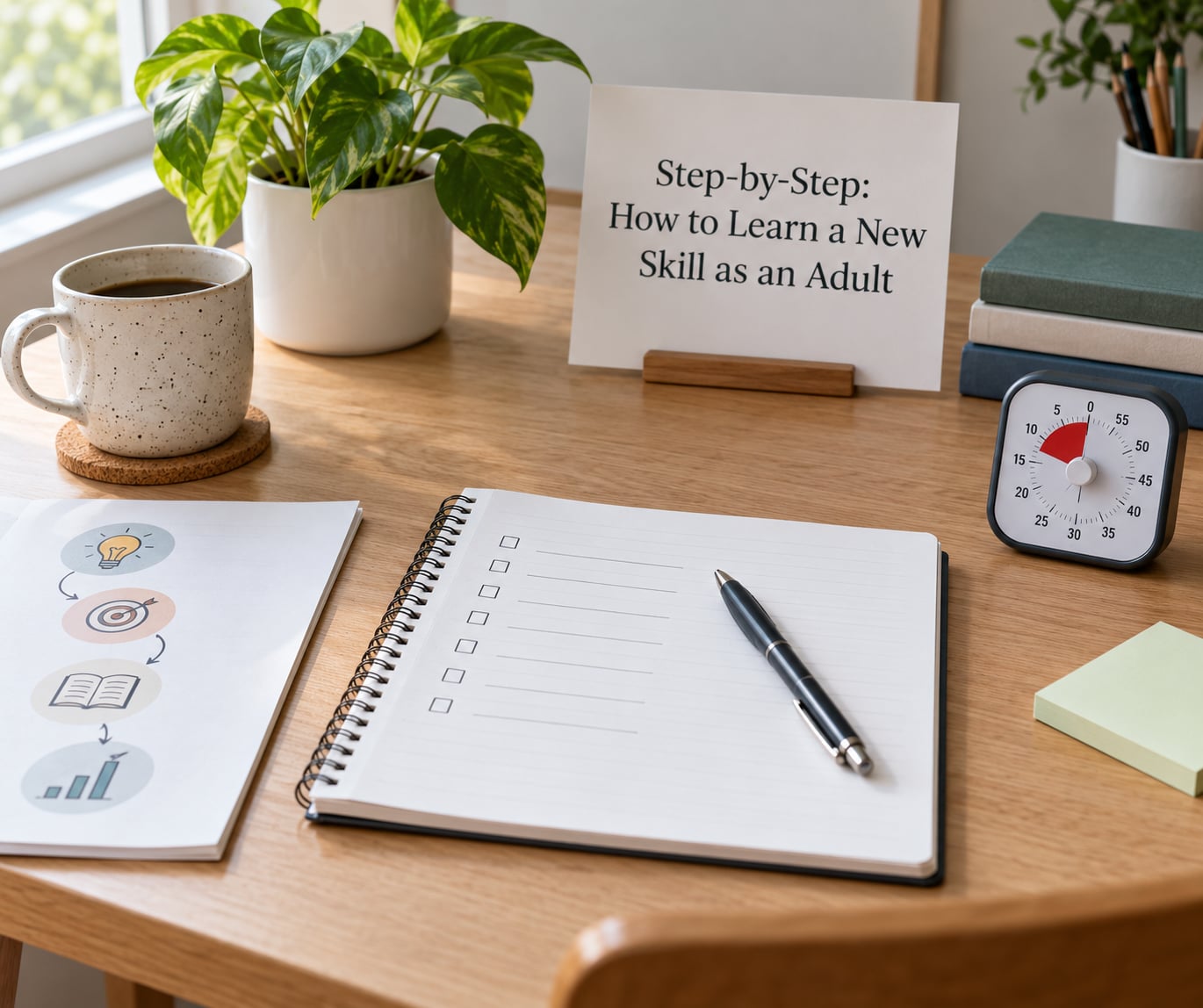
The process runs in six steps and each one has a check that tells you it worked. Skip a check and the next step turns into guesswork.
1. Choose One Skill and Define a Clear Outcome
Choose one skill and write down the first result you want to reach, with a date attached. Adults get stuck at step one because choosing feels like a permanent decision, so make it a temporary one: twelve weeks, then reassess.
A useful test is whether the skill gives you something within a month. Language, cooking, photography and software all produce visible results quickly. Guitar, drawing and weightlifting mostly do not, which is a detail worth knowing before you start.
What worked: your outcome is specific enough that a friend would know whether you hit it. Fail the moment you catch yourself writing words like get better at it.
One Reddit thread asking which skills adults picked up that changed their lives produced a very unglamorous list. Cooking proper meals, sorting out finances, a better way to communicate at work. Practical skills with immediate use beat abstract ones every time.
2. Start With the Fundamentals
Start with the fundamentals and ignore the advanced material for the first two weeks. Beginners who start with a shortcut usually spend months confused and quit before the basics ever click.
Find the smallest complete version of the skill and learn that first. A chord progression you can play cleanly beats a song full of chords you cannot. One recipe you can cook from memory beats five you have to read.
Confirm the basics with a tiny test. Make the thing badly but finish it. If you can complete the introductory task end to end, you understood the foundation and can move on.
- Physical or motor skills: the fundamentals are basic movement patterns, one correct repetition, and a safe setup. You have them when you can do ten clean repetitions without thinking about them.
- Cognitive or book skills: the fundamentals are core vocabulary, the main rules, and the standard workflow. You have them when you can explain that workflow to someone else in your own words.
3. Build a Short Practice Routine
Build a routine of three short sessions a week rather than one long one, because spacing sessions across days is what moves a skill from short-term memory into something you can do without effort. Three 20-minute blocks also survive a week that a two-hour Saturday does not.
Beginners do best at 15 to 30 minutes per session, because past that point attention has usually dropped and extra minutes buy very little. Quality of attention matters more than duration.
Give every session the same three parts: a goal, the practice itself, and a short review. Open your note, write that today’s only aim is to get the transition clean. Work for twenty minutes. Close by writing what was awkward.
One commenter in r/NoStupidQuestions asked how working adults find the time, and the answers were unsatisfyingly ordinary. Wake up twenty minutes earlier, use a lunch break, skip one evening TV hour. People who look like they have more time mostly have more scheduled time.
What worked: you practiced on the days you planned, not only the days you felt like it.
4. Practice Deliberately and Ask for Feedback
Practice deliberately, which means picking the weakest part of your performance and working on only that, then get feedback from someone who can see what you cannot.
K. Anders Ericsson, the researcher behind the idea of deliberate practice, defined it as working on a specific sub-skill with a clear goal, immediate feedback, and a challenge just past your current ability. That is different from turning up and doing the comfortable parts.
Find feedback in whichever form is available to you. A friend who plays the instrument, a group class, a weekly check-in with someone at the same level, or a recording you watch back yourself. Recording yourself is the cheapest option and the one most beginners skip.
Apply one correction at a time. Get nine notes in a session and you will change nothing. Take the single highest-value fix, spend the next three sessions on it, and move on.
Beginners often say the same thing about starting from scratch: it feels awful precisely because it is working. That discomfort is information, not a verdict on your ability.
5. Track Progress With Visible Evidence
Track progress with visible evidence rather than with how you feel, because feeling does not improve at the same rate as skill and it will convince you that nothing is happening right when everything is.
Keep one of these: a dated video from the first session and one from every month after, a checklist of moves you can now do, a count of attempts at something that used to fail, or a time benchmark such as how long your best run takes now.
Put the evidence where you will see it. A video file named with the date beats a memory of how it went. Reviewing month one after month three is also the fastest cure for quitting, because the improvement becomes impossible to argue with.
Hobby threads are full of the same warning about martial arts. Ten years of weekly Muay Thai can leave you competent rather than good. Real timelines look like that, and knowing it in advance is what keeps you from quitting in month two.
6. Increase Difficulty and Stay Consistent
Increase difficulty gradually and keep the routine intact through weeks when life gets busy, because skill comes from months of short sessions rather than a few intense bursts.
Raise the difficulty only after the current level feels comfortably boring. If a task stops being challenging, add speed, reduce help, or add a variable. If it stays hard for weeks, drop back a level, because a skill that never gets finished is a skill that never gets automatic.
Have a minimum version for bad weeks. Fifteen minutes counts. Ten minutes counts. The floor protects the habit, and the habit is doing the real work.
Once you reach a useful level, drop the frequency and hold the skill. Most of what you learned fades within a couple of years of zero practice, so one short session a week is the price of keeping it.
Common Mistakes
Taking on three courses at once
The fix is to finish one course before starting another, no exceptions. Forum users describe the pattern plainly: several bought courses, none finished, and a stack of half-watched material with no skill attached. Pick one, finish it, then pick the next.
Waiting until you feel ready
The fix is to start before you are ready, badly, with the first lesson of the first course. Nobody feels ready at the start of anything. The readiness feeling arrives about three weeks in, and only if you are still practicing.
Practicing without feedback
The fix is to arrange one outside check per week. Record a video, join a class, or agree with a friend to swap five-minute recordings. Practicing without feedback is how people spend a year making the same mistake at high speed.
Skipping the exercises you dislike
The fix is to do the boring drill on purpose. The dull warm-up, the slow drill, the part you keep scrolling past. Most plateaus are not mysterious, they are the result of avoiding one specific unfun task.
Setting goals with no finish line
The fix is to write an outcome you could show someone. Get better at guitar is a mood. Play three songs without stopping is a target with an end date.
Comparing your week one to someone else’s year five
The fix is to compare this month with last month and with nobody else. A beginner who is visibly beginner is behaving normally, which is the most repeated point across the Reddit threads about picking up hobbies as adults, and one 56-year-old commenter put the upside plainly: the joy is in the beginner phase, and you are never too old to have it.
Frequently Asked Questions
How long does it take to learn a new skill as an adult?
It depends on the skill, but plan in months rather than weeks. Most adults reach a decent, usable level in roughly three months of regular short sessions, and true competence takes two to three years. A language or an instrument takes longer because the skill has hundreds of separate parts. Anything with a clear finish line, like cooking a dish or learning one song, can show results in weeks. Judge progress by what you can do, not by the calendar.
Is it too late to learn a new skill at 40, 50 or 60?
No, and the evidence for that is reasonably strong. Adults learn physical skills a little more slowly than children do, mainly because of recovery and coordination, but adults bring better attention, better language and a clearer reason for learning. Many of the advantages children rely on, like fearlessness and unlimited time, are not really advantages. Starting late costs you years of starting early, not your ability to learn.
How do working adults find time to learn a new skill?
You protect a small fixed slot instead of waiting for free time to appear. Three sessions of 20 minutes a week beats one two-hour block, because the short version survives deadlines and illness. Most people use the edges of the day: earlier mornings, a lunch break, or one evening replaced. Write the slot in the calendar as an appointment with yourself, and lower the floor to ten minutes for weeks that go wrong.
What is the fastest way to learn a new skill?
Fast progress comes from practice with feedback, not from consuming more material. Pick one sub-skill, work on it with your full attention, find out immediately whether you did it right, and repeat across many days. Watched tutorials feel productive but produce very little. Deliberate practice, the term the researcher K. Anders Ericsson used for this, is slower looking and much faster overall.
Why do I quit hobbies before I get good at them?
Almost always for the same two reasons: progress is invisible early on, and boredom peaks exactly when results would start arriving. The early phase feels like work because your skill is improving faster than your judgement can perceive. Counter it with evidence, such as dated recordings and monthly comparisons, and pick a skill that gives you a visible result inside the first month if you know you quit things.
Is learning a new skill a hobby?
It can be, but the skill itself does not have to be a hobby. Plenty of people treat one as a project with a finish line and move on, which is perfectly valid. The adult learners who seem to stick with things usually treat the skill as a practice with a schedule and keep one social element attached, such as a class or a group, because practicing alone is the easiest thing in the world to quietly stop doing.
Conclusion: Start With One Small Session Today
Choosing one realistic skill is the only first step that matters, so pick it tonight and write down the result you want, dated twelve weeks out.
Then put a 20-minute session in tomorrow’s calendar, open your first lesson, and practice badly. That is how to learn a new skill as an adult: one skill, one outcome, short frequent sessions, feedback weekly, and evidence that you are improving even when you cannot feel it.