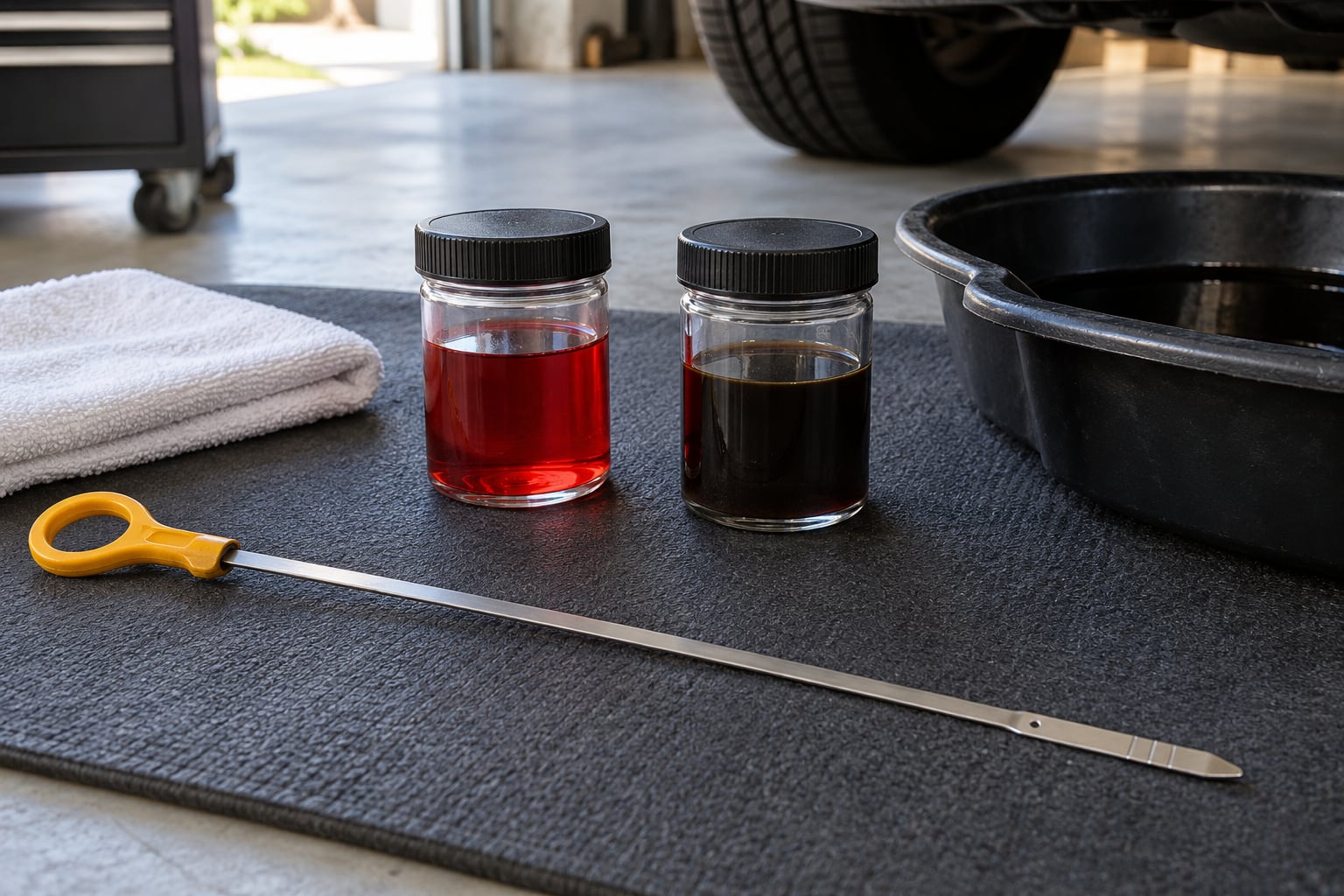
If you pull the dipstick and want a straight answer: fresh automatic transmission fluid is bright, translucent red. What does transmission fluid look like when it needs changing? Dark brown, black, or rust-red, with a burnt smell, grit in it, foam, or a level below the MIN mark.
Fluid condition is judged by three cues read together: color, smell and texture. None of them on its own proves a problem, and some factory fluids are dyed blue, green or purple instead of red, so the fill cap and your owner’s manual matter as much as the dipstick does.
Table of Contents
- 1What Does Transmission Fluid Look Like When It Needs Changing?
- 2Transmission Fluid Colors: What Each One May Mean
- 36 Signs the Transmission Fluid Needs Changing
- 41. The fluid has darkened
- 52. It smells burnt or fishy
- 63. Grit, sludge or metal particles
- 74. Slipping or delayed engagement
- 85. Harsh shifts, shudder and vibration
- 96. Overheating, leaks and warning lights
- 10How to Check Your Transmission Fluid Safely
- 11What Does Transmission Fluid Look Like on the Dipstick?
- 12Can You Still Drive It? A Triage Guide
- 13Does a Fluid Change Mean a Transmission Repair?
- 14Manual vs. Automatic Transmission Fluid: What to Check
- 15Why You Should Follow the Owner’s Manual
- 16Frequently Asked Questions
- 17Is dark transmission fluid always bad?
- 18What is the difference between a transmission drain-and-fill and a flush?
- 19Why does my transmission fluid smell burnt?
- 20Can I drive with low transmission fluid?
- 21Should I have the transmission checked before paying for a fluid change?
- 22Conclusion
What Does Transmission Fluid Look Like When It Needs Changing?
Transmission fluid that needs changing has usually darkened from bright red toward brown or black, smells burnt or fishy, and can feel gritty or frothy instead of slick. A level under the MIN line, pink or milky color from coolant, or metal flecks in the pan all point to service too.
Why does the color change at all? The fluid is dyed at the factory and it oxidizes as it heats under pressure for years. Along the way it loses the anti-shudder and friction properties that let a torque converter and clutch packs do their jobs, and the wear it produces shows up as slipping or harsh shifts.
But color alone is weak evidence. A car with 140,000 careful highway miles can hold brick-red fluid well past what a hard-towing truck shows in amber, and some brands never dyed their fluid red to begin with. Judge against the interval in your manual, not against a neighbor’s dipstick photo.
Transmission Fluid Colors: What Each One May Mean
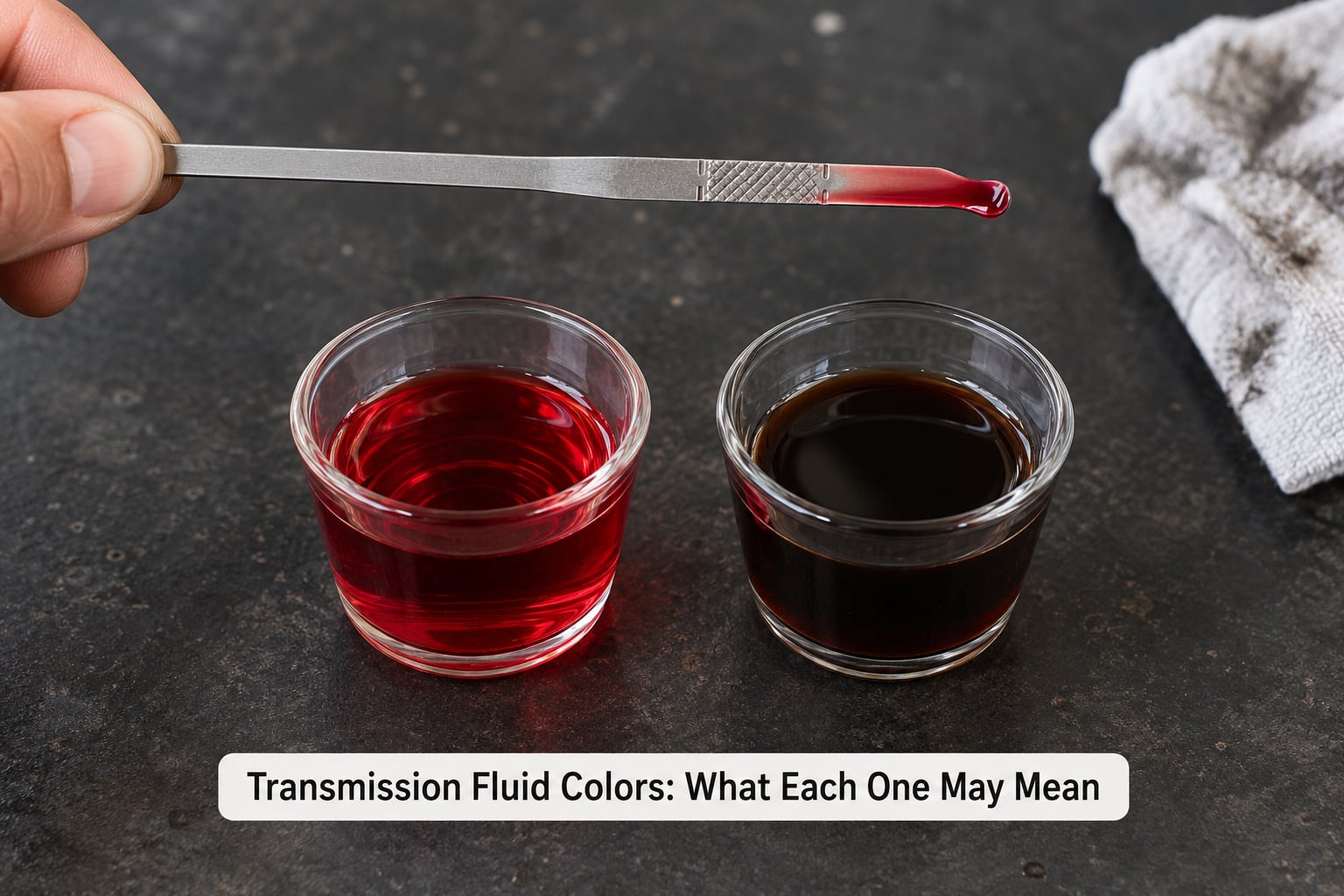
This is the color chart most guides leave out as an actual table. Read the color, then read what it may mean, then decide what to do about it.
| Color | What It May Mean | What to Do |
|---|---|---|
| Clear or pale amber | New fluid, lightly dyed, or a factory fill that was never red | Nothing, if the level is between MIN and MAX and it matches your specification |
| Bright translucent red | Healthy fluid early in its service life | Keep the interval your manual gives |
| Dark red or brick red | Normal aging, often several tens of thousands of miles old | Book service if you are near the interval in the manual |
| Rust-red or orange-brown | Dye fading and early oxidation, sometimes with varnish on the pan | Plan a drain-and-fill; check for a recent tow or heavy load |
| Muddy brown | Oxidation and accumulated wear particles | Service soon, and ask the shop whether a flush is worth it |
| Dark brown to black, often thin | Burnt fluid. Friction material is cooking in it | Stop daily use until a transmission specialist looks at it |
| Pink, milky or cloudy | Coolant mixed in through a failed cooler line or radiator weld | Do not just change the fluid. Diagnose the leak first |
| Foamy or frothy, opaque | Air in the system, a wrong low-viscosity fluid, or coolant again | Tow it in. Aerated fluid starves the pump of lubrication |
| Glittering grit or metal flakes | Clutch or gear wear coming off internal surfaces | Diagnosis, not a fluid change |
Two checks before you trust any of it. Wipe the fluid on a clean white paper towel and look at it in daylight: varnish that leaves a brown ring means heat damage, not just age. And find the service fluid identification sticker under the hood or in your manual, which tells you exactly what specification your car wants.
6 Signs the Transmission Fluid Needs Changing
1. The fluid has darkened
Progressive darkening is the most common signal, and the least conclusive on its own. Red that has drifted to brick or rust-red usually means the fluid is simply old. Dark brown or black means oxidation has gone past what a drain-and-fill was meant to restore.
2. It smells burnt or fishy
Fresh fluid has a clean, slightly petroleum smell. A burnt, scorched or fishy odor means friction material is breaking down inside the fluid, which is what overheating clutches actually smell like. Forum consensus treats smell as the confirming signal that dark color means damage rather than normal aging.
Smell is easy to test and easy to miss, because it often shows up as a hot-metal odor on a hot day after a long drive. If a passenger mentions it, take that seriously.
3. Grit, sludge or metal particles
Rub a drop between your fingers. Fresh fluid feels slick and even. Grit means metal or clutch material is suspended in it, and a thick, gritty sludge that clings to the dipstick rather than wiping off suggests varnish building inside the pan.
4. Slipping or delayed engagement
This is the one to act on. If the transmission does not pull in promptly when you shift into drive or reverse, or the revs climb before the vehicle actually moves, the clutches are slipping on fluid that has lost its friction. A momentary delay in park on a cold morning is normal; a delay that happens every day is not.
5. Harsh shifts, shudder and vibration
Hard shifts with no give, a shudder through the first few miles, or vibration tied to load all point at degraded anti-shudder properties. The same symptoms also show up with worn clutch packs or a tired torque converter, so treat them as a reason to get a diagnosis rather than proof of one cause.
6. Overheating, leaks and warning lights
Fluid that overheats gets a step-change in color, because heat cooks it. Leaks are worth reading too: fresh red fluid under the front of the car, centered on the pan, is usually a pan gasket or drain plug. A stained pan with no puddle means seepage that has dried. Any warning light or flashing indicator is a reason to stop and tow.
How to Check Your Transmission Fluid Safely
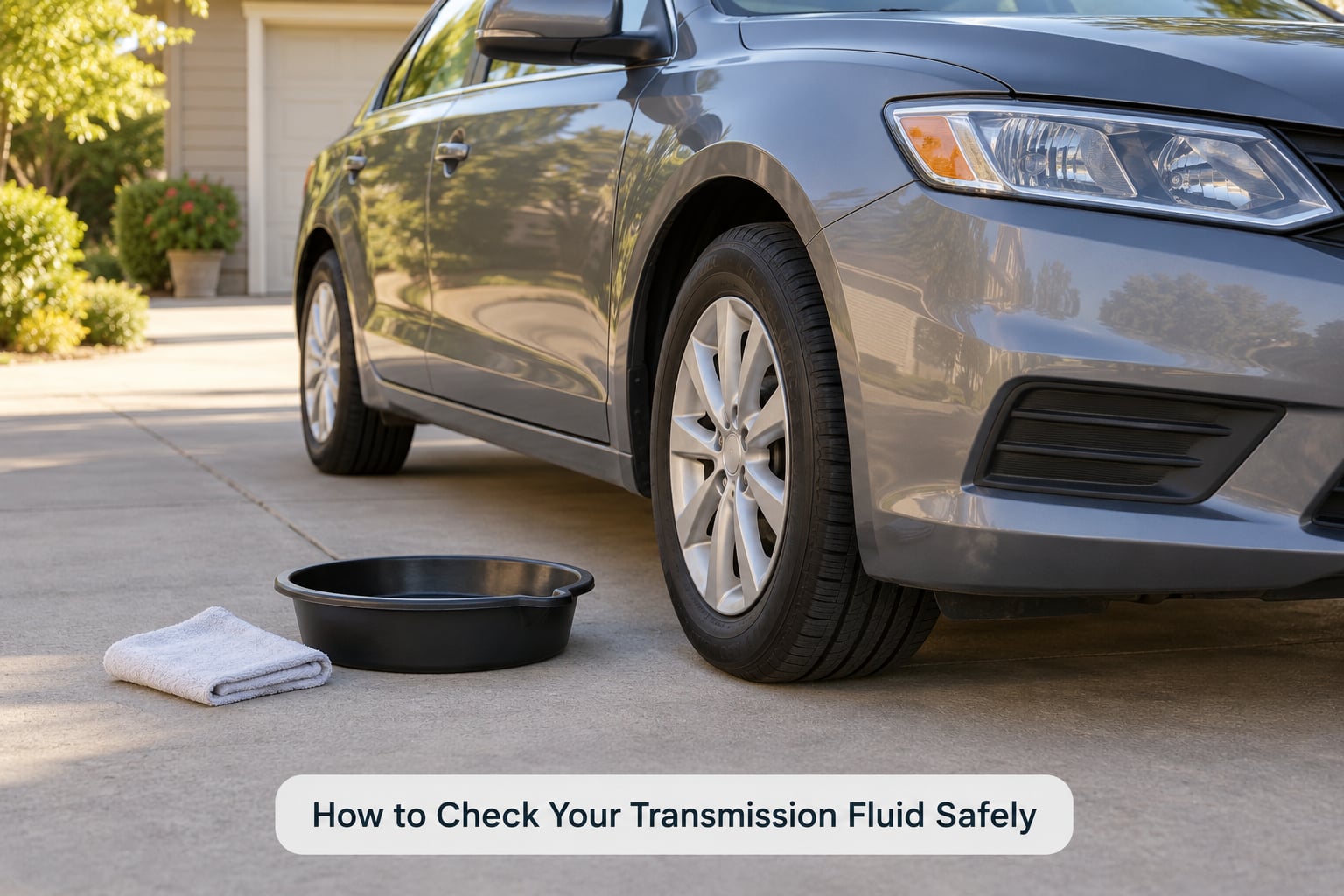
The routine check takes about five minutes and works on most automatics with a dipstick. The manual always outranks this sequence, so read the fluid check page first.
- Park on level ground, set the parking brake, and let the vehicle idle or drive until it reaches full operating temperature if your manual calls for a hot check.
- Put the transmission in the gear your manual specifies, usually park with the engine running, or neutral with the engine off.
- Locate the transmission dipstick and pull it. Wipe it clean with a lint-free rag.
- Push it fully back in, then pull it again and read it immediately. Skipping the second pull is the most common mistake in this whole procedure.
- Read the level against the marks, check the color, then rub a drop between your fingers and smell it.
- Reinsert the dipstick fully, close the filler plug, and check under the car for fresh fluid on the ground.
Keep your hands and loose clothing away from hot exhaust parts, and never work underneath a car supported by a jack alone. If your vehicle has no transmission dipstick, look for a check plug under the transmission, common on trucks and pickups, and add fluid through it. Many newer automatics have no dipstick and no plug at all, which means the level is read with a scan tool and a prescribed fluid temperature, so that check belongs at a shop.
What Does Transmission Fluid Look Like on the Dipstick?
You are looking for four things at once: a level between MIN and MAX, a smooth film rather than a gritty one, no burnt smell, and a color that matches what your specification calls for fresh fluid.
Many dipsticks carry a COLD range on one side and a HOT range on the other. The cold range is a rough safety reference for driving until the transmission warms up. The hot reading is the authoritative one, because fluid expands as it heats and the level rises between the two marks. Reading the cold side and calling it low is how people replace good fluid unnecessarily.
Warm fluid spreads across the dipstick in a thin, even film that shows the level clearly. Cold fluid beads up, and a very low level leaves nothing on the tip at all. If the level sits at or under MIN when the fluid is hot, add only the specification and amount your manual calls for, a little at a time, and recheck.
Can You Still Drive It? A Triage Guide
Dark but steady fluid, a correct level, no warning light and normal shifting usually means you can finish the week and schedule a drain-and-fill. That is the ordinary case, and it is what fluid service is for.
Do not keep driving if the transmission slips, hesitates, bangs into gear, shudders hard, shows a transmission warning light, leaks onto hot exhaust, or has pink or foamy fluid in it. Aerated or coolant-contaminated fluid cannot lubricate, and running the pump dry converts a fluid service into a transmission replacement. Tow it instead.
One more case worth knowing: fluid that looks fine can still be wrong. If the car was serviced with the wrong specification, a fluid that was never changed on a 200,000-mile vehicle, or fluid that was topped up with the wrong low-viscosity product, the color will not show it. Changing shifts, slipping or a service history you cannot verify are all reasons to get a proper diagnosis.
Does a Fluid Change Mean a Transmission Repair?
No. A routine service and a repair are different conversations, and it is worth knowing which one you are having.
A drain-and-fill empties the pan, replaces the filter and refills to the specified level. Fluid in the torque converter and the cooler lines never leaves, so a meaningful share of the old fluid stays inside, which is why some shops quote a machine exchange that pushes fluid through the system under pressure. A flush pulls more of the old fluid out, and it also moves wear debris that was settled in the pan, so it is not automatically the better option.
Skip the service-quote conversation entirely and go straight to diagnosis if the transmission slips, grinds, shudders or throws a warning light. New fluid will not restore a worn clutch pack, and paying for a flush first only adds to the bill. On some older or higher-wear units the manufacturer also prohibits high-pressure flushing, so the manual decides that question too.
Manual vs. Automatic Transmission Fluid: What to Check
In a manual gearbox, the fill is usually a plug on the side of the case or the tail of the transaxle, checked at a specific oil temperature with the vehicle level and the transmission in neutral. That fluid is heavier, darker and often not dyed, so it can look like used motor oil. Intervals are longer and less often specified than for automatics, and lots of manual gearboxes are designed to run the oil for the life of the vehicle.
A CVT uses a lighter, more friction-sensitive fluid, commonly a green or amber color. That is deliberate, not a defect. Using conventional ATF in a CVT or a CVT fluid in a conventional automatic causes exactly the shudder and slipping people describe as a fluid problem.
Keep three fluids apart in your head. Clutch and brake fluid is clear and thin and lives in the hydraulic reservoir. Transmission fluid is red, amber or undyed depending on type, and lives in the transmission. Engine oil is amber to brown and does not belong in the dipstick tube.
Why You Should Follow the Owner’s Manual
Fluid type, change interval, quantity, temperature and replacement method all come from the same document, and each one can be specified differently in the same transmission. Intervals for many automatics fall roughly in the 60,000 to 100,000 mile range or four to eight years, but a tow-heavy truck and a commuting sedan on the same platform can have completely different schedules.
The manual is also the authority on the service procedure. Some units require a specific fluid temperature at the drain plug, some call for a scan-based exchange, and some warn against high-pressure flushing. Using a fluid that does not meet the specification can change shifting behavior, cost you cooling capacity in the torque converter, and complicate warranty coverage.
If you have lost the manual, a dealer service department or a transmission specialist can identify the specification from the VIN in a few minutes. That is a cheap hour compared with a rebuild.
Frequently Asked Questions
Is dark transmission fluid always bad?
Not always. Brick-red or rust-red fluid that is smooth, smells clean and shifts normally is often just aging, especially on a high-mileage car with gentle service history. Black, thin fluid with a burnt odor, or grit under your fingers is a different story, because that combination means the fluid is oxidized and carrying friction material. Judge color against smell and texture, and against the interval in your manual rather than a photo online.
What is the difference between a transmission drain-and-fill and a flush?
A drain-and-fill empties the pan, replaces the filter and tops up to the specified level. Fluid trapped in the torque converter and cooler lines stays behind, so a good share of the old fluid remains. A machine flush pushes fluid through the system under pressure to pull more of it out, and it can also stir settled wear debris loose. Some manufacturers prohibit high-pressure flushing, so check the manual first.
Why does my transmission fluid smell burnt?
A burnt, scorched or fishy odor usually means friction material from the clutch packs is breaking down in the fluid. That happens when the transmission overheats or runs on fluid that has broken down, and it usually comes with a darkened color. If the smell shows up on hot days after long drives, get the transmission inspected rather than only changing the fluid, because the odor means something inside is cooking.
Can I drive with low transmission fluid?
A level between MIN and MAX on the hot reading is the target. If the fluid is low but there is no slipping, no warning light and normal shifting, you can drive carefully and add the specified fluid soon. Do not keep driving if the transmission slips, hesitates or bangs into gear, or if there is a leak. Continued running with low fluid starves the pump, and the damage that causes costs far more than a top-up.
Should I have the transmission checked before paying for a fluid change?
Yes, if the car shifts differently than it used to, slips, shudders, grinds or lights a warning. Those symptoms come from worn clutches, a failing torque converter or a leak, and no amount of new fluid repairs any of them. If the car shifts normally and the fluid is simply dark and old, a drain-and-fill on the manual’s schedule is a sensible expense you can book directly.
Conclusion
Start with the car on level ground and the owner’s manual open to the fluid specifications and service interval. Pull the dipstick, read the hot level against MIN and MAX, then look at the color in daylight, rub a drop between your fingers and smell it. Dark on its own is not a verdict.
Book the fluid service your interval calls for, and skip straight to a transmission specialist if you find slipping, grinding, shudder, a warning light, a leak onto hot exhaust, or pink or foamy fluid. That combination is not a maintenance item, it is a towing item.