Tires need replacing when the tread reaches 2/32 inch of remaining depth, when you start shopping at 4/32 inch, when the sidewall shows cracks, bulges or exposed cord, or when the tire is about six years old regardless of how much tread is left. The whole inspection takes about 15 minutes in your driveway with a gauge and a flashlight.
That is the short answer most people are after. The longer version matters more: a tire can look perfectly fine from the curb and still be one pothole away from a blowout, and a tire with deep tread can be too old to grip a wet road.
Knowing how to tell if your tires need replacing takes less time than most drivers expect. Here is a seven-check routine you can actually run without a shop. Do all four tires plus the spare, take photos if you want a before-and-after record, and follow your owner’s manual whenever it says something different from what you read here.
Table of Contents
- 1What You Need
- 2Step-by-Step: How to Tell If Your Tires Need Replacing
- 31. Check the tread depth first
- 42. Look for uneven or irregular wear
- 53. Inspect the sidewalls and tread surface
- 64. Check tire age with the DOT date code
- 75. Verify inflation and watch for pressure loss
- 86. Consider driving conditions and mileage
- 97. Confirm the result with a tire professional
- 10Common Mistakes
- 11Frequently Asked Questions
- 12How old is too old to drive on a tire?
- 13What is the minimum tread depth for a car tire in the US?
- 14Should I replace all four tires at the same time?
- 15Can I drive with one tire showing uneven wear?
- 16Does the tire sidewall pressure equal the recommended inflation pressure?
- 17Can a tire with a small puncture be repaired or does it need replacing?
- 18Conclusion
What You Need
You do not need to buy anything expensive. Most drivers already own half of this list.
- A tread-depth gauge. A pen-style gauge with a pointer costs very little and gives you a real number. This is the only tool that matters.
- A tire-pressure gauge. A stick gauge is fine; a digital one is easier to read in the dark.
- A flashlight or headlamp. Sidewall cracks hide in shadow.
- A quarter and a penny. The quarter test and penny test are the two DIY checks named most often by tire makers and driver clubs.
- Your owner’s manual and the door-jamb placard. The placard on the driver’s door frame lists the correct cold pressures for your specific vehicle.
- Your tire records. The purchase invoice, plus the date code molded into each tire, tell you the tire’s real age.
Park on a level, well-lit surface. If you have a jack and wheel chocks, they let you check the inner sidewall properly, though you can inspect most of the tire without taking a wheel off.
Step-by-Step: How to Tell If Your Tires Need Replacing
Run the checks in this order. Tread depth is the biggest factor, damage is the biggest danger, and age is the one people forget. Inspect all four tires and the spare, then decide.
1. Check the tread depth first
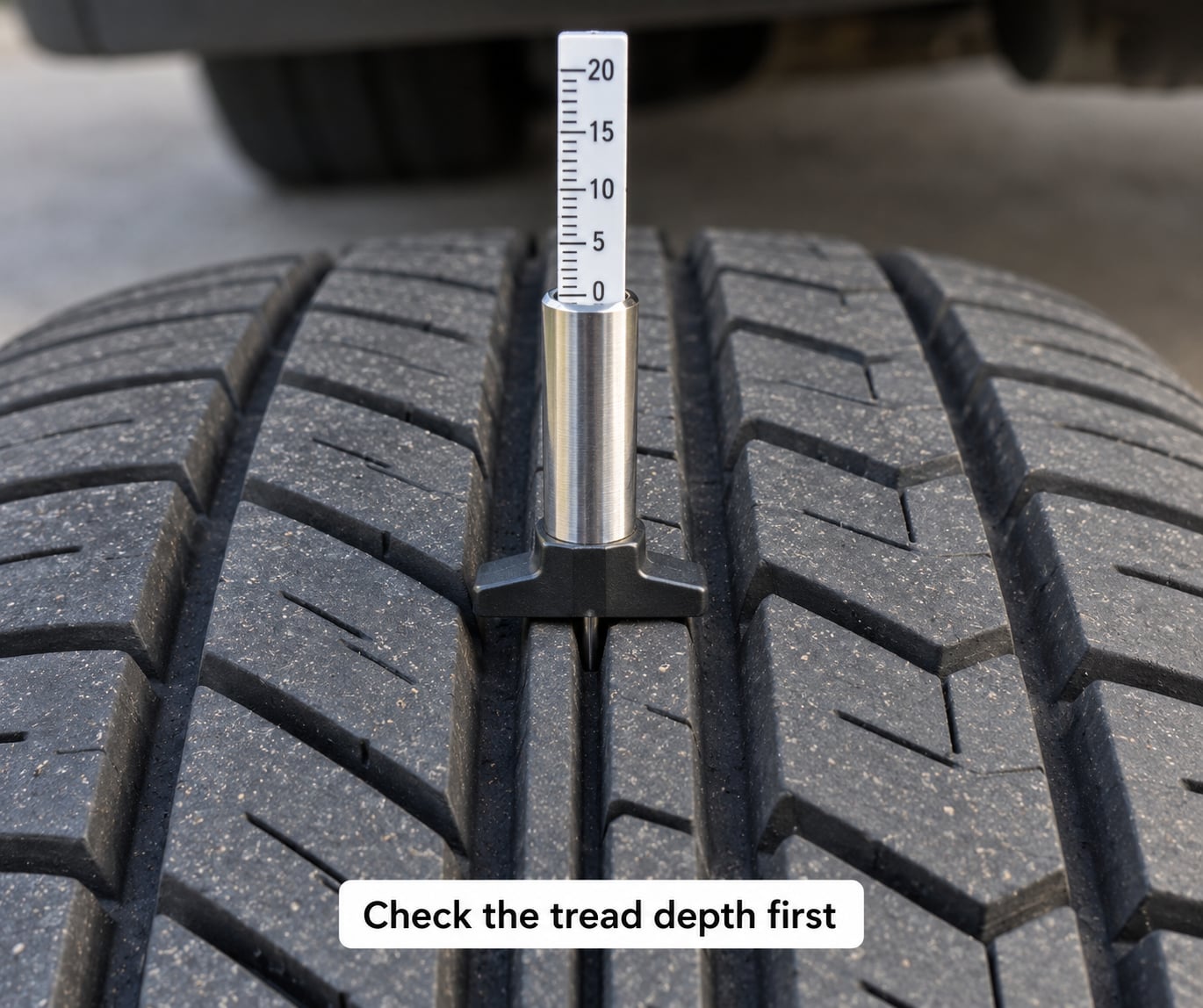
Insert the gauge into the main grooves and read the depth, then repeat in at least three places around each tire: the center, the inner shoulder and the outer shoulder. Depth varies across the face of a tire, and one good spot hides a bald spot elsewhere.
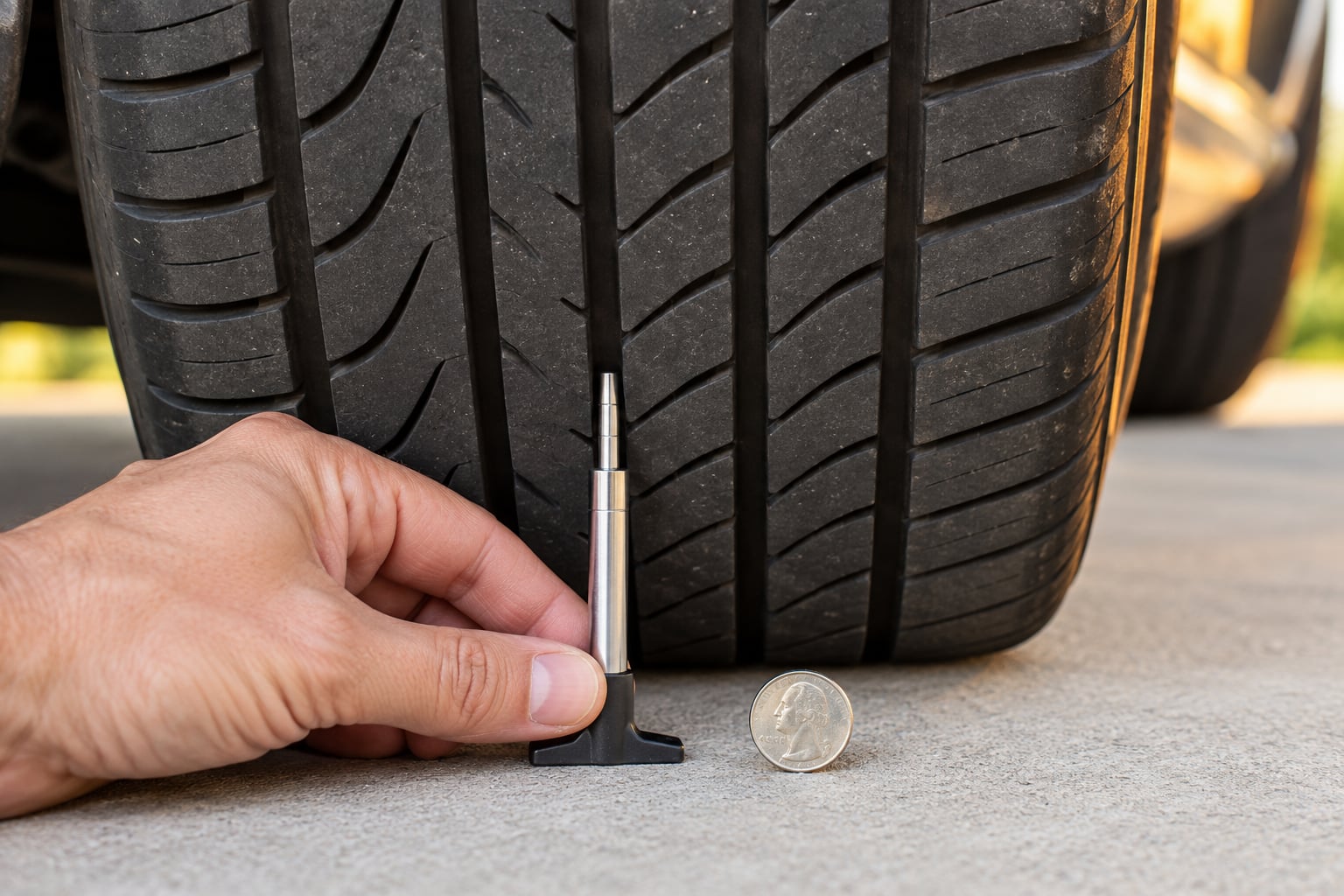
The penny test is the quick version. Put a penny upside down in the groove and cover as much of Lincoln’s head as you can. If you can see any part of the head above the tread, you are under 2/32 inch and legally out of tread.
The quarter test gives you the smarter threshold. Push a quarter into the groove the same way. If the top of Washington’s head is flush with or just above the tread surface, you have roughly 4/32 inch left, which is when you should start shopping rather than when you should panic.
Also look for the tread wear indicator bars: small raised bars molded into the bottom of the main grooves. When tread wears down level with those bars, you are at 2/32 inch. Tread wear bars are the legal standard, which is why a shop that tells you to replace a tire that “still looks deep” is usually working from the bars, not from the side profile.
| Tread reading | What it means | What to do |
|---|---|---|
| 8/32 inch or more | Plenty of usable life | Keep rotating every 5,000 to 7,000 miles |
| 6/32 inch | Comfortable, and typical for a well-used set | No action, keep checking monthly |
| 5/32 inch | Still safe, but below what most mechanics like to see | Start planning the purchase |
| 4/32 inch | Wet-weather grip is dropping; the point to shop | Order replacement tires now |
| 3/32 inch | Rain, snow and standing water become risky | Replace soon, avoid highway trips in storms |
| 2/32 inch | Federal minimum reached; tire is worn out | Replace immediately, or the tire is out of legal use |
| Below 2/32 inch | Unsafe and illegal in most states | Do not drive on it |
2. Look for uneven or irregular wear
Even wear across the whole face is the goal. When one area of a tire wears faster than the rest, the cause is usually a pressure problem, an alignment problem, or a worn steering or suspension part, and new tires will wear the same way if you do not fix it.
| Wear pattern | Likely cause | What to check |
|---|---|---|
| Smooth center band, edges still grooved | Overinflation | Cold pressures against the door-jamb placard |
| Both outer edges worn, center intact | Underinflation | For a leak, and the placard pressure again |
| Inner edge or outer edge worn on one tire only | Wheel alignment out of spec | Alignment check and worn tie rods or ball joints |
| Ragged, angled tread blocks pointing in different directions | Feathering from alignment or worn steering parts | Alignment, tie rod ends, pitman arm |
| Repeating rounded scallops around the tread | Cupping, usually from a worn shock, strut or wheel bearing | Suspension and wheel bearings |
| One side of a tire flat and shiny, other side untouched | Tire ran underinflated on one side, often a bead or slow leak issue | Tire carcass, wheel, and how long it ran low |
If a tire has worn unevenly down to the bars in one spot, the tread depth reading from step 1 is not the whole story. That tire is finished even if the center still measures 6/32 inch.
3. Inspect the sidewalls and tread surface
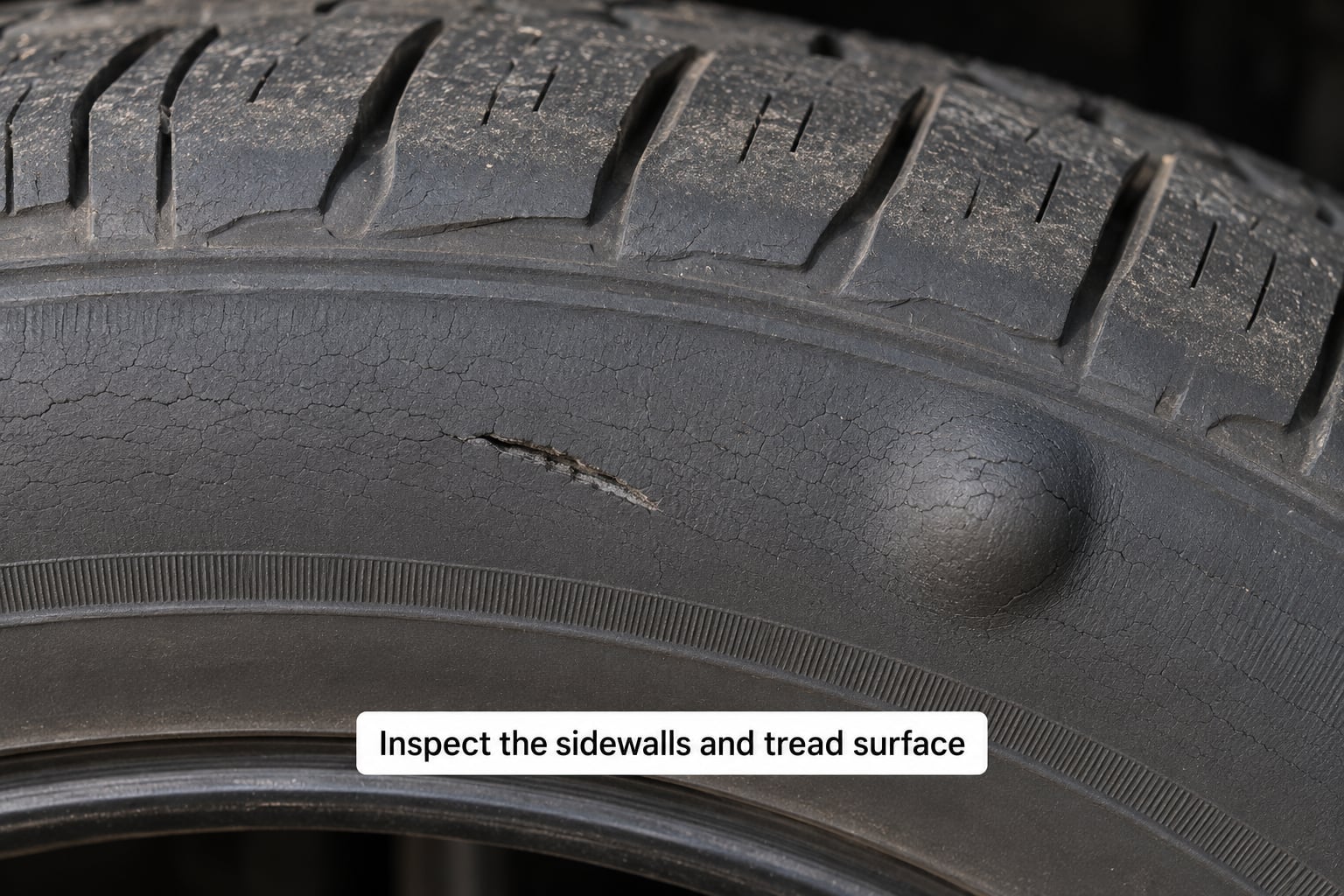
Run your fingers around the full circumference of each sidewall, not just the outer face. Cracks that run side by side and look like dried mud are a normal sign of age and UV exposure. Cracks that branch, crumble, or open into the rubber are not.
A bulge or knot anywhere on the sidewall is a reason to stop using the tire. That shape means a belt or carcass has separated inside, and the same failure that made the bulge can open suddenly at highway speed.
Other damage worth ending the tire: cuts or slashes deep enough to see the cords, exposed steel belt or textile ply through the tread, blisters or bubbles in the tread surface, a puncture in the shoulder or sidewall area rather than the tread, and any tire you have run flat, even if it looks fine afterwards. Damage in the sidewall or shoulder is generally not repairable, because repair patches only work in the tread area.
A tire with a small nail or screw in the tread can usually be repaired from the inside with a proper patch-plug combination, as long as the hole is in the tread, not the shoulder, and the tire is not near the end of its life. One repair per tire, in the tread area, is the usual rule.
4. Check tire age with the DOT date code
Every tire has a DOT code stamped on the sidewall, and the last four digits are a manufacturing date: two digits for the week and two for the year. “2212” means the tire was made in the 22nd week of 2012. A three-digit code on older tires uses the decade’s last digit as the first digit, so “715” means week 15 of 2015.
Use the date code on the oldest tire on the vehicle, not the newest. A set where one tire is four years old and the other is a year old is an old set.
The general guidance is to start inspecting closely around six years and to plan replacement by ten years regardless of tread depth, sooner if the rubber looks baked, chalky or cracked. Rubber ages whether or not the car moves, which is why a tire on a trailer or a rarely driven car can be past its useful life while sitting still.
5. Verify inflation and watch for pressure loss
Compare your tires against the placard on the driver’s door jamb, never against the number molded into the sidewall. The sidewall figure is a maximum cold pressure rating, and filling to it can give you a harsh ride, a worn center band and worse wet grip.
Check pressures cold, before you drive more than a mile or so, since driving warms the air and raises the reading. Tire pressure monitoring systems warn when a tire falls about 25 percent below the expected pressure, which is late in the game for a slow leak.
If a tire needs air every month or two, you have a leak until proven otherwise. Use soapy water on the bead, the valve stem and any tread repair to find the bubble. A tire that has gone flat, or has had a repair plug installed in the wrong place, is usually a replacement tire, not a patch candidate.
6. Consider driving conditions and mileage
Tread depth tells you the present, not the future. A tire at 5/32 inch that has already covered 45,000 miles has a different amount of life left than a tire at 5/32 inch that has covered 12,000 miles, because the compound has been heat-cycled and the carcass has taken the hits.
Add the load you ask of the tire. Long highway commutes, roof racks, a boat or trailer, frequent trips with full seats, potholed streets, summer heat, and driving in rain, snow or ice all shorten useful life.
Mileage on its own does not condemn a tire. Thirty thousand miles on a set is fine if the tread is still deep and the rubber looks healthy; forty thousand miles on a highway tire that has never been rotated is where the story turns.
7. Confirm the result with a tire professional
Once you have your numbers, a shop visit settles the rest. Knowing how to tell if your tires need replacing gets you to a yes or no, but a technician should still inspect the tire carcass and bead, check the wheel for a bend or crack, look at the brakes while the wheel is off, and check alignment. Ask them to explain any uneven wear before they install anything.
On whether to replace four or two: the common rule is that two tires on the same axle should be within 2/32 inch of each other, because a difference means the axle grips unevenly. On all-wheel-drive and four-wheel-drive vehicles, tires are commonly matched across the front axle to each other and across the rear axle to each other, and many shops replace all four when the cost difference is small.
Match the size, load rating and speed rating on the replacement, and check whether the vehicle is a staggered fitment before you buy. If only two are going on, put the newer pair on the rear axle for traction under acceleration, following your vehicle maker’s guidance.
Common Mistakes
Trusting the sidewall pressure number. That number is a maximum, not a target. Use the door-jamb placard.
Judging tread by eye from the curb. The shoulder can look deep while the center is at the wear bars. Measure in three spots.
Waiting for 2/32 inch. The legal floor is not the safe floor. Wet braking degrades well before the tire is technically bald, which is why the 4/32 inch shopping threshold exists and why many mechanics replace at or below 5/32 inch.
Ignoring age. A six-year-old tire with 9/32 inch of tread still ages. Rubber hardens whether or not the tread is gone.
Replacing a single tire without checking the others. If one tire is at the bars, the cause is usually a pressure or alignment problem that the new tire will inherit. Match sizes and ratings, and get the wear pattern checked.
Driving on visible damage. Bulges, exposed cord, cracks in the sidewall and tires you have run flat are not “monitor it” situations.
A few habits catch most problems early: walk around the car once a month and look at the tires before you get in, check cold pressures with your own gauge rather than trusting the dashboard, rotate every 5,000 to 7,000 miles, and give the tires a proper look before a long trip rather than after a blowout on the interstate.
Frequently Asked Questions
How old is too old to drive on a tire?
Most passenger tires are considered past their useful life around six years old and should be replaced by ten years from the manufacture date, even with deep tread remaining. Find the date in the last four digits of the DOT code on the sidewall, where 2212 means week 22 of 2012. Inspect closely at six years and replace by ten, or sooner if the rubber looks chalky, cracked or hard. Age matters because the compound and belts degrade with heat, UV and time, not with mileage.
What is the minimum tread depth for a car tire in the US?
The federal minimum is 2/32 inch of tread depth on the main grooves, which is the level of the tread wear indicator bars molded into every tire. Below that, the tire is worn out and illegal to drive on in most states. Because wet braking and standing-water grip fall off sharply before that point, many drivers shop at 4/32 inch and many mechanics recommend replacement at 5/32 inch or less.
Should I replace all four tires at the same time?
Not always, but the two tires on each axle should stay within about 2/32 inch of each other so that axle grips evenly. Replacing all four is the simplest answer and often the cheapest once labor is already booked. On all-wheel-drive and four-wheel-drive vehicles, matching across axles is common. If you replace only two, buy the same size, load rating and speed rating, and put the newer pair where your vehicle maker directs, often the rear.
Can I drive with one tire showing uneven wear?
You can, but treat it as a warning rather than a clearance. Uneven wear such as feathering, cupping or one edge going bald usually points to an alignment problem, a worn steering or suspension part, or repeated underinflation, and a new tire will wear the same way. If one edge has worn down to the wear bars while the center still has tread, that tire is finished. Have the cause diagnosed before paying for rubber.
Does the tire sidewall pressure equal the recommended inflation pressure?
No. The number molded into the sidewall is the tire’s maximum cold pressure rating, not the pressure your vehicle should run at. Overinflating to that number gives a harsh ride, wears the center band faster and reduces the shoulder contact patch. Use the placard on the driver’s door jamb or the owner’s manual, and check the tires cold, before driving more than about a mile.
Can a tire with a small puncture be repaired or does it need replacing?
A puncture in the tread area, away from the shoulder and sidewall, can usually be repaired from the inside with a patch-plug combination, provided the hole is small and the tire still has usable life above the wear bars. Shoulder and sidewall punctures are not repairable. Any tire driven on while flat, or already down to the wear bars, should be replaced. Most shops allow one tread-area repair per tire.
Conclusion
Start with the number. Put the gauge in three spots on each tire, note the lowest reading, and treat 4/32 inch as your cue to shop and 2/32 inch as your cue to stop. Then look at the sidewalls for bulges, cracks or exposed cord, and read the oldest DOT date code on the vehicle.
That covers how to tell if your tires need replacing for almost any driver in about fifteen minutes. If anything looks questionable, or one tire is far below the others, let a shop inspect the tire, wheel, brakes and alignment before you keep driving. That one appointment catches the problems a driveway check cannot.